Isaac Newton: The Plague Years That Rewrote the Universe
When the plague shut down Cambridge in 1665, a socially awkward young scholar retreated to a Lincolnshire farmhouse — and there, alone, began to reinvent physics itself.
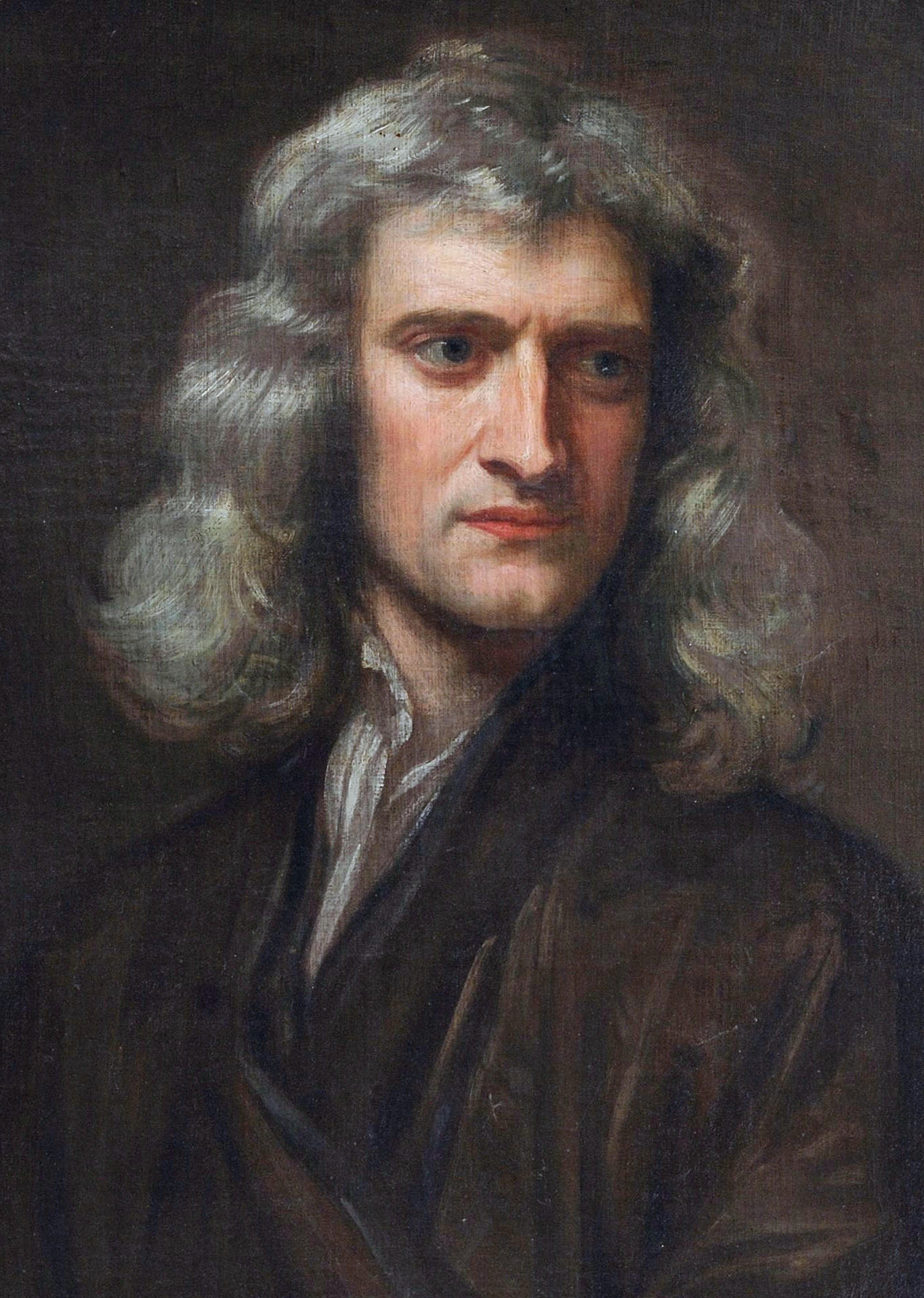
Isaac Newton was born prematurely on Christmas Day, 25 December 1642 by the Old Style Julian calendar then used in England — 4 January 1643 by the modern Gregorian calendar — at Woolsthorpe Manor in Lincolnshire, so small his mother said he could have fit inside a quart mug. His father, a farmer also named Isaac, had died three months earlier.
When Newton was three, his mother remarried and went to live with her new husband, the Reverend Barnabas Smith, leaving her son behind with his grandmother — an abandonment he never forgave, later confessing in a private list of sins that he had threatened to burn his mother and stepfather in their own house.
From the age of about twelve until he was seventeen, Newton attended The King's School in Grantham, learning Latin and Ancient Greek, finishing there in 1661. His mother briefly pulled him out to work the family farm, but Newton showed no interest in agriculture, spending his time watching the sky and reading instead. Eventually persuaded to let him return to school, he was admitted to Trinity College, Cambridge, in 1661 as a sizar — a student who worked for his keep while studying.
At Cambridge, the curriculum still leaned on Aristotle, largely ignoring Copernicus, Kepler, and Galileo. Newton nonetheless discovered their work on his own, alongside the writings of Descartes and Boyle, and filled a notebook titled Quaestiones Quaedam Philosophicae with his private musings. He was not a standout student in the ordinary sense — his true genius revealed itself not in the lecture hall but during an enforced exile from it.
In August 1665, plague swept through London and Cambridge shut its doors. Newton retreated to Woolsthorpe, where he remained until March 1667. Those two years on the farm became astonishingly productive: he began developing the foundations of differential and integral calculus, unifying older methods for finding areas, arc lengths, and tangents. He also darkened a room, passed sunlight through a prism, and discovered that white light was not a single entity but a spectrum of colours.
More from People

Frida Kahlo: Painting Through the Pain
An iron handrail pierced a teenage girl's body on a Mexico City street — and out of that wreckage came one of the most searingly honest artists of the twentieth century.

The Ox-Cart and the Snow: Şerife Bacı's Last Road
Somewhere on a frozen road outside Kastamonu, a young mother pressed her body against a quilt to keep her infant warm through the night. By morning, she had become a legend.

Pompey the Great: The Friendship That Broke Rome
He was called 'the teenage butcher' by his enemies and 'the Great' by his mentor — and the empire he helped build would ultimately be the death of him.

The Third Pole: How Hunt, Hillary and Tenzing Conquered Everest
For decades the world's highest mountain had turned back every climber who dared it — sometimes swallowing them whole. In the spring of 1953, one expedition finally reached the point where the sky simply stopped going up.

Two Rivals Under One Roof: Picasso and Matisse
Long before they were named together as the twin poles of modern art, they were simply two names on the walls of the same small Paris gallery — one already known for wild colour, the other not yet known at all.

Fire and Ice: The Borg–McEnroe Rivalry
One man never raised his voice. The other rarely lowered his. Between them they produced two of the greatest matches tennis has ever seen.