Photo 51: The Woman Who Saw the Double Helix First
She took the sharpest picture of life's blueprint ever made — then watched two men win a Nobel Prize for reading it.
On 25 July 1920, Rosalind Elsie Franklin was born at 50 Chepstow Villas in Notting Hill, London, into an affluent and influential British Jewish family. Her father, Ellis Arthur Franklin, was a liberal merchant banker who taught evening classes at the Working Men's College; her mother, Muriel Frances Waley, raised five children, of whom Rosalind was the eldest daughter. The family's history was threaded with public life — a great-uncle, Herbert Samuel, had served as Home Secretary in 1916, and an aunt, Helen Bentwich, was active in the suffrage movement. The Franklins also opened their home to Jewish refugee children fleeing the Nazis through the Kindertransport.
From age six, Franklin displayed unusual scholastic gifts, first at Norland Place School, then at Lindores School for Young Ladies in Sussex, and from age eleven at St Paul's Girls' School in Hammersmith — one of the few London schools that taught girls physics and chemistry. She excelled in science, Latin, and sport, learned German, and became fluent in French. In 1938, with six distinctions in her matriculation, she won a scholarship to university, which her father asked her to redirect to a refugee student in need.
Franklin entered Newnham College, Cambridge, in 1938, studying chemistry within the Natural Sciences Tripos, and graduated in 1941. She began a PhD under Ronald George Wreyford Norrish but, disappointed by his lack of enthusiasm, left in 1942 to join the British Coal Utilisation Research Association. Her research into the microstructure of coal and graphite earned her a PhD from Cambridge in 1945.
In 1947, Franklin moved to Paris as a postdoctoral researcher under Jacques Mering at the Laboratoire Central des Services Chimiques de l'État, where she mastered the techniques of X-ray crystallography that would define her career. In 1951, she joined King's College London as a research associate, working on X-ray diffraction images of DNA. Her measurements revealed key properties of the molecule that would prove essential to describing its structure.
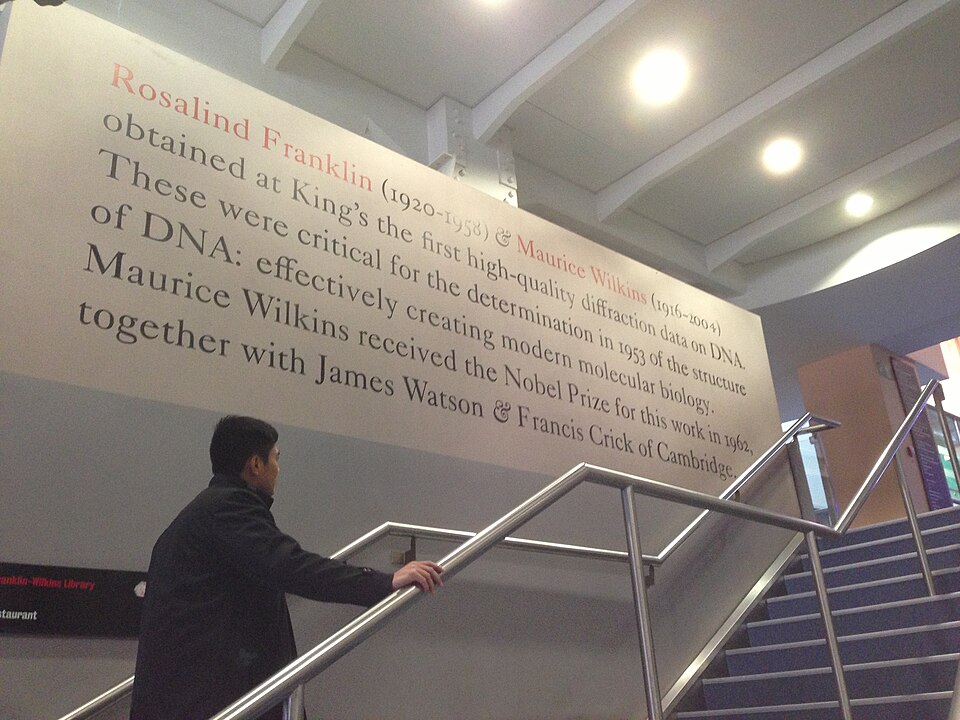
Her time at King's was marred by conflict with director John Randall and colleague Maurice Wilkins, and in 1953 Franklin moved to Birkbeck College, where J. D. Bernal gave her a research team of her own. It was at King's, though, that her student Raymond Gosling captured Photo 51 — the X-ray diffraction image of DNA that became pivotal evidence for the double helix. Wilkins showed this photograph to James Watson without Franklin's permission, and Watson, together with Francis Crick, used it to complete their model of DNA's structure.
More from People

Frida Kahlo: Painting Through the Pain
An iron handrail pierced a teenage girl's body on a Mexico City street — and out of that wreckage came one of the most searingly honest artists of the twentieth century.

The Ox-Cart and the Snow: Şerife Bacı's Last Road
Somewhere on a frozen road outside Kastamonu, a young mother pressed her body against a quilt to keep her infant warm through the night. By morning, she had become a legend.

Pompey the Great: The Friendship That Broke Rome
He was called 'the teenage butcher' by his enemies and 'the Great' by his mentor — and the empire he helped build would ultimately be the death of him.

The Third Pole: How Hunt, Hillary and Tenzing Conquered Everest
For decades the world's highest mountain had turned back every climber who dared it — sometimes swallowing them whole. In the spring of 1953, one expedition finally reached the point where the sky simply stopped going up.

Two Rivals Under One Roof: Picasso and Matisse
Long before they were named together as the twin poles of modern art, they were simply two names on the walls of the same small Paris gallery — one already known for wild colour, the other not yet known at all.

Fire and Ice: The Borg–McEnroe Rivalry
One man never raised his voice. The other rarely lowered his. Between them they produced two of the greatest matches tennis has ever seen.