An Uneasy Trinity: Roosevelt, Churchill, and Stalin
A capitalist democracy, an empire in decline, and a communist dictatorship found themselves fighting the same enemy — but could they trust each other any further than that?
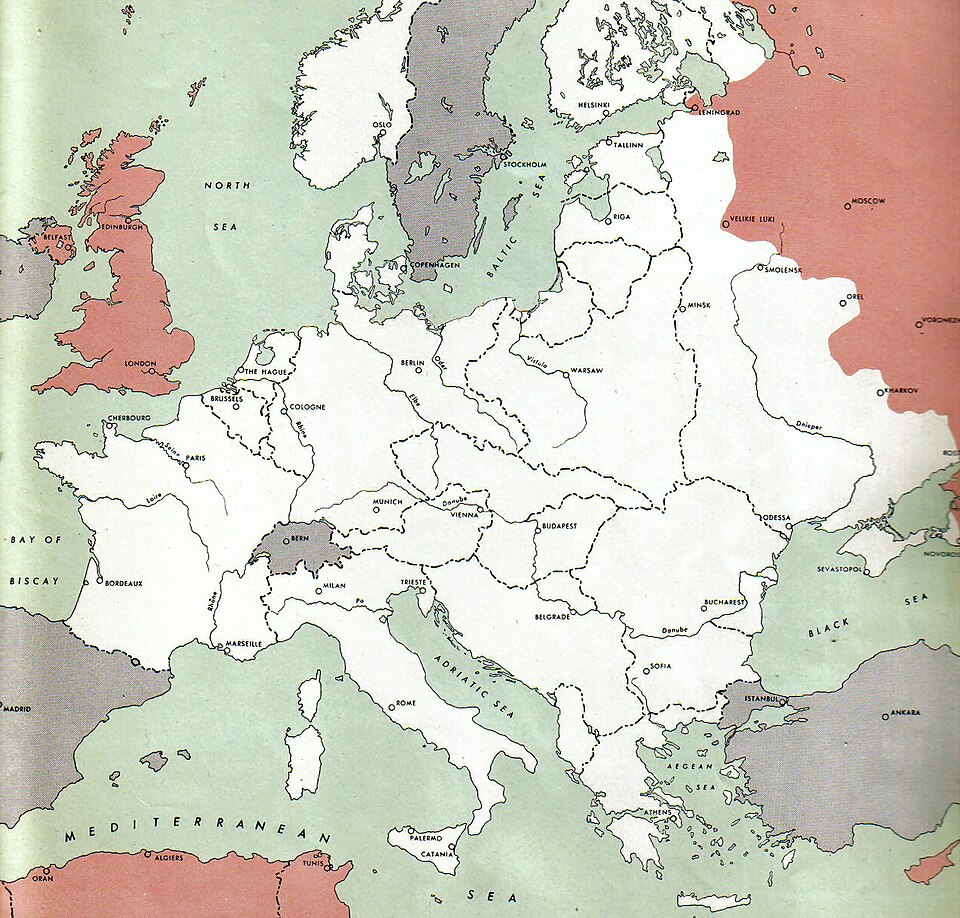
By the time Adolf Hitler's armies had swallowed Poland, Denmark, Norway, Belgium, the Netherlands, Luxembourg, and France using the shock tactics of Blitzkrieg, Europe's map had been redrawn in a matter of months. Britain alone, protected by the English Channel, held out against German air assaults in the Battle of Britain and the Blitz, with Winston Churchill as its wartime prime minister. It was a lonely stand, and for a long stretch of the war, Britain's survival depended on holding a line that Germany could not cross by land.
The alliance that would eventually crush Nazi Germany did not begin as an alliance of shared purpose. The Soviet Union, under Joseph Stalin, had signed a non-aggression pact with Germany and invaded eastern Poland alongside the Nazis in 1939, carving the country in two. It was only when Germany broke that pact and invaded the Soviet Union in June 1941 — driving nearly a thousand kilometers toward Moscow — that Stalin's government was forced onto the Allied side, a partner of necessity rather than conviction.
The United States, under President Franklin D. Roosevelt, joined later still. It was Germany's declaration of war on the U.S. in late 1941, following the wider Pacific conflict, that formally brought American power into the European theatre. From that point on, three very different leaders — a British conservative fighting for empire and survival, an American president leading a young superpower, and a Soviet dictator ruling through terror — were bound together by the singular fact that Hitler had made enemies of them all.
On the Eastern Front, the war took on a scale and brutality that dwarfed anything in the west. German forces pushed to the banks of the Volga River and the city of Stalingrad in 1942, but the winter of 1942–43 brought catastrophe for the Wehrmacht. The Soviet victory at Stalingrad became the war's decisive turning point, beginning a long German retreat that would not stop until Soviet troops reached Berlin itself in April 1945.
In the west, the Allies pressed forward on their own timeline. After liberating Rome in 1944, they launched the invasion of Normandy on 6 June — D-Day — pouring more than two million soldiers into France. By March 1945, Allied forces had crossed the Rhine, driving toward the heart of Germany while Soviet armies closed in from the east. Two fronts, coordinated only loosely, were converging on the same doomed capital.
More from People

Frida Kahlo: Painting Through the Pain
An iron handrail pierced a teenage girl's body on a Mexico City street — and out of that wreckage came one of the most searingly honest artists of the twentieth century.

The Ox-Cart and the Snow: Şerife Bacı's Last Road
Somewhere on a frozen road outside Kastamonu, a young mother pressed her body against a quilt to keep her infant warm through the night. By morning, she had become a legend.

Pompey the Great: The Friendship That Broke Rome
He was called 'the teenage butcher' by his enemies and 'the Great' by his mentor — and the empire he helped build would ultimately be the death of him.

The Third Pole: How Hunt, Hillary and Tenzing Conquered Everest
For decades the world's highest mountain had turned back every climber who dared it — sometimes swallowing them whole. In the spring of 1953, one expedition finally reached the point where the sky simply stopped going up.

Two Rivals Under One Roof: Picasso and Matisse
Long before they were named together as the twin poles of modern art, they were simply two names on the walls of the same small Paris gallery — one already known for wild colour, the other not yet known at all.

Fire and Ice: The Borg–McEnroe Rivalry
One man never raised his voice. The other rarely lowered his. Between them they produced two of the greatest matches tennis has ever seen.