Beethoven: The Music Written in Silence
He conducted symphonies he could no longer hear — and one of them became the anthem of a continent.
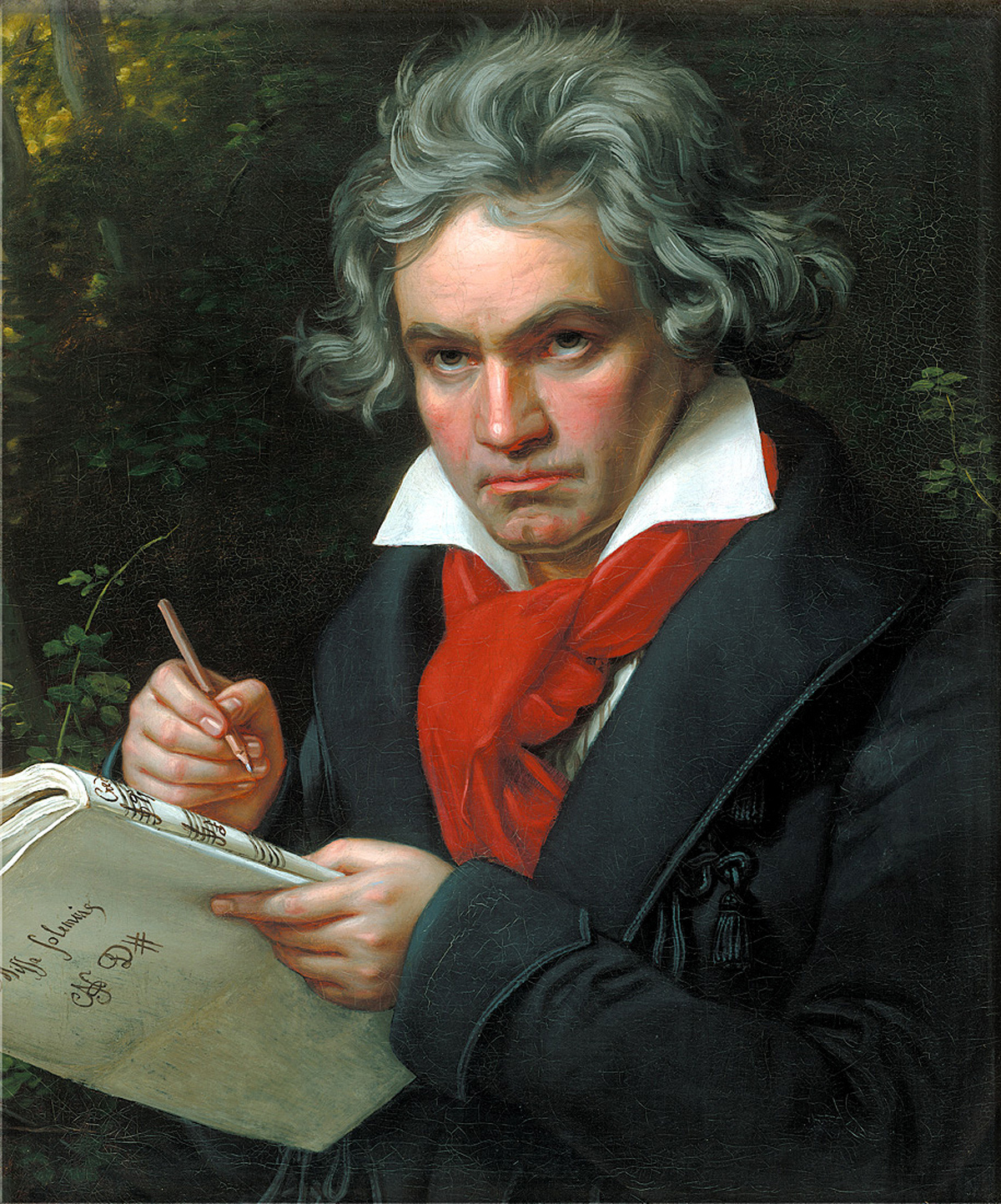
In a modest house on Bonngasse in Bonn, a boy was baptised on 17 December 1770, though family tradition held his true birthday was a day earlier. His grandfather, also named Ludwig, had risen from bass singer to Kapellmeister in the same court where his father Johann worked as a tenor. Of the seven children born to Johann and Maria Magdalena Keverich, only Ludwig and two younger brothers, Kaspar and Johann, survived infancy.
Music came to him not gently but relentlessly. His father drilled him at the keyboard from age five, and family friend Tobias Friedrich Pfeiffer, an insomniac, sometimes dragged the boy from bed for late-night lessons. Johann, aware of how Leopold Mozart had promoted his own prodigy son, billed young Ludwig as six years old — he was actually seven — for his first public performance in March 1778. Oddly, the boy who could master counterpoint struggled with simple multiplication his whole life, adding columns of numbers instead.
His real education in composition began around 1780 with Christian Gottlob Neefe, under whose guidance Beethoven published his first work in 1783. The Elector of Bonn, Maximilian Friedrich, recognized his talent and offered support. A brief trip to Vienna in 1787, hoping to study with Mozart, was cut short when he learned his mother was dying; she died that year, and his father's descent into alcoholism forced teenage Beethoven to take financial responsibility for his younger brothers. The von Breuning family became a refuge — he taught their children piano and found in their household a warmth his own had lacked.
At 21, in 1792, he left Bonn for Vienna, which became his home for the rest of his life. He studied with Joseph Haydn and quickly built a reputation not as a composer but as a formidable virtuoso pianist. Prince Lichnowsky's patronage helped bring forth the three Piano Trios, Op. 1, in 1795 — the first works Beethoven considered worthy of an opus number. The Pathétique Sonata followed in 1798, around the same time the first symptoms of hearing loss began to appear.
His career is often divided into three periods. The first followed the classical language of Haydn and Mozart, producing his First Symphony in 1800 and his earliest string quartets in 1801. The beloved Moonlight Sonata, dedicated to his pupil Julie Guicciardi, also belongs to this era. Then, between 1802 and 1812, his voice grew unmistakably his own: the vast, unprecedented Eroica Symphony in 1805, the opera Fidelio the same year, the Fifth Symphony in 1808, the Violin Concerto in 1806, and piano works like the Waldstein and Appassionata sonatas.
More from People

Frida Kahlo: Painting Through the Pain
An iron handrail pierced a teenage girl's body on a Mexico City street — and out of that wreckage came one of the most searingly honest artists of the twentieth century.

The Ox-Cart and the Snow: Şerife Bacı's Last Road
Somewhere on a frozen road outside Kastamonu, a young mother pressed her body against a quilt to keep her infant warm through the night. By morning, she had become a legend.

Pompey the Great: The Friendship That Broke Rome
He was called 'the teenage butcher' by his enemies and 'the Great' by his mentor — and the empire he helped build would ultimately be the death of him.

The Third Pole: How Hunt, Hillary and Tenzing Conquered Everest
For decades the world's highest mountain had turned back every climber who dared it — sometimes swallowing them whole. In the spring of 1953, one expedition finally reached the point where the sky simply stopped going up.

Two Rivals Under One Roof: Picasso and Matisse
Long before they were named together as the twin poles of modern art, they were simply two names on the walls of the same small Paris gallery — one already known for wild colour, the other not yet known at all.

Fire and Ice: The Borg–McEnroe Rivalry
One man never raised his voice. The other rarely lowered his. Between them they produced two of the greatest matches tennis has ever seen.