Chopin: The Poet of the Piano
A frail boy who gave concerts at seven would grow up to reinvent the piano itself — then die at 39, having given only 30 public performances during his nineteen years in France.
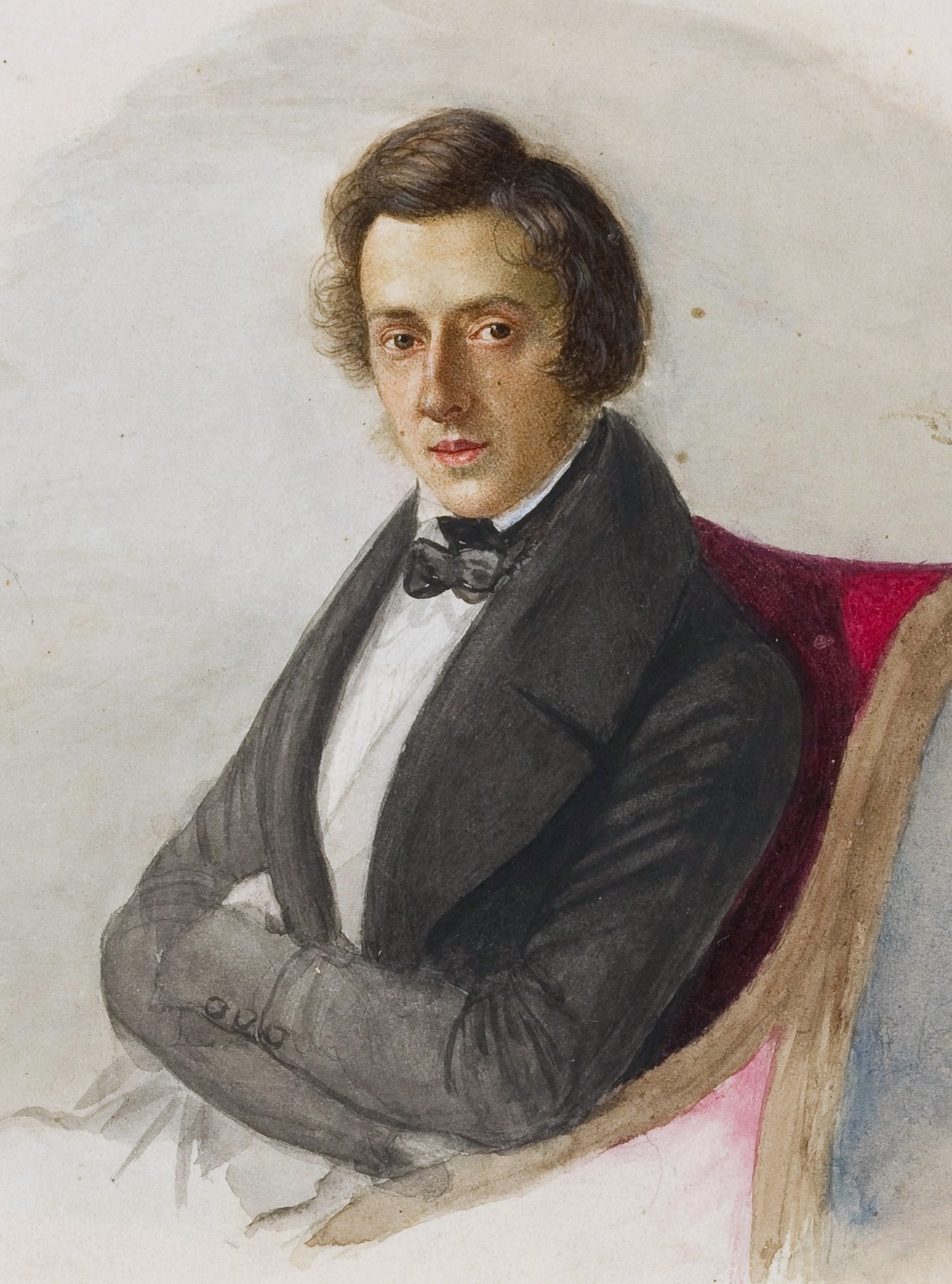
In a manor at Żelazowa Wola, 46 kilometres from Warsaw, a sickly infant was born on 1 March 1810 to a French émigré father and a Polish mother. Nicolas Chopin had come from Lorraine at sixteen and made Poland his home so completely that he insisted his household speak only Polish. His wife Justyna, a poor relation of the Skarbek family for whom Nicolas once worked, gave her son, Fryderyk Franciszek, his first brushes with music before he was formally taught.
The family soon moved to Warsaw, where Nicolas taught French at the Lyceum and the household doubled as a boarding school. Amid flutes, violins, and piano lessons for boarders, young Fryderyk's gift became impossible to miss. From 1816 he studied with the Czech-born pianist Wojciech Żywny, and by seven he was already performing in public. In 1817 he composed his first polonaises; four years later, a polonaise dedicated to Żywny survives as his earliest manuscript. He was even summoned to play for Grand Duke Konstantin Pavlovich at the Belweder Palace, composing a march in his honour.
Warsaw shaped him fully — his education, his early compositions, his first taste of celebrity — until, at twenty, he left the city less than a month before the November 1830 Uprising erupted. He would never return. At twenty-one he settled in Paris, the city that would define the rest of his life.
There, Chopin chose intimacy over spectacle. In his nineteen years in France he gave only 30 public performances, favouring instead the hushed elegance of the salon. He earned his living by selling compositions and teaching piano, a service so sought-after it kept him financially afloat. Paris also brought him into the orbit of Franz Liszt, whose friendship endured, and admirers like Robert Schumann who recognized in him something rare.
His personal life carried the same mixture of promise and disappointment as his public one. An engagement to Maria Wodzińska, formed in 1836, dissolved by 1837. Soon after, he entered a long and often turbulent relationship with the French writer Aurore Dupin, known to the world as George Sand. Their visit to Mallorca in 1838–39 was brief and unhappy in comfort and health, yet paradoxically became one of the most fertile periods of his creative life.
More from People

Frida Kahlo: Painting Through the Pain
An iron handrail pierced a teenage girl's body on a Mexico City street — and out of that wreckage came one of the most searingly honest artists of the twentieth century.

The Ox-Cart and the Snow: Şerife Bacı's Last Road
Somewhere on a frozen road outside Kastamonu, a young mother pressed her body against a quilt to keep her infant warm through the night. By morning, she had become a legend.

Pompey the Great: The Friendship That Broke Rome
He was called 'the teenage butcher' by his enemies and 'the Great' by his mentor — and the empire he helped build would ultimately be the death of him.

The Third Pole: How Hunt, Hillary and Tenzing Conquered Everest
For decades the world's highest mountain had turned back every climber who dared it — sometimes swallowing them whole. In the spring of 1953, one expedition finally reached the point where the sky simply stopped going up.

Two Rivals Under One Roof: Picasso and Matisse
Long before they were named together as the twin poles of modern art, they were simply two names on the walls of the same small Paris gallery — one already known for wild colour, the other not yet known at all.

Fire and Ice: The Borg–McEnroe Rivalry
One man never raised his voice. The other rarely lowered his. Between them they produced two of the greatest matches tennis has ever seen.