God Does Not Play Dice: The Bohr-Einstein Debates
Two of the twentieth century's greatest minds spent decades arguing about the nature of reality itself — and remained devoted friends the whole time.
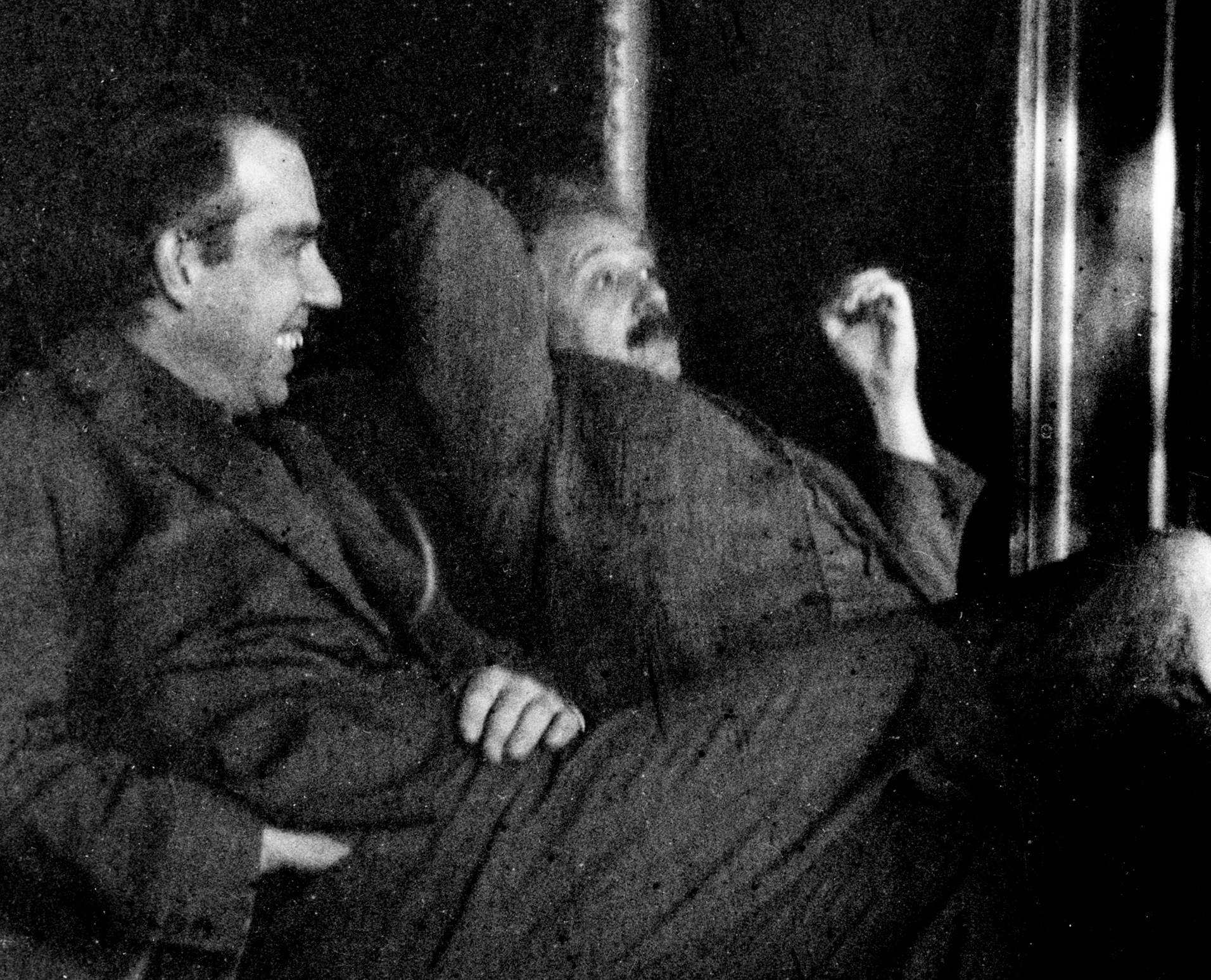
It began, oddly enough, with light. In 1905, Albert Einstein proposed that light sometimes behaves not as a wave but as a particle — a 'light quantum,' later called the photon. Niels Bohr, the young Danish physicist who would soon revolutionize atomic theory, hated the idea. To Bohr, letting light be sometimes a particle and sometimes a wave meant a scientist would have to arbitrarily choose between equations, and that felt like an abdication of rigor. Bohr held out against the photon until 1925, even as Arthur Compton's 1922 experiment offered strong evidence for it.
Bohr's own resistance led him, along with Hans Kramers and John Slater, to propose in 1924 that energy conservation applied only to statistical averages, not to individual events — a theory known as BKS. It was a direct challenge to one of Einstein's convictions. But in 1925, the Bothe-Geiger coincidence experiment demolished BKS, vindicating Einstein's insistence that energy was conserved collision by collision. It was an early skirmish in what would become a lifelong intellectual war.
Then came the quantum revolution of the mid-1920s. Erwin Schrödinger produced his wave equation, and Einstein wrote back praising it as a work of 'true genius.' Meanwhile Werner Heisenberg's 1925 paper stripped away the old Newtonian notions of space and time as fixed underlying realities, reinterpreting mechanics through matrix-like operators. A year later, Max Born, working with Heisenberg, proposed that the new mechanics should be understood fundamentally through probability, with no deeper causal story beneath it.
This was too much for Einstein — and for Schrödinger too. Both rejected Born's renunciation of causality, a principle that had survived even the upheaval of general relativity. In a now-famous 1926 letter to Born, Einstein wrote that quantum mechanics was 'certainly imposing,' but that 'an inner voice' told him it wasn't yet the real thing — that it did not bring physicists closer to the secrets of the 'old one.' 'I, at any rate, am convinced that He is not playing at dice,' he wrote.
Even Heisenberg and Bohr disagreed at first — over whether matrix mechanics and wave mechanics were truly compatible, and over Heisenberg's uncertainty principle, which Bohr initially opposed. But by the fifth Solvay Conference in October 1927, Heisenberg and Born declared the revolution complete: nothing further, they believed, needed to be worked out. For Einstein, this was the moment his skepticism turned to genuine dismay.
More from People

Frida Kahlo: Painting Through the Pain
An iron handrail pierced a teenage girl's body on a Mexico City street — and out of that wreckage came one of the most searingly honest artists of the twentieth century.

The Ox-Cart and the Snow: Şerife Bacı's Last Road
Somewhere on a frozen road outside Kastamonu, a young mother pressed her body against a quilt to keep her infant warm through the night. By morning, she had become a legend.

Pompey the Great: The Friendship That Broke Rome
He was called 'the teenage butcher' by his enemies and 'the Great' by his mentor — and the empire he helped build would ultimately be the death of him.

The Third Pole: How Hunt, Hillary and Tenzing Conquered Everest
For decades the world's highest mountain had turned back every climber who dared it — sometimes swallowing them whole. In the spring of 1953, one expedition finally reached the point where the sky simply stopped going up.

Two Rivals Under One Roof: Picasso and Matisse
Long before they were named together as the twin poles of modern art, they were simply two names on the walls of the same small Paris gallery — one already known for wild colour, the other not yet known at all.

Fire and Ice: The Borg–McEnroe Rivalry
One man never raised his voice. The other rarely lowered his. Between them they produced two of the greatest matches tennis has ever seen.