Kara Fatima: The Chieftain Who Rode into an Empire's War
A little dark-eyed woman in men's clothes rode into Constantinople at the head of three hundred horsemen — and no one in the capital quite knew what to make of her.
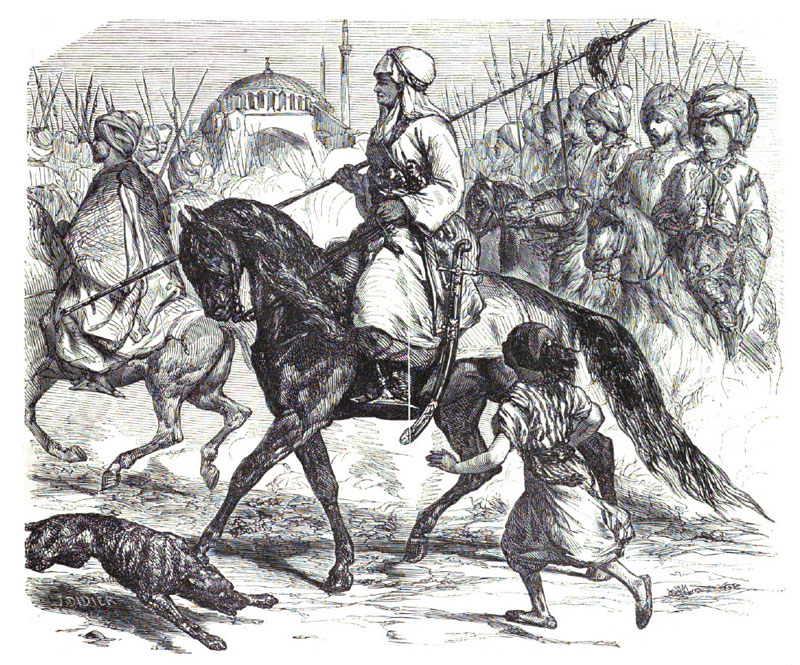
In the spring of 1854, as the Ottoman Empire braced for war against Russia, an unusual procession crossed the Bosphorus toward Stamboul. At its head rode a woman called Kara Fatima Khanum — 'Black Lady Fatima' — flanked by handmaids dressed like herself in male attire, trailed by three hundred mounted tribal warriors. The Illustrated London News gave the arrival a full-page illustration and a long article, astonished that such a spectacle could unfold at the dawn of the Crimean War.
Who she actually was remains tangled in dispute. Some historians identify her as a Kurd of the Sinemilli tribe from around Marash, remembered among Sinemilli Kurds to this day as Fataraş or Fato Paşa — a name some of her descendants still carry as a surname. According to this account, she was the sister of Kara Bilal, the tribe's leader, and had to settle in the village of Emiruşağı after getting married. Other historians insist her real name was Asiye Hatun, that she hailed from the Adana or Osmaniye region, and that she belonged to the Turkmen Cerit tribe instead. It is even possible, scholars note, that there were multiple women known as Kara Fatma across different regions of eastern Anatolia in the same era.
Whatever her exact origins, one detail recurs in every version of the story: her husband, a tribal leader, had been imprisoned by Ottoman authorities. It is proposed that Fatima took up arms and rode to the capital specifically to prove her family's loyalty to the state — turning a personal crisis into a public demonstration of allegiance at a moment when the empire desperately needed it.
The Illustrated London News described the scene in Constantinople with a mixture of fascination and disbelief, calling her 'the Queen, or Prophetess — for she is endowed with supernatural attributes — a little dark old woman of about sixty, with nothing of the amazon in her appearance, although she wears what seems to be intended for male attire, and bestrides her steed like the warriors of her train.' She was brought, the paper noted, with her select band of followers to a barracks in Stamboul. A German observer who saw her separately remarked simply that she had a 'manly look'.
Her purpose in the city was direct: to request an audience with the padishah, to show support for the Ottoman war effort, and to offer her tribe's assistance against Russia. It was an extraordinary gesture — a woman leading armed horsemen to the seat of imperial power to pledge loyalty in wartime, at a time when such acts were almost unheard of for a woman of any tribe.
More from People

Frida Kahlo: Painting Through the Pain
An iron handrail pierced a teenage girl's body on a Mexico City street — and out of that wreckage came one of the most searingly honest artists of the twentieth century.

The Ox-Cart and the Snow: Şerife Bacı's Last Road
Somewhere on a frozen road outside Kastamonu, a young mother pressed her body against a quilt to keep her infant warm through the night. By morning, she had become a legend.

Pompey the Great: The Friendship That Broke Rome
He was called 'the teenage butcher' by his enemies and 'the Great' by his mentor — and the empire he helped build would ultimately be the death of him.

The Third Pole: How Hunt, Hillary and Tenzing Conquered Everest
For decades the world's highest mountain had turned back every climber who dared it — sometimes swallowing them whole. In the spring of 1953, one expedition finally reached the point where the sky simply stopped going up.

Two Rivals Under One Roof: Picasso and Matisse
Long before they were named together as the twin poles of modern art, they were simply two names on the walls of the same small Paris gallery — one already known for wild colour, the other not yet known at all.

Fire and Ice: The Borg–McEnroe Rivalry
One man never raised his voice. The other rarely lowered his. Between them they produced two of the greatest matches tennis has ever seen.