Mehmed the Conqueror: The Sultan Who Ended an Empire at 21
He sank a stray ship with a single cannon shot and impaled its captain as a warning — then, at 21, he did what no army had managed in a thousand years.
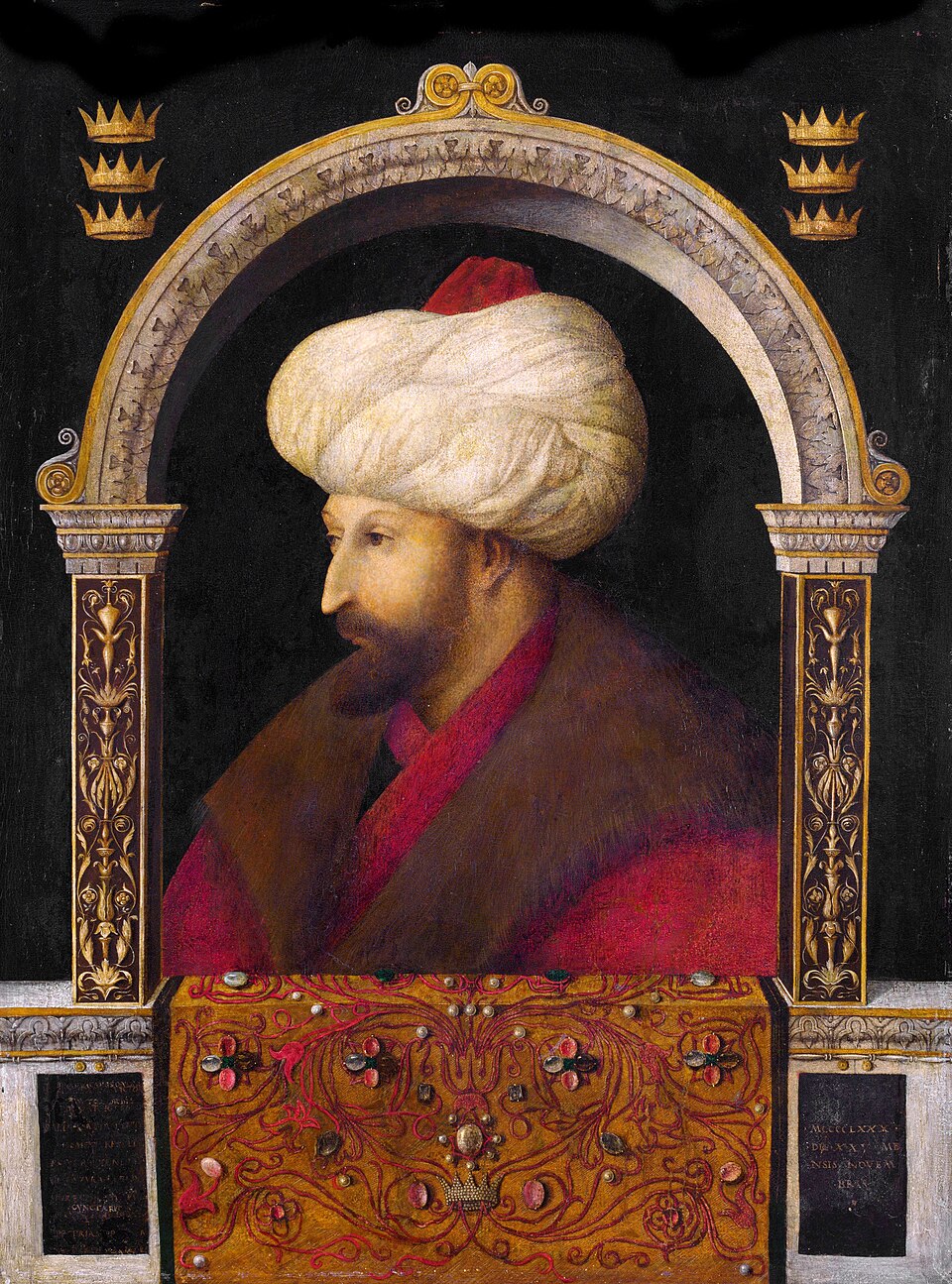
On a Sunday dawn in Edirne, 30 March 1432, a boy was born to Sultan Murad II and a slave woman named Hüma Hatun. No one could have guessed that this child, Mehmed, would one day be remembered as the man who closed the door on the Middle Ages. Sent at eleven to govern in Amasya and later Manisa, per Ottoman custom, he was tutored by leading scholars of his day, among them Molla Gürani, and shaped spiritually by the sheikh Akshamsaddin, who instilled in him the conviction that conquering Constantinople was an Islamic duty owed to history itself.
Mehmed first took the throne astonishingly young — just twelve years old, in 1444, when his father abdicated in his favor. That first reign was brief and turbulent. When Hungarian forces under John Hunyadi broke the truces of Edirne and Szeged, the boy-sultan faced a crusade he could not manage alone. According to later chronicles, he wrote to his father: 'If you are the sultan, come and lead your armies. If I am the sultan, I hereby order you to come and lead my armies.' Murad II returned to command the army and crushed the crusaders at the Battle of Varna in November 1444. By 1446, Murad had reclaimed the throne outright, leaving Mehmed to govern as a provincial ruler in Manisa.
Everything changed in 1451, when Murad II died and Mehmed, now nineteen, became sultan for the second and final time. He turned immediately to the sea, rebuilding and strengthening the Ottoman navy, his mind fixed on the one prize his ancestors had never taken: Constantinople. On the Bosphorus, where his great-grandfather Bayezid I had built the fortress of Anadoluhisarı on the Asian shore, Mehmed raised an even mightier fortress, Rumelihisarı, on the European side — giving him total command of the strait.
His intentions were unmistakable. Ships that ignored his signals to stop were fired upon; one Venetian vessel was sunk by a single cannon shot, its surviving sailors beheaded, its captain impaled as a gruesome warning to anyone else who might try to pass. As his army advanced on the city, his sheikh Akshamsaddin located the tomb of Abu Ayyub al-Ansari, the standard-bearer of the Prophet Muhammad who had died besieging Constantinople centuries earlier — a discovery Mehmed would later commemorate by building the Eyüp Sultan Mosque on the site.
In early April 1453, the siege began in earnest. Mehmed commanded a force estimated between 80,000 and 200,000 troops, more than seventy heavy siege guns including a massive bombard designed by the engineer Orban, and a fleet of 320 vessels stretched across the Bosphorus to seal the city from the sea. The ancient walls of Constantinople, which had turned back armies for a thousand years, held for weeks against the bombardment. But on 29 May 1453, the city fell. Mehmed was twenty-one years old, and the Byzantine Empire — the last living thread of Rome — was finished.
More from People

Frida Kahlo: Painting Through the Pain
An iron handrail pierced a teenage girl's body on a Mexico City street — and out of that wreckage came one of the most searingly honest artists of the twentieth century.

The Ox-Cart and the Snow: Şerife Bacı's Last Road
Somewhere on a frozen road outside Kastamonu, a young mother pressed her body against a quilt to keep her infant warm through the night. By morning, she had become a legend.

Pompey the Great: The Friendship That Broke Rome
He was called 'the teenage butcher' by his enemies and 'the Great' by his mentor — and the empire he helped build would ultimately be the death of him.

The Third Pole: How Hunt, Hillary and Tenzing Conquered Everest
For decades the world's highest mountain had turned back every climber who dared it — sometimes swallowing them whole. In the spring of 1953, one expedition finally reached the point where the sky simply stopped going up.

Two Rivals Under One Roof: Picasso and Matisse
Long before they were named together as the twin poles of modern art, they were simply two names on the walls of the same small Paris gallery — one already known for wild colour, the other not yet known at all.

Fire and Ice: The Borg–McEnroe Rivalry
One man never raised his voice. The other rarely lowered his. Between them they produced two of the greatest matches tennis has ever seen.