Mimar Sinan: The Soldier Who Learned to Build Empires
A boy conscripted from a small Anatolian village would spend seventeen years marching with the Janissaries before ever touching architecture — and then reshape an empire's skyline for the next fifty years.
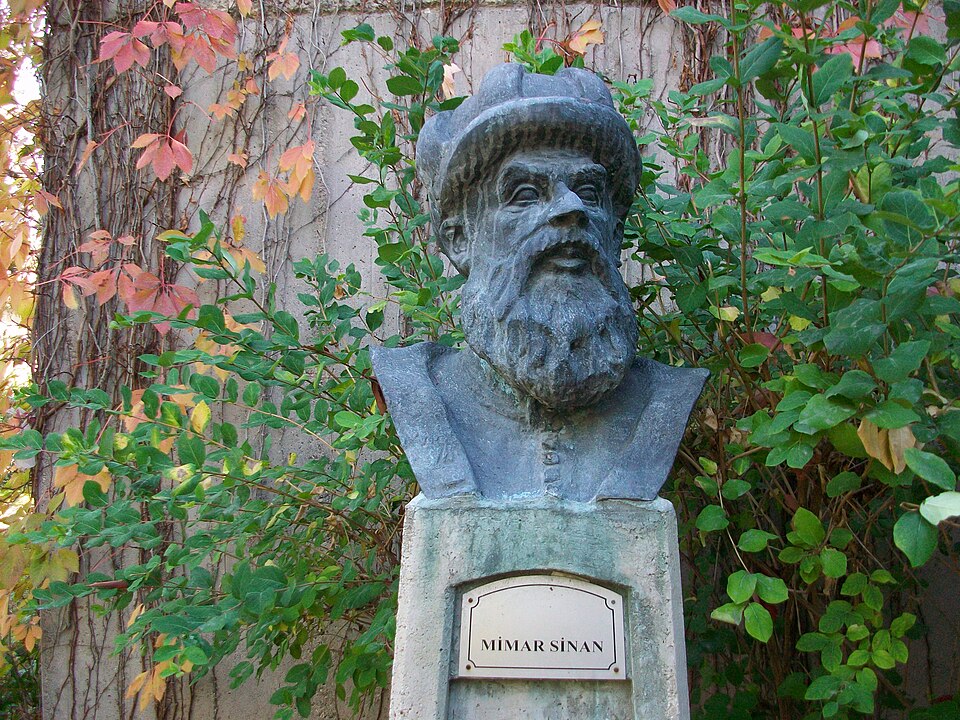
In the small town of Ağırnas near Kayseri, a boy was born sometime around 1488 to 1490, the son of a stonemason. His origins remain disputed among scholars — Armenian, Cappadocian Greek, and Christian Turkish theories all persist — but what is certain is that he grew up assisting his father, absorbing the practical knowledge of stone and structure long before anyone called him an architect. In 1511, under Sultan Selim I, he was conscripted into imperial service through the devshirme system and brought to Constantinople, where he converted to Islam and entered the Janissary Corps.
Too old for the elite Enderun school, he instead trained as a military engineer, a path that would prove decisive. He fought at the Battle of Chaldiran in 1514 and in the Egyptian campaign of 1517. Under Suleiman the Magnificent, he took part in the Belgrade campaign, the Siege of Rhodes, and the Battle of Mohács, steadily rising through the ranks — first to company commander, then to chief of the arquebusiers, and eventually to head technician. Each campaign sharpened his eye for fortifications, roads, bridges, and aqueducts.
One moment revealed his growing reputation: during Suleiman's Persian campaign in 1533, Sinan built and equipped three galleys on Lake Van in just two weeks so troops could cross to the far shore. The feat earned him the prestigious rank of Hasekilik within the Janissary Corps. He went on to serve in campaigns in Corfu, Apulia, and Moldavia. In 1538, during the Karaboğdan campaign, when the army was stalled for days trying to bridge the marshy banks of the Prut River, the vizier Lütfi Pasha turned to Sinan. He completed a sturdy bridge in just ten days, allowing the army to cross.
That achievement marked a turning point. After seventeen years as a Janissary, at around age forty-nine, Sinan was appointed chief royal architect — a post he would hold for forty-nine years under three sultans: Suleiman the Magnificent, Selim II, and Murad III. He later reflected that though leaving the Janissary path grieved him, he came to see architecture as a way to serve both worldly and spiritual purposes, through the building of mosques and public works.
More from People

Frida Kahlo: Painting Through the Pain
An iron handrail pierced a teenage girl's body on a Mexico City street — and out of that wreckage came one of the most searingly honest artists of the twentieth century.

The Ox-Cart and the Snow: Şerife Bacı's Last Road
Somewhere on a frozen road outside Kastamonu, a young mother pressed her body against a quilt to keep her infant warm through the night. By morning, she had become a legend.

Pompey the Great: The Friendship That Broke Rome
He was called 'the teenage butcher' by his enemies and 'the Great' by his mentor — and the empire he helped build would ultimately be the death of him.

The Third Pole: How Hunt, Hillary and Tenzing Conquered Everest
For decades the world's highest mountain had turned back every climber who dared it — sometimes swallowing them whole. In the spring of 1953, one expedition finally reached the point where the sky simply stopped going up.

Two Rivals Under One Roof: Picasso and Matisse
Long before they were named together as the twin poles of modern art, they were simply two names on the walls of the same small Paris gallery — one already known for wild colour, the other not yet known at all.

Fire and Ice: The Borg–McEnroe Rivalry
One man never raised his voice. The other rarely lowered his. Between them they produced two of the greatest matches tennis has ever seen.