One Small Step: The Voyage of Apollo 11
For eight days in July 1969, three men rode a column of fire toward a goal a president had dared them to reach — and the world stopped to watch.
It began with a beep. On October 4, 1957, the Soviet Union launched Sputnik 1, the first artificial satellite, and the simple radio pulse it sent back to Earth shattered American confidence in its own technological supremacy. The Sputnik crisis ignited a full-blown Space Race, and when cosmonaut Yuri Gagarin became the first human in orbit on April 12, 1961, the pressure on the United States became unbearable. Alan Shepard's suborbital hop less than a month later was a consolation, not an answer.
President John F. Kennedy chose a bolder path. On May 25, 1961, he told Congress the nation should commit to landing a man on the Moon and returning him safely before the decade was out. He repeated the challenge in 1962 at Rice University, framing it not as an easy task but as one worth doing precisely because it was hard. The Apollo program that followed absorbed the lessons of Mercury and Gemini, and endured tragedy — the fatal Apollo 1 launchpad fire of January 1967 — before it was ready to attempt the goal itself.
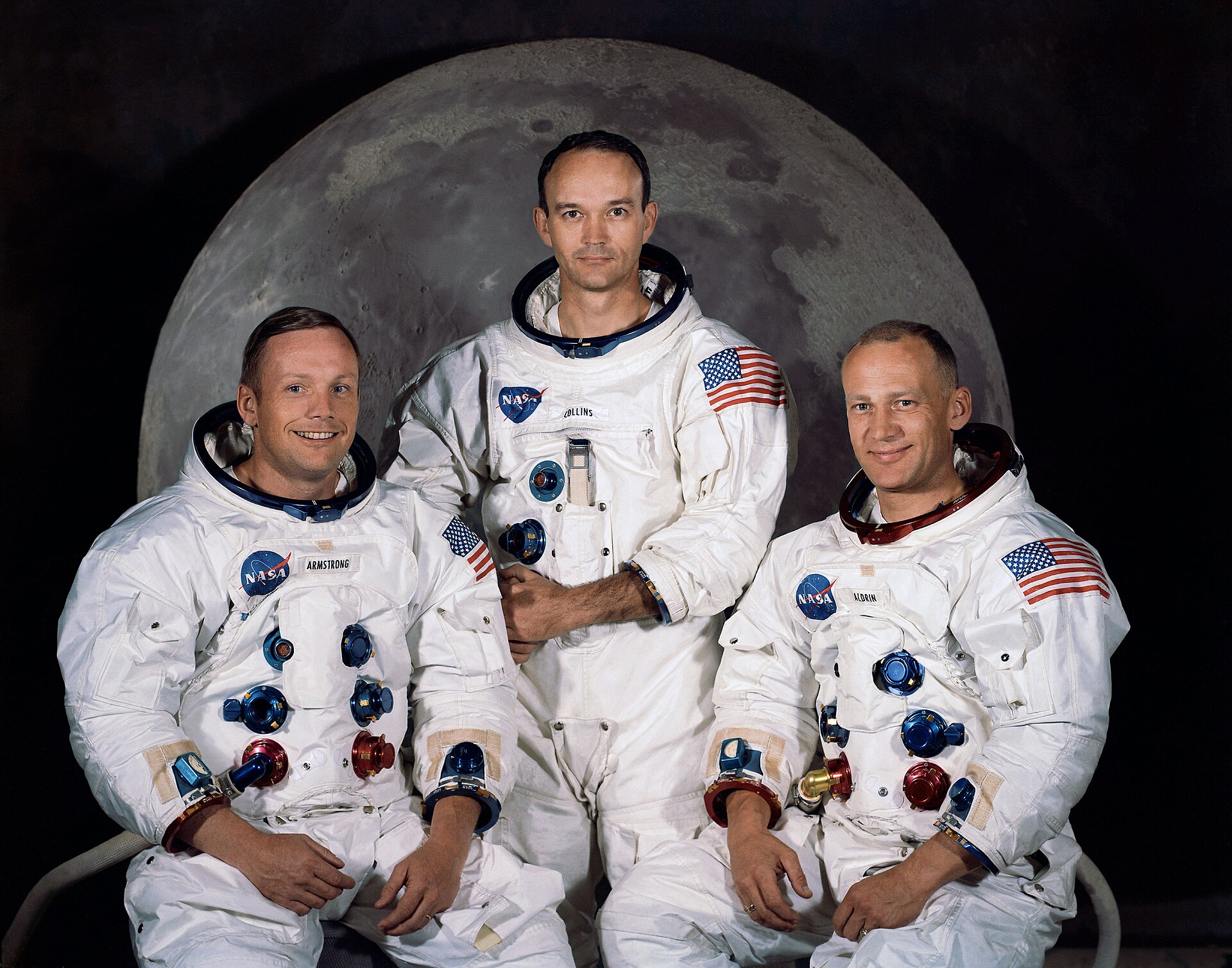
Apollo 11 launched from Kennedy Space Center in Florida on July 16, 1969, at 13:32 UTC, atop a Saturn V rocket. Aboard were Commander Neil Armstrong, Command Module Pilot Michael Collins, and Lunar Module Pilot Edwin 'Buzz' Aldrin — all veterans of earlier spaceflights. Their spacecraft had three parts: the command module Columbia, which alone would return to Earth; the service module, providing power and propulsion; and the lunar module Eagle, built to carry two astronauts down to the surface and back up again.
After three days in transit, Armstrong and Aldrin climbed into Eagle and separated from Columbia, leaving Collins alone in lunar orbit. On July 20 at 20:17 UTC, Eagle touched down in the Sea of Tranquility. Roughly six hours later, Armstrong stepped onto the lunar surface, becoming the first human being to do so, and spoke the words that would outlive him: 'That's one small step for [a] man, one giant leap for mankind.' Aldrin followed nineteen minutes later.
Together the two astronauts spent about two and a half hours outside the lunar module, planting an American flag, speaking by telephone with President Richard Nixon, setting up scientific instruments, and gathering 21.5 kilograms of lunar rock and soil. In total they remained on the surface for more than 21 hours before lifting off to rejoin Collins in orbit. Even as they worked, the Soviet Union's uncrewed probe Luna 15 was racing to beat them to a sample return — it crashed on the Moon on July 21, a quiet coda to the Space Race.
More from People

Frida Kahlo: Painting Through the Pain
An iron handrail pierced a teenage girl's body on a Mexico City street — and out of that wreckage came one of the most searingly honest artists of the twentieth century.

The Ox-Cart and the Snow: Şerife Bacı's Last Road
Somewhere on a frozen road outside Kastamonu, a young mother pressed her body against a quilt to keep her infant warm through the night. By morning, she had become a legend.

Pompey the Great: The Friendship That Broke Rome
He was called 'the teenage butcher' by his enemies and 'the Great' by his mentor — and the empire he helped build would ultimately be the death of him.

The Third Pole: How Hunt, Hillary and Tenzing Conquered Everest
For decades the world's highest mountain had turned back every climber who dared it — sometimes swallowing them whole. In the spring of 1953, one expedition finally reached the point where the sky simply stopped going up.

Two Rivals Under One Roof: Picasso and Matisse
Long before they were named together as the twin poles of modern art, they were simply two names on the walls of the same small Paris gallery — one already known for wild colour, the other not yet known at all.

Fire and Ice: The Borg–McEnroe Rivalry
One man never raised his voice. The other rarely lowered his. Between them they produced two of the greatest matches tennis has ever seen.