The Clerk Who Mapped the World's Knowledge
A war orphan who buried his father in Mosul grew up to build the greatest library Istanbul had ever seen — and an encyclopedia the world still cites.
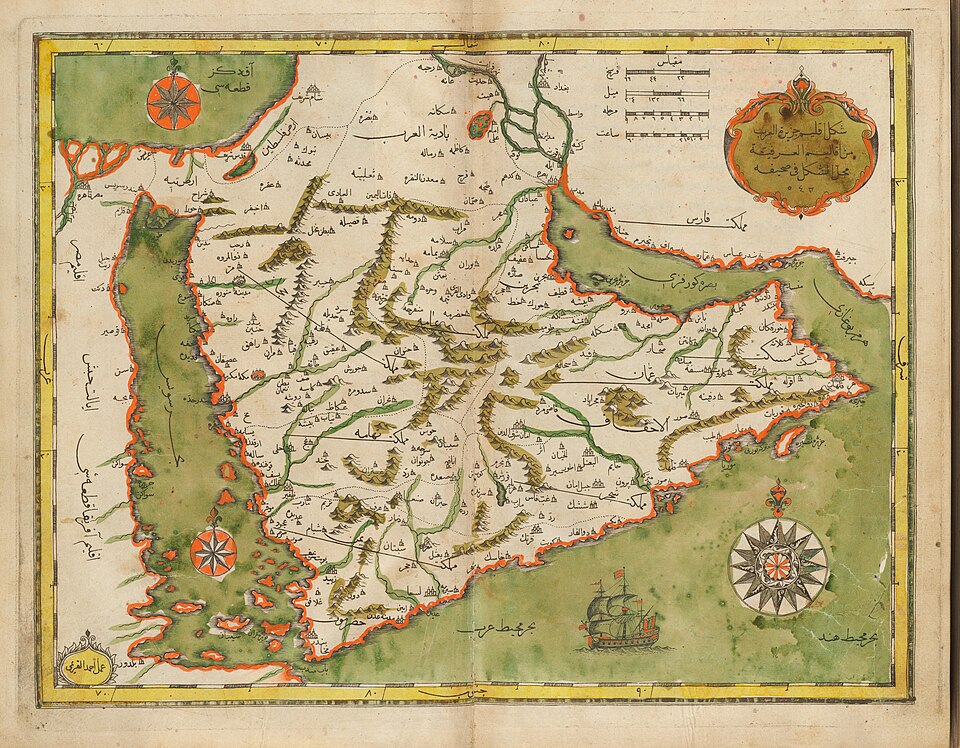
In August 1626, a young Ottoman finance clerk named Mustafa watched his father die at Mosul, the exhausted end of a failed campaign to retake Baghdad from Persia. A month later his uncle, who had served in the same campaign force, died too, in the Nusaybin-Cerahlu region. He was seventeen, alone in a foreign province with the imperial army, and he had already seen more war than most men see in a lifetime. He could not have known that this grief-marked boy would become Kâtip Çelebi — the Learned Scribe — remembered as the greatest encyclopedist the Ottomans ever produced.
Born in February 1609 in Istanbul, Mustafa ibn Abd Allah was the son of a sipahi and Sublime Porte secretary. From age five or six he learned the Qur'an, Arabic grammar, and calligraphy; by fourteen his father had secured him a clerkship in the Anatolian finance bureau, where he mastered accountancy and the secretive Treasury cipher called siyāqat. War interrupted study early: he marched with his father on the Tercan Campaign of 1624, witnessed a battle near Kayseri on 7 September 1624 against Abaza Mehmed Paşa's rebel forces, and endured the disastrous 1625 attempt to recapture Baghdad.
Returning to Istanbul after his father's death, he fell under the spell of the preacher Qādīzāde, whose sermons reignited his hunger for learning. An inheritance let him settle permanently in the capital, though military duty pulled him away again — to Baghdad in 1629, Hamadan in 1630, and to Aleppo, from which in 1633 he set out on the Hajj that earned him the title Hajji. In Aleppo's bookshops and libraries he began the habit that would define his life: hunting manuscripts, gathering the notes that would one day become his masterwork.
Back in Istanbul in 1635, an old family friend, Mehmed Kalfa, secured him a post as second clerk in the Cavalry Audit Office. He studied under masters like A'rej Mustafa Efendi, Kurd Abd Allāh Efendi at Hagia Sophia, and Mehmed Efendi at the Süleymaniye, absorbing law, logic, astronomy, prosody, and Ulugh Beg's astronomical tables. In 1645, a legacy from a wealthy relative changed everything: he could finally devote himself entirely to scholarship, and he spent much of that inheritance building a personal library that would become the largest in Istanbul.
He taught as widely as he studied — medicine, geometry, geography, the astrolabe, logic, arithmetic, astronomy — describing his method as entering 'every plurality by way of unity.' His own research ranged across lexicology, jurisprudence, rhetoric, Qur'anic exegesis, mathematics, medicine, genealogy, and history. Among fellow scholars he earned the nickname that outlived him: Kâtip Çelebi, the Learned Scribe, a title given to men of learning outside the official religious hierarchy.
More from People

Frida Kahlo: Painting Through the Pain
An iron handrail pierced a teenage girl's body on a Mexico City street — and out of that wreckage came one of the most searingly honest artists of the twentieth century.

The Ox-Cart and the Snow: Şerife Bacı's Last Road
Somewhere on a frozen road outside Kastamonu, a young mother pressed her body against a quilt to keep her infant warm through the night. By morning, she had become a legend.

Pompey the Great: The Friendship That Broke Rome
He was called 'the teenage butcher' by his enemies and 'the Great' by his mentor — and the empire he helped build would ultimately be the death of him.

The Third Pole: How Hunt, Hillary and Tenzing Conquered Everest
For decades the world's highest mountain had turned back every climber who dared it — sometimes swallowing them whole. In the spring of 1953, one expedition finally reached the point where the sky simply stopped going up.

Two Rivals Under One Roof: Picasso and Matisse
Long before they were named together as the twin poles of modern art, they were simply two names on the walls of the same small Paris gallery — one already known for wild colour, the other not yet known at all.

Fire and Ice: The Borg–McEnroe Rivalry
One man never raised his voice. The other rarely lowered his. Between them they produced two of the greatest matches tennis has ever seen.