The Corporal Who Carried a Battleship's Doom
When the crane broke and every gunner nearby lay wounded, one soldier decided the shell would reach the barrel anyway — even if he had to carry it himself.
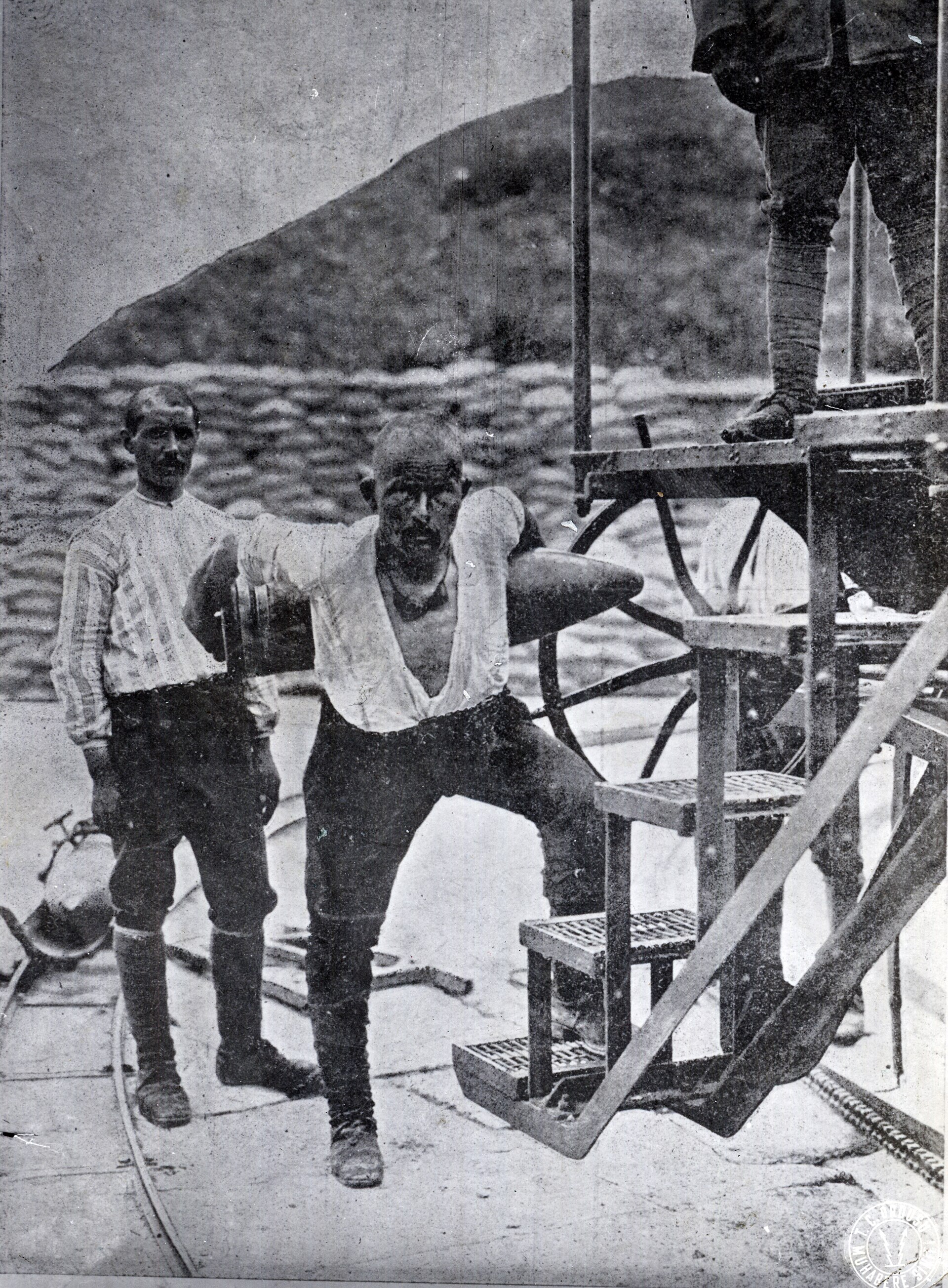
On the morning of 18 March 1915, the Allied fleet pushed into the Dardanelles determined to force its way through to Istanbul. Along the Narrows, Ottoman forts absorbed a merciless naval bombardment. At the Mecidiye Coastal Battery, a shell struck the ammunition depot directly, killing fourteen men and wounding twenty-four others. Only two soldiers walked away unhurt: Seyit Ali, a corporal born in the village of Havran in September 1889, and his comrade Ali of Niğde.
Of all the guns in the battery, only one remained functional. But its mechanical crane, the device meant to lift shells weighing around 215 to 276 kilograms into the breech, had been destroyed. Without it, the gun was useless — unless someone found another way to load it. Seyit Ali, with help from his surviving comrade, hoisted a shell onto his own back and carried it to the gun.
He fired at HMS Ocean, a British pre-dreadnought battleship that had come to rescue sailors from HMS Irresistible, itself disabled earlier by a mine. His first two shots did little damage. But his third shot struck below the waterline, tearing into the ship's steering gear. Ocean lost control, drifted into the minefield laid earlier by the Ottoman minelayer Nusret, and struck a mine. The great ship capsized and sank near what is now the site of the Çanakkale Martyrs' Memorial.
With Ocean gone and the assault repulsed, Admiral de Robeck ordered the Allied fleet to withdraw from the strait that evening. For his role, Seyit Ali was awarded the rank of corporal — the title by which history would remember him. Sources differ on the exact weight of the shells he carried: some records cite 276 kilograms, though researchers who later weighed a surviving shell from the battery found it closer to 215 kilograms, likely a unit-conversion error from Ottoman-German weight measures.
More from People

Frida Kahlo: Painting Through the Pain
An iron handrail pierced a teenage girl's body on a Mexico City street — and out of that wreckage came one of the most searingly honest artists of the twentieth century.

The Ox-Cart and the Snow: Şerife Bacı's Last Road
Somewhere on a frozen road outside Kastamonu, a young mother pressed her body against a quilt to keep her infant warm through the night. By morning, she had become a legend.

Pompey the Great: The Friendship That Broke Rome
He was called 'the teenage butcher' by his enemies and 'the Great' by his mentor — and the empire he helped build would ultimately be the death of him.

The Third Pole: How Hunt, Hillary and Tenzing Conquered Everest
For decades the world's highest mountain had turned back every climber who dared it — sometimes swallowing them whole. In the spring of 1953, one expedition finally reached the point where the sky simply stopped going up.

Two Rivals Under One Roof: Picasso and Matisse
Long before they were named together as the twin poles of modern art, they were simply two names on the walls of the same small Paris gallery — one already known for wild colour, the other not yet known at all.

Fire and Ice: The Borg–McEnroe Rivalry
One man never raised his voice. The other rarely lowered his. Between them they produced two of the greatest matches tennis has ever seen.