The Lady with the Lamp
A wealthy young Englishwoman gave up marriage and comfort for the stench of a military hospital — and changed medicine forever with a lamp, a pen, and a pie chart.
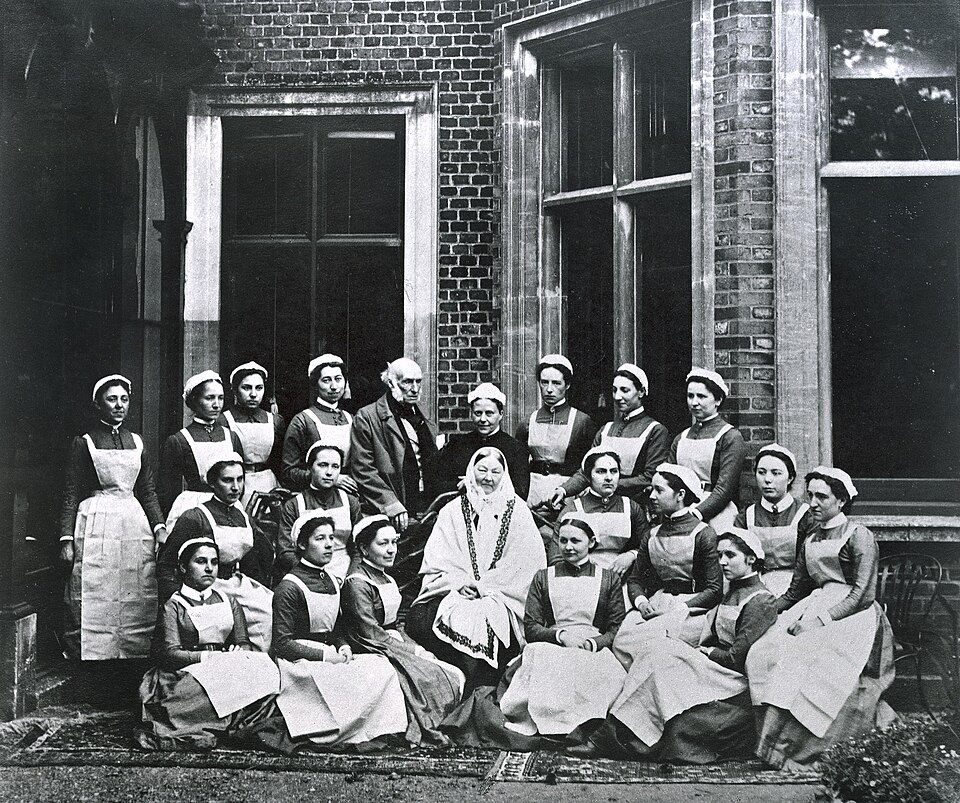
Florence Nightingale was born on 12 May 1820 in the Villa Colombaia in Florence, Tuscany, and named after the city itself, just as her older sister Frances Parthenope had been named after Parthenope, a Greek settlement near Naples. The family returned to England the following year, and Florence grew up between two homes: Embley in Hampshire and Lea Hurst in Derbyshire. Her father, William Edward Nightingale, educated her personally, and she absorbed a liberal-humanitarian outlook from both sides of her family — her maternal grandfather, William Smith, had been an abolitionist and Unitarian.
Under her father's unusually progressive guidance, Florence and Parthenope studied history, mathematics, Italian, classical literature, and philosophy. Florence proved the more academic of the two, showing an early gift for collecting and analysing data — a talent that would later reshape how the world understood public health. In 1838, a family tour of Europe brought her into contact with Mary Clarke, an English-born Parisian hostess who cared nothing for appearances or upper-class convention and who believed women could be equal to men. Despite a 27-year age gap, the two remained close friends for four decades.
In February 1837, at Embley Park, Nightingale experienced what she believed was the first of several calls from God, awakening in her a powerful desire to serve others. She kept this calling largely private for years out of respect for her family, only announcing in 1844 her decision to become a nurse. The news devastated her mother and sister, who expected her to marry and take her place in society. Florence refused. She had already turned down the politician and poet Richard Monckton Milnes after a nine-year courtship, convinced marriage would obstruct her purpose. In Rome in 1847, she met Sidney Herbert, a politician who would later become central to her work.
Nightingale's decisive moment came during the Crimean War, when she rose to prominence organising and training nurses to care for wounded soldiers at Constantinople. Through relentless attention to hygiene and living conditions, she dramatically reduced death rates among the injured. Her nightly rounds through the wards, lamp in hand, checking on wounded men, gave rise to the enduring image of 'The Lady with the Lamp' and made her an icon of Victorian culture.
Some later commentators have argued that the press exaggerated her Crimean achievements to satisfy a public hungry for heroes. But even critics acknowledge the lasting importance of what came next: in 1860, Nightingale founded a nursing school at St Thomas' Hospital in London — the world's first secular nursing school, now part of King's College London. It laid the foundation for nursing as a genuine profession rather than an informal, often disreputable occupation for women.
More from People

Frida Kahlo: Painting Through the Pain
An iron handrail pierced a teenage girl's body on a Mexico City street — and out of that wreckage came one of the most searingly honest artists of the twentieth century.

The Ox-Cart and the Snow: Şerife Bacı's Last Road
Somewhere on a frozen road outside Kastamonu, a young mother pressed her body against a quilt to keep her infant warm through the night. By morning, she had become a legend.

Pompey the Great: The Friendship That Broke Rome
He was called 'the teenage butcher' by his enemies and 'the Great' by his mentor — and the empire he helped build would ultimately be the death of him.

The Third Pole: How Hunt, Hillary and Tenzing Conquered Everest
For decades the world's highest mountain had turned back every climber who dared it — sometimes swallowing them whole. In the spring of 1953, one expedition finally reached the point where the sky simply stopped going up.

Two Rivals Under One Roof: Picasso and Matisse
Long before they were named together as the twin poles of modern art, they were simply two names on the walls of the same small Paris gallery — one already known for wild colour, the other not yet known at all.

Fire and Ice: The Borg–McEnroe Rivalry
One man never raised his voice. The other rarely lowered his. Between them they produced two of the greatest matches tennis has ever seen.