The Man Who Became a Nation's Father
He was born plain Mustafa in a Salonica household — by the time he died, an entire alphabet, calendar, and republic had been remade around his name.
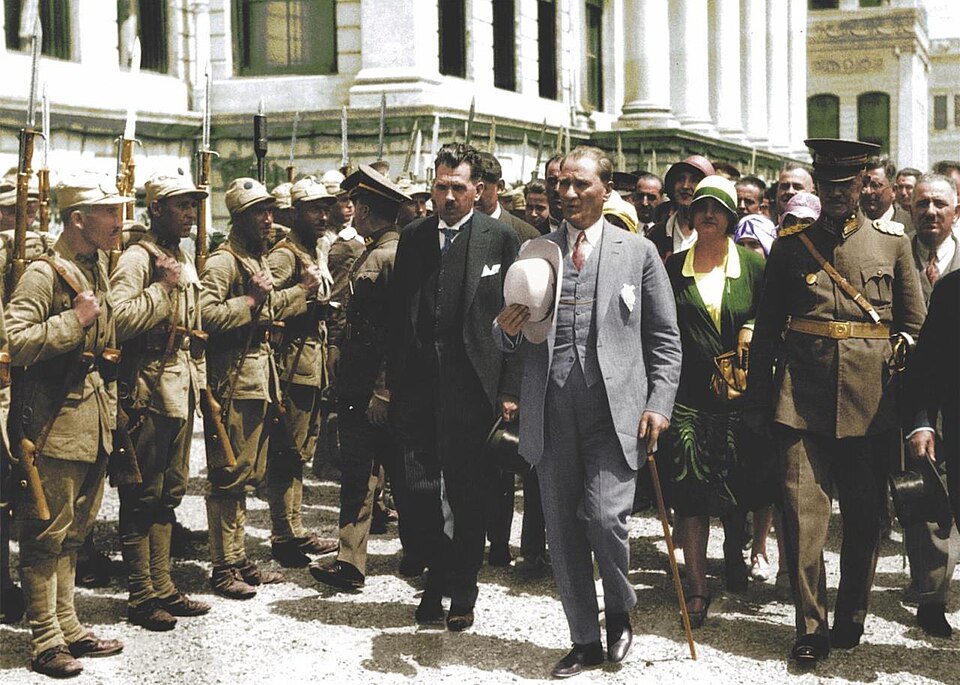
Mustafa Kemal was born in Salonica, in the Ottoman Empire, the son of Ali Rıza Efendi, a minor official and lumber trader, and Zübeyde Hanım, a farmer's daughter from Langaza. Of his siblings, only a sister, Makbule, survived childhood. As a boy he received the name Kemal from a schoolteacher — accounts differ on whether it was given in admiration of his maturity, to distinguish him from a teacher of the same name, or chosen by Mustafa himself in tribute to the nationalist poet Namık Kemal. Whatever its origin, the name would travel with him through decades of war and political transformation.
His early years were shaped by opposition to Sultan Abdul Hamid II's autocratic rule. He joined the Committee of Union and Progress and the Young Turks, took part in the Young Turk Revolution and the 31 March Incident, then broke with CUP leadership over its politicization of the military — a rift that sidelined him even as the movement consolidated power. His military career advanced through the Italo-Turkish and Balkan Wars, but it was his defense of Gallipoli during the First World War that made his name known across the empire.
Defeat in the war brought the threat of partition, and it was in resisting that fate that Mustafa Kemal became indispensable. He organized the Turkish National Movement, established a provisional government in Ankara, and led resistance against Greek, Armenian, French, and British forces. His success at the Battle of Sakarya earned him the title of gazi and the rank of field marshal. The struggle culminated in victory confirmed by the Treaty of Lausanne — though the war years and their aftermath also saw the ethnic cleansing of Armenians and Greeks from Anatolia, completed through massacres, expulsions, flight, and the Greek-Turkish population exchange.
In 1922 the Ottoman sultanate was abolished; in 1923 the Republic of Turkey was proclaimed, with Mustafa Kemal as its first president. What followed was one of the twentieth century's most sweeping campaigns of state-directed transformation. The caliphate was abolished. The Mecelle, the old semi-secular legal code, gave way to a fully secular civil code. The fez was banned, Western dress encouraged, and thousands of new schools opened. The Arabic-based Ottoman script was replaced with a Latin alphabet — a change requiring the whole nation to relearn how to read and write.
Women gained civil and political rights during his presidency, including the vote — years before many Western democracies extended the same. State enterprises were founded, foreign industrial holdings nationalized, and Turkey's first five-year industrial plan put into motion. Diplomatically, he sought rapprochement with Iran, Yugoslavia, Iraq, Romania, and Greece, and helped form the Balkan Pact against the expansionist ambitions of Italy and Bulgaria. Alongside these achievements ran policies of Turkification and assimilation that bore heavily on Kurds and continued the persecution of Christian minorities begun under earlier CUP rule.
More from People

Frida Kahlo: Painting Through the Pain
An iron handrail pierced a teenage girl's body on a Mexico City street — and out of that wreckage came one of the most searingly honest artists of the twentieth century.

The Ox-Cart and the Snow: Şerife Bacı's Last Road
Somewhere on a frozen road outside Kastamonu, a young mother pressed her body against a quilt to keep her infant warm through the night. By morning, she had become a legend.

Pompey the Great: The Friendship That Broke Rome
He was called 'the teenage butcher' by his enemies and 'the Great' by his mentor — and the empire he helped build would ultimately be the death of him.

The Third Pole: How Hunt, Hillary and Tenzing Conquered Everest
For decades the world's highest mountain had turned back every climber who dared it — sometimes swallowing them whole. In the spring of 1953, one expedition finally reached the point where the sky simply stopped going up.

Two Rivals Under One Roof: Picasso and Matisse
Long before they were named together as the twin poles of modern art, they were simply two names on the walls of the same small Paris gallery — one already known for wild colour, the other not yet known at all.

Fire and Ice: The Borg–McEnroe Rivalry
One man never raised his voice. The other rarely lowered his. Between them they produced two of the greatest matches tennis has ever seen.