The Man Who Jumped: Wesley Autrey and the Trench Between the Rails
A train was coming, a stranger lay seizing on the tracks, and a father with two young daughters at his side had less than a second to decide what kind of man he was.
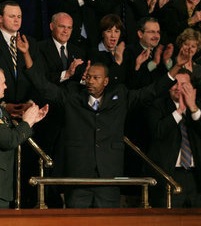
At 12:45 p.m. on January 2, 2007, Wesley Autrey stood on the platform of the 137th Street–City College station in Manhattan, waiting for a train with his two young daughters beside him. Nearby, a young film student named Cameron Hollopeter began having a seizure. Autrey and two women noticed immediately. Autrey borrowed a pen from a bystander and used it to keep Hollopeter's jaw open through the convulsions, a small act of first aid that would soon be overshadowed by what came next.
When the seizure passed, Hollopeter stumbled toward the platform's edge and fell onto the tracks below. Autrey looked up and saw the headlights of an oncoming 1 train bearing down. There was no time for hesitation. One of the women grabbed Autrey's daughters, pulling them back from the platform edge, and Autrey dove onto the tracks after Hollopeter.
He had hoped to drag the young man clear, but as the train's lights closed in, he realized there wasn't enough time. Instead, Autrey made a different calculation: he pressed Hollopeter down into a narrow drainage trench between the rails and threw his own body over him, pinning them both flat. The train's operator hit the brakes, but momentum carried the cars forward. All but two of them passed directly over the two men, so close that grease from the train's undercarriage smeared onto Autrey's cap.
Afterward, Autrey played down what he'd done. 'I don't feel like I did something spectacular,' he told The New York Times. 'I just saw someone who needed help. I did what I felt was right.' He credited his construction background — he was a member of LIUNA union Local 79, accustomed to working in confined spaces — with helping him judge, correctly, that there was just enough clearance for his body beneath the train.
Hollopeter's family was overwhelmed with gratitude. His father, Larry, said that Autrey's 'instinctive and unselfish act saved our son's life,' adding that there were no words to properly express his family's feelings. Within a day, strangers were showering Autrey with gifts. Jerry Sherlock, president of the New York Film Academy where Hollopeter studied, gave Autrey $5,000 in cash and another $5,000 in scholarships for his daughters. Donald Trump contributed $10,000 and later wrote a tribute to Autrey when Time magazine named him one of its 100 Most Influential People of 2007.
More from People

Frida Kahlo: Painting Through the Pain
An iron handrail pierced a teenage girl's body on a Mexico City street — and out of that wreckage came one of the most searingly honest artists of the twentieth century.

The Ox-Cart and the Snow: Şerife Bacı's Last Road
Somewhere on a frozen road outside Kastamonu, a young mother pressed her body against a quilt to keep her infant warm through the night. By morning, she had become a legend.

Pompey the Great: The Friendship That Broke Rome
He was called 'the teenage butcher' by his enemies and 'the Great' by his mentor — and the empire he helped build would ultimately be the death of him.

The Third Pole: How Hunt, Hillary and Tenzing Conquered Everest
For decades the world's highest mountain had turned back every climber who dared it — sometimes swallowing them whole. In the spring of 1953, one expedition finally reached the point where the sky simply stopped going up.

Two Rivals Under One Roof: Picasso and Matisse
Long before they were named together as the twin poles of modern art, they were simply two names on the walls of the same small Paris gallery — one already known for wild colour, the other not yet known at all.

Fire and Ice: The Borg–McEnroe Rivalry
One man never raised his voice. The other rarely lowered his. Between them they produced two of the greatest matches tennis has ever seen.