The Man Who Moved the Earth
He watched a chandelier sway in the wind and, comparing it to his own heartbeat, stumbled onto a truth that would eventually put him under house arrest for life.
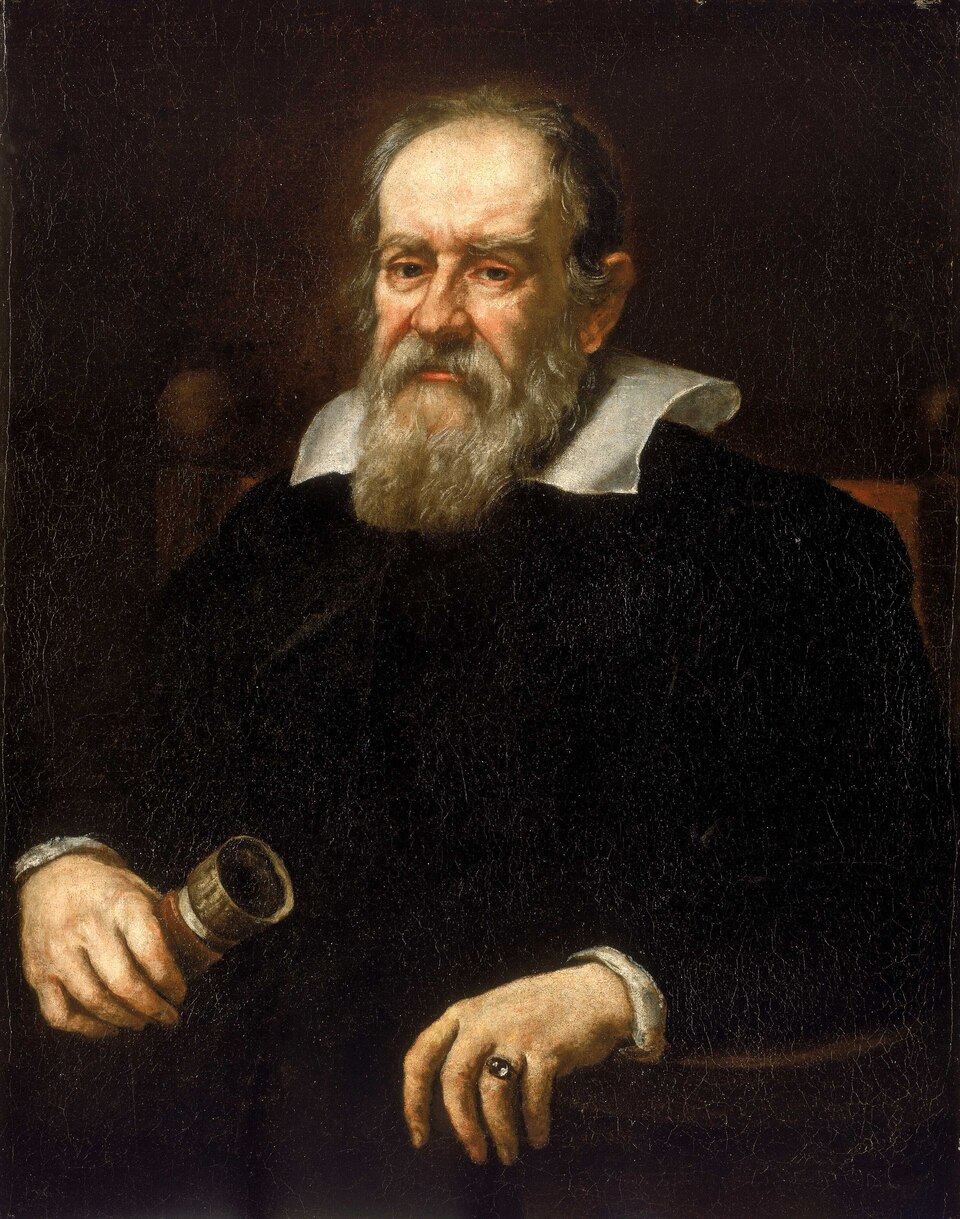
In 1581, while studying medicine at the University of Pisa (where he had enrolled the previous year at his father's urging), a young Galileo Galilei sat in a cathedral watching a chandelier swing back and forth, pushed by drafts of air. Timing its arcs against his own pulse, he noticed something strange: whether the swing was wide or narrow, the time it took seemed constant. That small, curious observation about pendulums was an early sign of a mind that would not simply accept what it was told, but measure it.
Galileo was born on 15 February 1564 in Pisa, then part of the Duchy of Florence, the first of six children of Vincenzo Galilei, a lutenist and music theorist, and Giulia Ammannati. His father wanted him to study medicine, a more lucrative path than mathematics, and in 1580 Galileo enrolled at the University of Pisa for that purpose. But after sitting in on a geometry lecture, he persuaded his father to let him pursue mathematics and natural philosophy instead. Financial pressures shadowed him throughout his life — his brother Michelangelo, also a musician, repeatedly failed to pay his share of family dowries, leaving Galileo to cover the debts and driving him, by his own admission, toward inventions that might bring in money.
His early scientific output was wide-ranging. In 1583, at the request of his patron the Grand Duke of Tuscany, he tackled a probability puzzle about dice. He helped develop the thermoscope, an ancestor of the thermometer, and in 1586 wrote about a hydrostatic balance of his own design, drawing scientific attention. He also studied art formally, teaching perspective and chiaroscuro in Florence, and befriended the painter Cigoli, who later incorporated Galileo's lunar observations into a painting.
In 1589 Galileo became chair of mathematics at Pisa, and in 1592 he moved to the University of Padua, where he taught geometry, mechanics, and astronomy until 1610. It was during this period that his work in physics deepened — studying speed, velocity, gravity, free fall, inertia, projectile motion, and the principle of relativity. He also built improved telescopes, and with them turned his gaze skyward: he observed the stars of the Milky Way, the phases of Venus, the four largest moons of Jupiter, the rings of Saturn, craters on the Moon, and sunspots. He built an early microscope as well.
Galileo's private life left its own imprint. Though a devout Catholic, he fathered three children out of wedlock with Marina Gamba — daughters Virginia and Livia, and a son, Vincenzo. Considering his daughters unmarriageable because of their illegitimate birth, Galileo placed them in the convent of San Matteo in Arcetri. Virginia took the name Maria Celeste and died on 2 April 1634; she is buried alongside her father in the Basilica of Santa Croce in Florence. Livia became Sister Arcangela and was often ill. Vincenzo was later legitimized as Galileo's heir and married Sestilia Bocchineri.
More from People

Frida Kahlo: Painting Through the Pain
An iron handrail pierced a teenage girl's body on a Mexico City street — and out of that wreckage came one of the most searingly honest artists of the twentieth century.

The Ox-Cart and the Snow: Şerife Bacı's Last Road
Somewhere on a frozen road outside Kastamonu, a young mother pressed her body against a quilt to keep her infant warm through the night. By morning, she had become a legend.

Pompey the Great: The Friendship That Broke Rome
He was called 'the teenage butcher' by his enemies and 'the Great' by his mentor — and the empire he helped build would ultimately be the death of him.

The Third Pole: How Hunt, Hillary and Tenzing Conquered Everest
For decades the world's highest mountain had turned back every climber who dared it — sometimes swallowing them whole. In the spring of 1953, one expedition finally reached the point where the sky simply stopped going up.

Two Rivals Under One Roof: Picasso and Matisse
Long before they were named together as the twin poles of modern art, they were simply two names on the walls of the same small Paris gallery — one already known for wild colour, the other not yet known at all.

Fire and Ice: The Borg–McEnroe Rivalry
One man never raised his voice. The other rarely lowered his. Between them they produced two of the greatest matches tennis has ever seen.