The Man Who Raced Darwin to an Idea
In 1858, a letter arrived from a fever-stricken naturalist in the Malay Archipelago, and it forced Charles Darwin to finally speak. Alfred Russel Wallace had arrived, alone, at the same revolutionary idea.
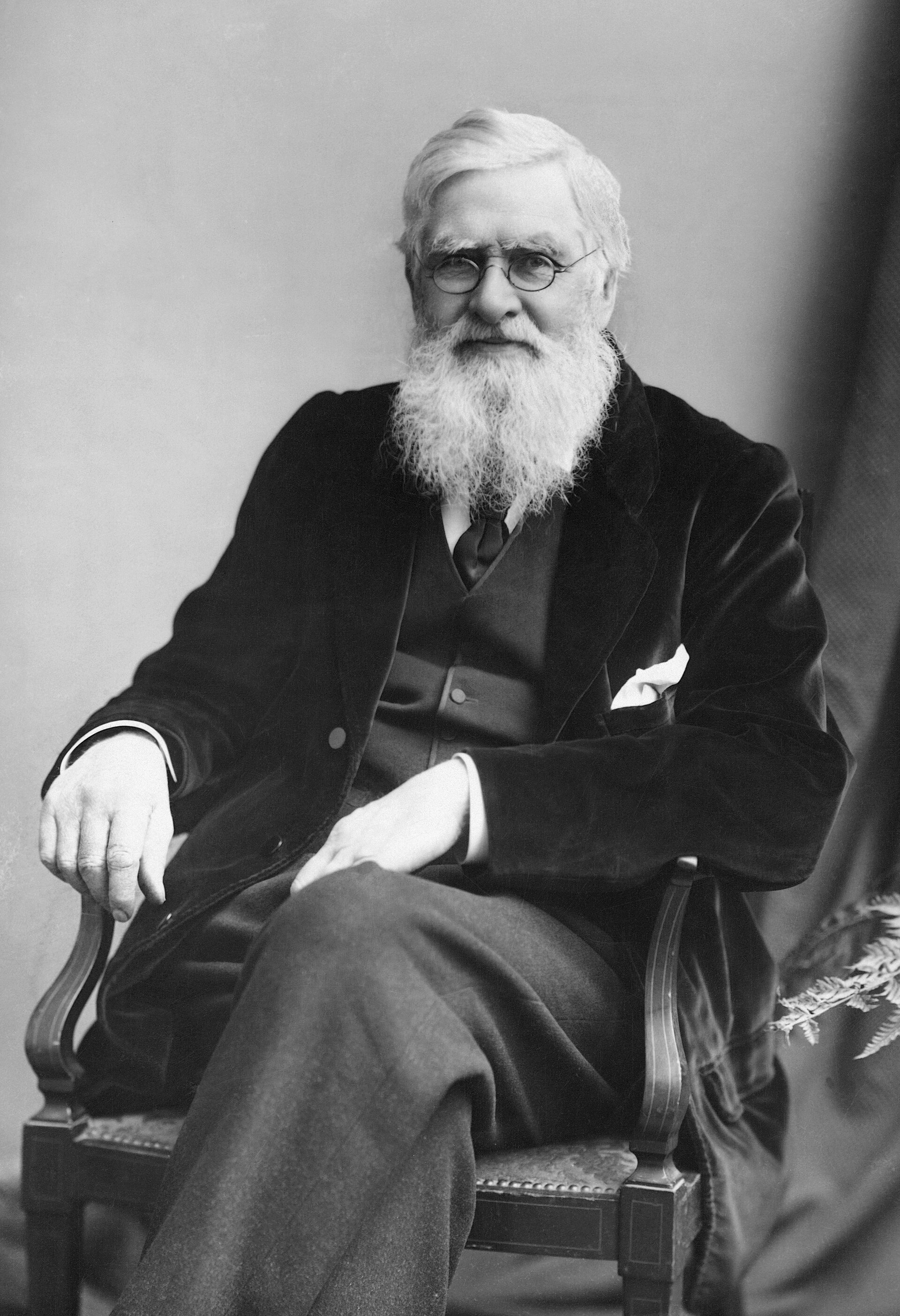
Alfred Russel Wallace was born on 8 January 1823 in Llanbadoc, Monmouthshire, the eighth of nine children in a family whose fortunes were steadily unravelling. His father, a lawyer who never practised, watched bad investments erode what little the family had, and Wallace attended Hertford Grammar School until 1837, when he left to move to London and lodge with his older brother John, an apprentice builder. There, at the London Mechanics Institute, he absorbed the radical ideas of Robert Owen and Thomas Paine, before joining another brother, William, as an apprentice surveyor across Mid-Wales and the English borderlands.
Between 1840 and 1843, tramping the countryside as a land surveyor, Wallace discovered an unexpected passion: the plants and flowers around him. He began collecting as an amateur botanist. His father died in 1843, and with surveying work drying up, Wallace found himself briefly unemployed, until early in 1844 he took a teaching post at the Collegiate School in Leicester. There he spent his evenings at the town library devouring Thomas Malthus's essay on population, Alexander von Humboldt's travel writings, Charles Lyell's geology, and Charles Darwin's own account of the Beagle voyage. It was in Leicester, too, that he met the young entomologist Henry Walter Bates, who drew him into the world of insect collecting.
In 1848, Wallace and Bates set off together for Brazil, spending years collecting specimens along the Amazon River basin. It was here, amid the sheer, overwhelming diversity of the rainforest, that the question of how species originate first took firm root in his mind. He returned to England in 1852, only to set out again in 1854, this time for the Malay Archipelago, where he would remain until 1862.
It was in the islands of Southeast Asia that Wallace made his most enduring geographical discovery: a faunal boundary, later named the Wallace Line, splitting the archipelago into a western zone of largely Asian animals and an eastern zone reflecting Australasia. The observation would earn him lasting recognition as the leading 19th-century authority on the geographical distribution of species — sometimes called the father of biogeography, or more precisely, zoogeography.
But it was also in the archipelago, in 1858, that Wallace independently arrived at the theory of evolution through natural selection — the same idea Charles Darwin had been quietly developing, and shelving, for two decades, wary of the storm it would provoke among religious and conservative circles. Wallace sent his paper to Darwin, and the two men's work was published together that year. The jolt was enough to push Darwin to abandon his sprawling unfinished manuscript and rapidly compose an abstract instead — published in 1859 as On the Origin of Species.
More from People

Frida Kahlo: Painting Through the Pain
An iron handrail pierced a teenage girl's body on a Mexico City street — and out of that wreckage came one of the most searingly honest artists of the twentieth century.

The Ox-Cart and the Snow: Şerife Bacı's Last Road
Somewhere on a frozen road outside Kastamonu, a young mother pressed her body against a quilt to keep her infant warm through the night. By morning, she had become a legend.

Pompey the Great: The Friendship That Broke Rome
He was called 'the teenage butcher' by his enemies and 'the Great' by his mentor — and the empire he helped build would ultimately be the death of him.

The Third Pole: How Hunt, Hillary and Tenzing Conquered Everest
For decades the world's highest mountain had turned back every climber who dared it — sometimes swallowing them whole. In the spring of 1953, one expedition finally reached the point where the sky simply stopped going up.

Two Rivals Under One Roof: Picasso and Matisse
Long before they were named together as the twin poles of modern art, they were simply two names on the walls of the same small Paris gallery — one already known for wild colour, the other not yet known at all.

Fire and Ice: The Borg–McEnroe Rivalry
One man never raised his voice. The other rarely lowered his. Between them they produced two of the greatest matches tennis has ever seen.