The Miracle of Salzburg
A three-year-old boy sat at his father's keyboard, quietly picking out thirds — and within two years he was composing pieces of his own, faultlessly, in perfect time.
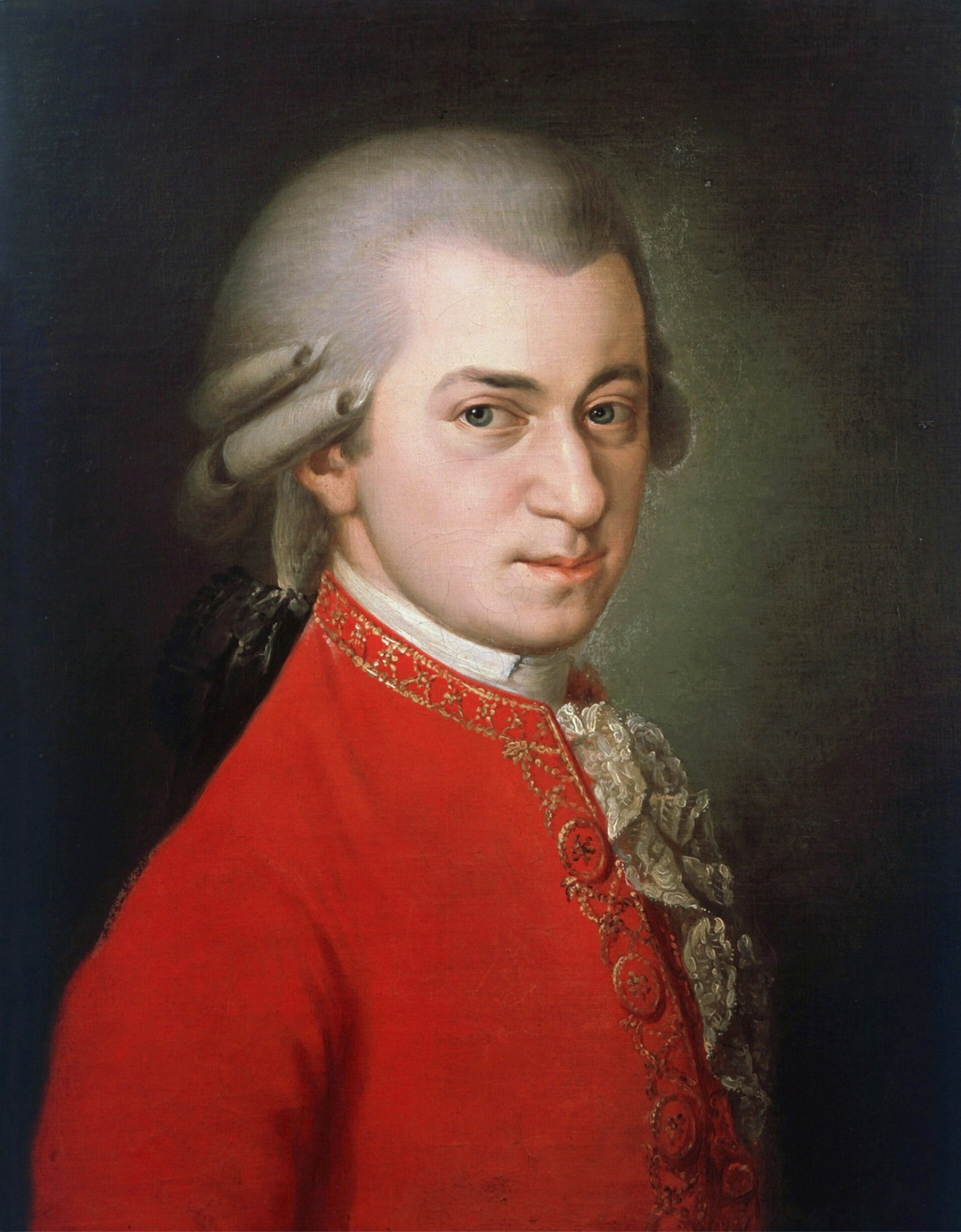
He was born on 27 January 1756 at Getreidegasse 9 in Salzburg, capital of a small ecclesiastical principality within the Holy Roman Empire. Wolfgang Amadeus Mozart was the youngest of seven children born to Leopold and Anna Maria Mozart, and only he and his elder sister Maria Anna, nicknamed Nannerl, survived infancy. Baptised the day after his birth as Joannes Chrysostomus Wolfgangus Theophilus Mozart, he would later call himself Wolfgang Amadè Mozart, one of many variants of a name history would remember differently.
His father Leopold, a violinist in the musical establishment of the Prince-Archbishop of Salzburg and author of a respected violin textbook, became the boy's only teacher. Nannerl began keyboard lessons at seven while her three-year-old brother watched, fascinated by the sound of thirds struck on the clavier. By four, Leopold was teaching him minuets as a kind of game; by five, Wolfgang was composing little pieces that his father wrote down for him. Leopold, astonished by a talent he had not fully instilled, eventually abandoned composing himself and called his son 'the miracle whom God allowed to be born in Salzburg.'
Childhood for Mozart meant almost constant travel. In 1762 he performed at the Bavarian court in Munich, then in Prague and Vienna. A grand tour beginning that year stretched three and a half years across Munich, Mannheim, Paris, London — where he played with the Italian cellist Giovanni Battista Cirri — The Hague, Zurich, and Donaueschingen. He met celebrated musicians and absorbed influences, among them the music of Johann Sebastian Bach. A return to Vienna in 1767 brought a bout of smallpox, from which he recovered.
Three journeys to Italy followed between 1769 and 1773. During these trips he composed three operas — Mitridate Rè di Ponto, Ascanio in Alba, and Lucio Silla — all staged in Milan. In Bologna he was accepted into the Accademia Filarmonica. It was in Italy that he reportedly heard Gregorio Allegri's Miserere performed once in the Sistine Chapel and wrote it down from memory, correcting small errors as he went.
At seventeen, Mozart took a position as a court musician in Salzburg, but restlessness soon set in. A journey in search of better employment, from 1777 to 1779, took him through Paris, Mannheim, and Munich. In Mannheim he fell in love with Aloysia Weber, though the relationship ended; he would later marry her sister Constanze. His mother died in Paris in 1778 during this difficult journey, and Mozart eventually returned to Salzburg, where he wrote his five violin concertos, the Sinfonia Concertante, several masses, and the opera Idomeneo, staged in Munich in 1780.
More from People

Frida Kahlo: Painting Through the Pain
An iron handrail pierced a teenage girl's body on a Mexico City street — and out of that wreckage came one of the most searingly honest artists of the twentieth century.

The Ox-Cart and the Snow: Şerife Bacı's Last Road
Somewhere on a frozen road outside Kastamonu, a young mother pressed her body against a quilt to keep her infant warm through the night. By morning, she had become a legend.

Pompey the Great: The Friendship That Broke Rome
He was called 'the teenage butcher' by his enemies and 'the Great' by his mentor — and the empire he helped build would ultimately be the death of him.

The Third Pole: How Hunt, Hillary and Tenzing Conquered Everest
For decades the world's highest mountain had turned back every climber who dared it — sometimes swallowing them whole. In the spring of 1953, one expedition finally reached the point where the sky simply stopped going up.

Two Rivals Under One Roof: Picasso and Matisse
Long before they were named together as the twin poles of modern art, they were simply two names on the walls of the same small Paris gallery — one already known for wild colour, the other not yet known at all.

Fire and Ice: The Borg–McEnroe Rivalry
One man never raised his voice. The other rarely lowered his. Between them they produced two of the greatest matches tennis has ever seen.