The One Man Who Said No
Three signatures stood between the world and thermonuclear war. Two men were ready to sign. One was not.
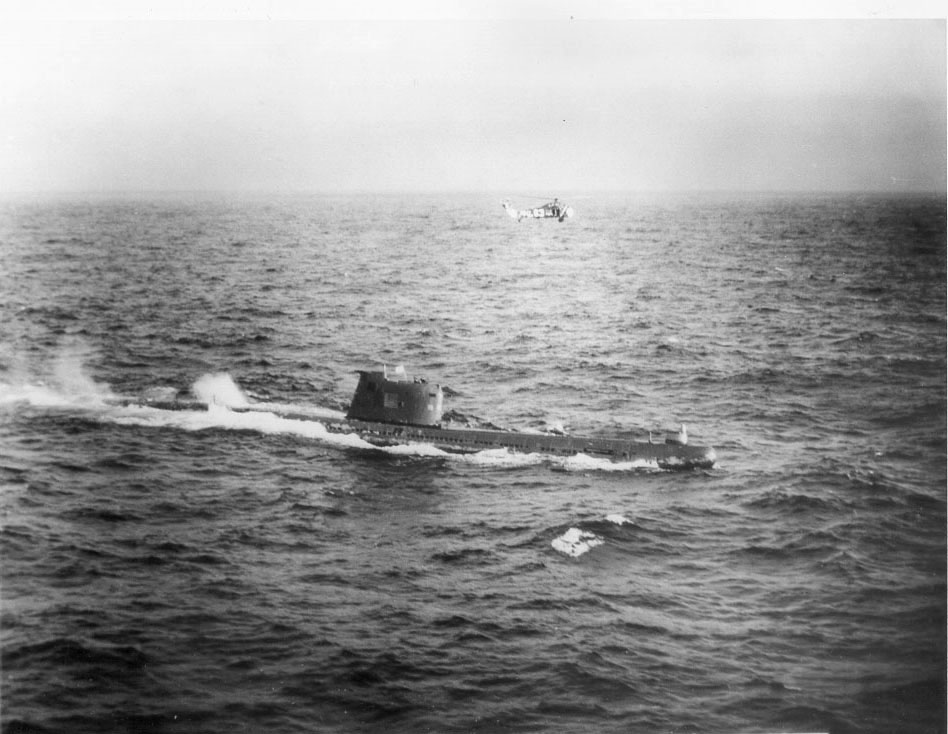
On 27 October 1962, eleven American destroyers and the carrier USS Randolph cornered a Soviet submarine off Cuba. B-59 was a diesel-electric Foxtrot-class boat, but it carried something the U.S. Navy did not know about: a nuclear-tipped torpedo. When American ships began dropping practice depth charges to force it to surface, the men trapped inside had no way of knowing these were mere signals. They had heard nothing from Moscow in days. The air conditioning had failed, the batteries were nearly dead, and carbon dioxide was thickening in the hull. To Captain Valentin Savitsky, it seemed entirely possible that war had already begun above him.
Savitsky wanted to fire. On most Soviet nuclear submarines, launching required only the captain's and the political officer's agreement. But B-59 carried a third man whose signature also mattered: Vasili Arkhipov, chief of staff of the submarine flotilla, serving aboard as executive officer. Political officer Ivan Maslennikov sided with Savitsky. Arkhipov did not. What followed was a fierce argument in a sweltering, suffocating hull, with the fate of millions resting on it.
Arkhipov was not simply the junior officer he appeared to be. As flotilla chief of staff, his authority technically outranked the ship's chain of command, and his voice carried weight the others could not ignore. He also carried the memory of an earlier catastrophe. In July 1961, as executive officer of the submarine K-19, Arkhipov had lived through a reactor coolant failure that forced seven engineers to improvise a fix at the cost of their lives — all seven died of radiation sickness within a month, and fifteen more crew members died in the following two years. Arkhipov himself had been irradiated. That history of disaster, and survival, gave his objections a gravity few could dismiss.
He argued that the American charges were meant only to force B-59 to the surface, not to sink it — a signal, not an attack. Slowly, he persuaded Savitsky to stand down and await orders from Moscow rather than fire. The submarine surfaced among the American warships it had spent hours evading. It made contact with a U.S. destroyer, came briefly under warning fire from aircraft that blinded the crew with searchlights before firing past the hull, and was eventually ordered home to the Soviet Union.
There was no medal waiting for them. When the crew returned, they were reprimanded rather than praised. One admiral reportedly told them it would have been better if they had gone down with their ship. Arkhipov's wife, Olga, later said he rarely spoke of what happened, feeling their ordeal went unappreciated. Soviet anger cooled only when officials realized the submarines sent to Cuba were diesel-electric, not nuclear-powered — a detail that, when Marshal Andrei Grechko learned of it, reportedly made him smash his glasses on a table in fury.
More from People

Frida Kahlo: Painting Through the Pain
An iron handrail pierced a teenage girl's body on a Mexico City street — and out of that wreckage came one of the most searingly honest artists of the twentieth century.

The Ox-Cart and the Snow: Şerife Bacı's Last Road
Somewhere on a frozen road outside Kastamonu, a young mother pressed her body against a quilt to keep her infant warm through the night. By morning, she had become a legend.

Pompey the Great: The Friendship That Broke Rome
He was called 'the teenage butcher' by his enemies and 'the Great' by his mentor — and the empire he helped build would ultimately be the death of him.

The Third Pole: How Hunt, Hillary and Tenzing Conquered Everest
For decades the world's highest mountain had turned back every climber who dared it — sometimes swallowing them whole. In the spring of 1953, one expedition finally reached the point where the sky simply stopped going up.

Two Rivals Under One Roof: Picasso and Matisse
Long before they were named together as the twin poles of modern art, they were simply two names on the walls of the same small Paris gallery — one already known for wild colour, the other not yet known at all.

Fire and Ice: The Borg–McEnroe Rivalry
One man never raised his voice. The other rarely lowered his. Between them they produced two of the greatest matches tennis has ever seen.