The Patent Clerk Who Rewrote the Universe
A boy who spoke late, whose father worried he might have a learning disability, would one day teach the world that time itself bends. In a small office in Bern, that boy — grown into a young man stamping patent applications — quietly began to rewrite the laws of physics.
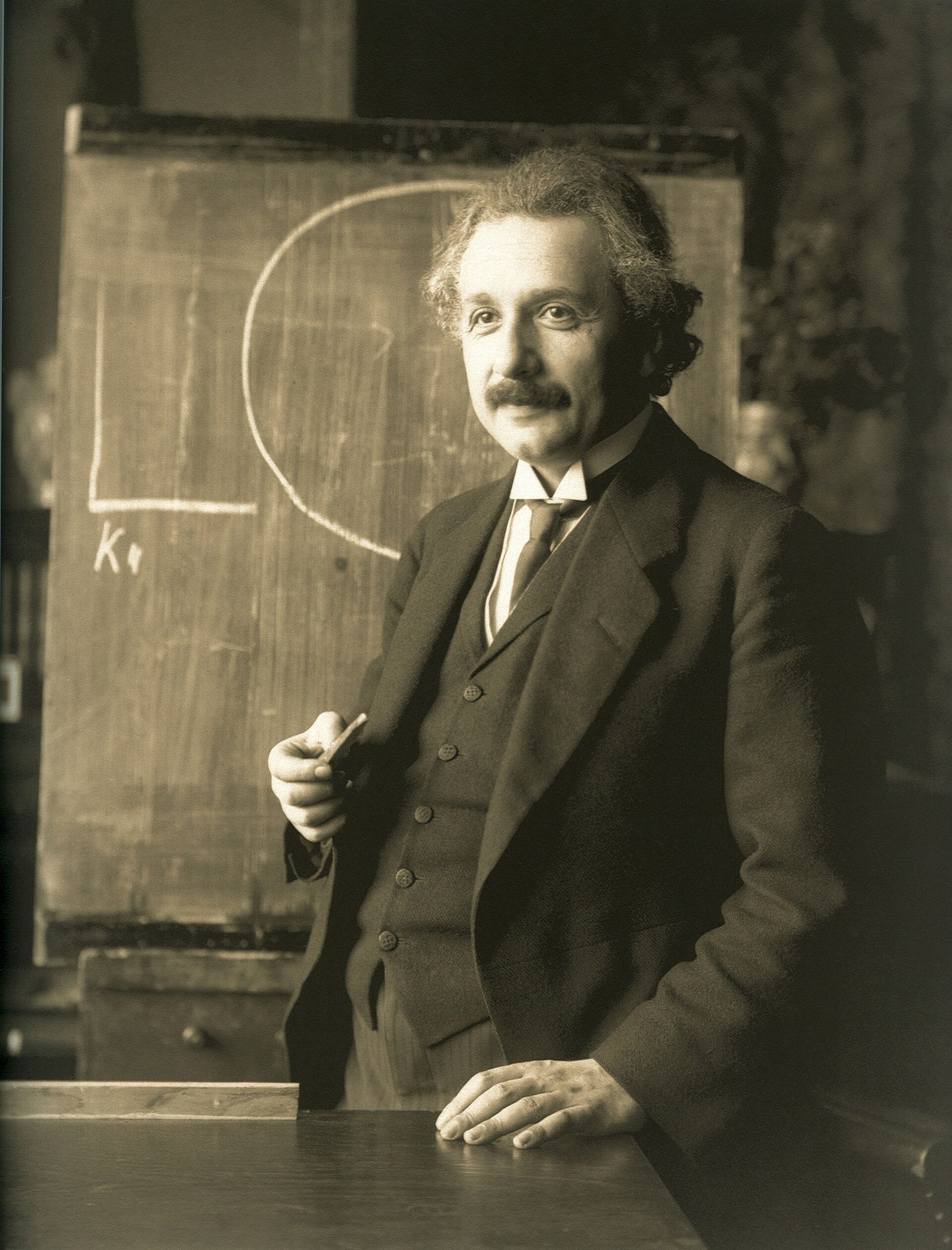
Albert Einstein was born on 14 March 1879 in Ulm, in the Kingdom of Württemberg, part of the German Empire, to Hermann Einstein, a salesman and engineer, and Pauline Koch, both secular Ashkenazi Jews. The family soon moved to Munich, where Hermann and his brother Jakob founded a company making electrical equipment run on direct current. Albert was slow to learn to talk, enough to worry his parents, but when he was five and sick in bed, his father gave him a compass — and the boy became transfixed by the invisible force twitching its needle. He later said something deeply hidden had to lie behind such things.
His schooling was uneven. He attended a Catholic elementary school and then the Luitpold Gymnasium, but chafed against its rigid, rote-learning methods, which he later blamed for stifling creativity. When his father's business failed to win a lighting contract in Munich, the family relocated to Italy, first Milan and then Pavia. Einstein, fifteen, was left behind to finish school, but a doctor's letter secured his release, and he rejoined his family in Italy — already showing the independence of mind that would define his life.
In 1895 he moved to Switzerland, and the following year renounced his German citizenship. That same year, 1896, at seventeen, he enrolled in the mathematics and physics teaching diploma program at the Swiss federal polytechnic school in Zurich, graduating in 1900. He became a Swiss citizen in 1901, a nationality he kept for the rest of his life, and — after struggling to find a university post — took a permanent position at the Swiss Patent Office in Bern. It was there, examining other people's inventions by day, that he quietly built the foundations of modern physics.
In 1905, his 'miracle year', he submitted a doctoral dissertation to the University of Zurich and published four papers that would upend science. One explained the photoelectric effect; another accounted for Brownian motion; a third introduced special relativity; and a fourth showed that mass and energy are equivalent, expressed in the equation E = mc², later called the world's most famous equation. None of these ideas was immediately embraced by the scientific establishment.
In 1914 he moved to Berlin at Max Planck's personal request, joining the Prussian Academy of Sciences and Humboldt University, and in 1917 became director of the Kaiser Wilhelm Institute for Physics. In 1915 he had proposed general relativity, extending his mechanics to incorporate gravitation, and a 1916 paper laid the groundwork for modern theoretical cosmology by introducing the cosmological constant. In 1917 he described spontaneous and stimulated emission — the latter the principle behind the laser and maser.
More from People

Frida Kahlo: Painting Through the Pain
An iron handrail pierced a teenage girl's body on a Mexico City street — and out of that wreckage came one of the most searingly honest artists of the twentieth century.

The Ox-Cart and the Snow: Şerife Bacı's Last Road
Somewhere on a frozen road outside Kastamonu, a young mother pressed her body against a quilt to keep her infant warm through the night. By morning, she had become a legend.

Pompey the Great: The Friendship That Broke Rome
He was called 'the teenage butcher' by his enemies and 'the Great' by his mentor — and the empire he helped build would ultimately be the death of him.

The Third Pole: How Hunt, Hillary and Tenzing Conquered Everest
For decades the world's highest mountain had turned back every climber who dared it — sometimes swallowing them whole. In the spring of 1953, one expedition finally reached the point where the sky simply stopped going up.

Two Rivals Under One Roof: Picasso and Matisse
Long before they were named together as the twin poles of modern art, they were simply two names on the walls of the same small Paris gallery — one already known for wild colour, the other not yet known at all.

Fire and Ice: The Borg–McEnroe Rivalry
One man never raised his voice. The other rarely lowered his. Between them they produced two of the greatest matches tennis has ever seen.