The Tentmaker's Equations: Omar Khayyam's Century
A boy who memorized the Quran grew into a man who solved cubic equations with a compass and predicted, with eerie accuracy, that petals would one day bury his grave. Both things came true.
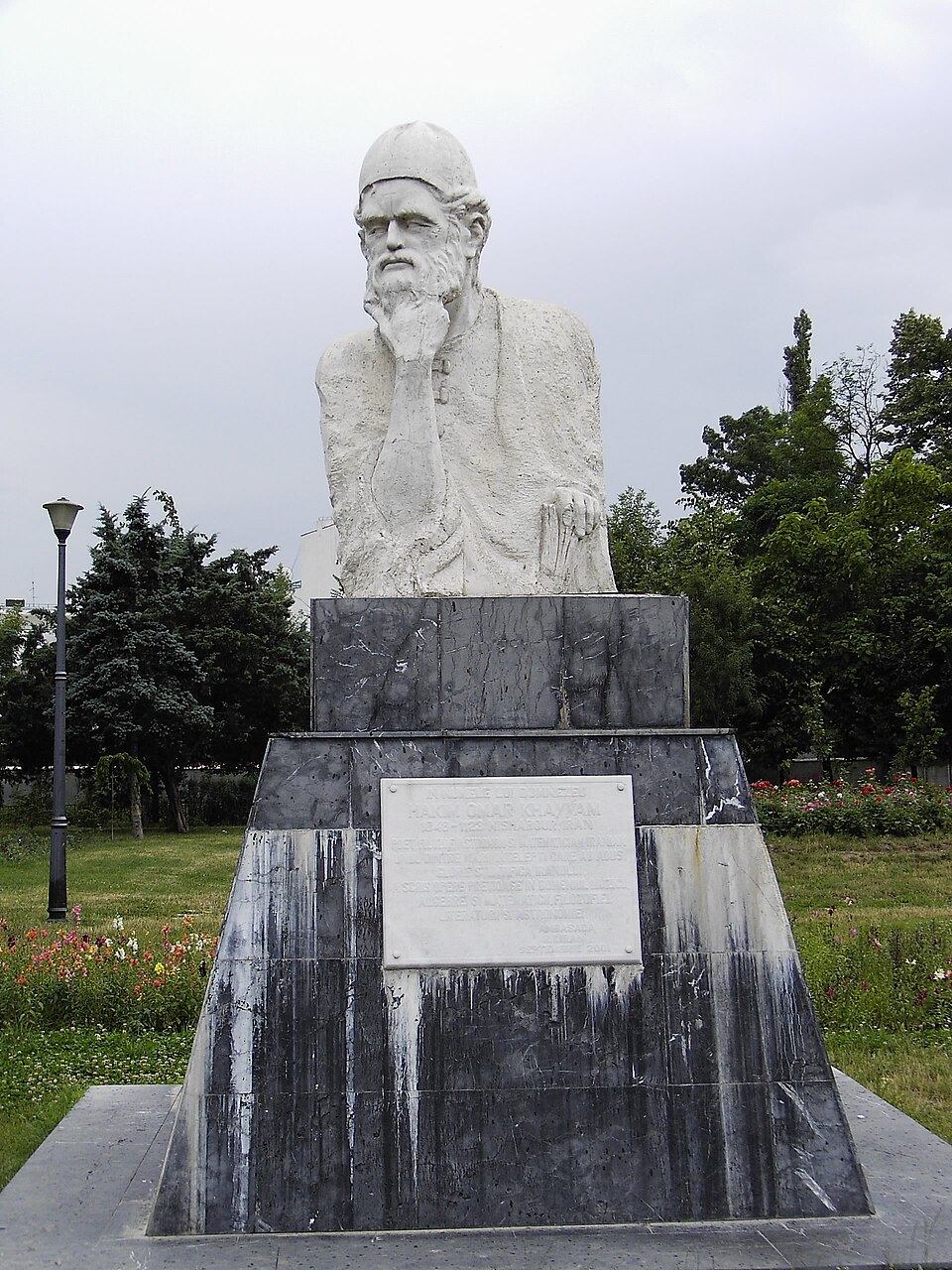
In Nishapur, a city that had once thrived as a Zoroastrian stronghold before becoming a jewel of the Seljuk Empire, a boy named Ghiyath al-Din Abu al-Fath Omar ibn Ibrahim was born on 18 May 1048. Centuries later, historians would pin down that exact date from the horoscope recorded by Bayhaqi, a contemporary who knew him personally and noted that he was born under Gemini, with the sun and Mercury in the ascendant. The world would come to call him simply Omar Khayyam — though whether his family actually made tents, as his name in Arabic suggests, remains uncertain.
His education followed the path of a gifted mind moving through the best teachers his region could offer. He memorized much of the Quran young, studied grammar and literature, then turned to mathematics and astronomy, eventually working under Imam Muwaffaq Nishaburi, the most respected teacher in Khorasan, who tutored the children of nobility. Khayyam may also have studied alongside Bahmanyar, a disciple of the philosopher Avicenna. Around 1068 he traveled to Bukhara to frequent its renowned library, and by 1070 he had settled in Samarkand, where, under the patronage of the governor Abu Tahir, he began writing his famous Treatise on Algebra.
In Samarkand, the Karakhanid ruler Shams al-Mulk Nasr received him with striking honor — Bayhaqi records that Khayyam was seated beside the ruler on his own throne. Peace between the Karakhanids and Sultan Malik-Shah I in 1073-4 opened a new chapter: in 1074, Grand Vizier Nizam al-Mulk invited Khayyam to the city of Marv to meet the sultan, and Khayyam entered his service.
It was under Malik-Shah's patronage that Khayyam undertook his most enduring practical achievement. Commissioned to build an observatory in Isfahan, he led a team of astronomers in years of precise observation aimed at reforming the Persian calendar. The undertaking probably began with the opening of the observatory in 1074 and ended in 1079, when the group concluded their measurements of the length of the solar year, reporting it as 365.24219858156 days — a figure so accurate that, given how imperceptibly the true value shifts over a human lifetime, it remains remarkably close to modern measurements of 365.242190 days. This work became the foundation of the Jalali calendar, a solar calendar with a 33-year intercalation cycle that still underlies the Persian calendar used today, nearly a millennium later.
His mathematics reached beyond astronomy. Khayyam was the first to provide a general geometric solution for all third-degree, or cubic, equations, using the intersection of conic sections — a method later echoed, unknowingly, by Descartes. Unlike Descartes, Khayyam worked strictly within the rule of homogeneity, selecting a unit length for his geometric calculations. In his treatise On the Division of a Quarter of a Circle, he sought approximate numerical solutions to cubic equations using trigonometric tables. He also advanced the study of Euclid's parallel postulate in his book Explanations of the Difficulties in the Postulates of Euclid, describing a quadrilateral later credited jointly to him and the Italian mathematician Saccheri.
More from People

Frida Kahlo: Painting Through the Pain
An iron handrail pierced a teenage girl's body on a Mexico City street — and out of that wreckage came one of the most searingly honest artists of the twentieth century.

The Ox-Cart and the Snow: Şerife Bacı's Last Road
Somewhere on a frozen road outside Kastamonu, a young mother pressed her body against a quilt to keep her infant warm through the night. By morning, she had become a legend.

Pompey the Great: The Friendship That Broke Rome
He was called 'the teenage butcher' by his enemies and 'the Great' by his mentor — and the empire he helped build would ultimately be the death of him.

The Third Pole: How Hunt, Hillary and Tenzing Conquered Everest
For decades the world's highest mountain had turned back every climber who dared it — sometimes swallowing them whole. In the spring of 1953, one expedition finally reached the point where the sky simply stopped going up.

Two Rivals Under One Roof: Picasso and Matisse
Long before they were named together as the twin poles of modern art, they were simply two names on the walls of the same small Paris gallery — one already known for wild colour, the other not yet known at all.

Fire and Ice: The Borg–McEnroe Rivalry
One man never raised his voice. The other rarely lowered his. Between them they produced two of the greatest matches tennis has ever seen.