The Universe in a Wheelchair: Stephen Hawking's Improbable Life
Given two years to live at twenty-one, he spent the next five decades rewriting our understanding of black holes, time, and the universe's very beginning.
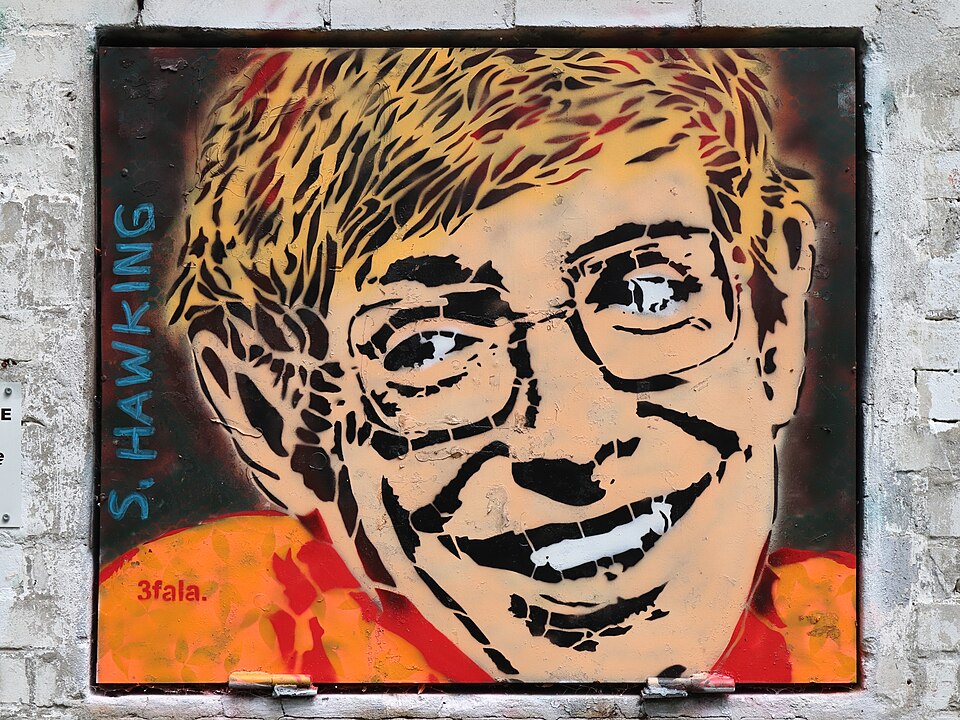
Stephen William Hawking was born on 8 January 1942 in Oxford, into a family that valued books over comfort. His father Frank was a medical researcher specialising in tropical diseases; his mother Isobel had studied Philosophy, Politics and Economics at Oxford. Meals in the Hawking household were often spent with everyone silently reading. The family lived frugally in a large, cluttered house in St Albans and drove around in a converted London taxicab — an eccentric household that nonetheless prized the life of the mind above almost everything else.
Hawking was not, by his own account, an early academic star. He struggled to read as a child and was known at school by the nickname 'Einstein' more as a tease than a prophecy. It was a mathematics teacher, Dikran Tahta, who awakened his real aptitude — inspiring him, along with friends, to build a rudimentary computer from clock parts and an old telephone switchboard. Though his father hoped he would study medicine, Hawking wanted mathematics; when St Albans School offered no such course, he turned instead to physics, entering University College, Oxford in 1959 at just seventeen.
He graduated with a first-class degree in physics, then moved to Cambridge in 1962 to pursue cosmology — a field barely studied at Oxford at the time. He had hoped to work under the astronomer Fred Hoyle but was instead assigned Dennis Sciama as his supervisor, a turn that shaped his path toward general relativity. In 1966 he earned his PhD in applied mathematics and theoretical physics from Trinity Hall, Cambridge.
Just as his academic life was taking shape, Hawking's body began to fail him. In 1963, at twenty-one, he was diagnosed with an early-onset, slow-progressing form of motor neurone disease. Doctors gave him two years to live. Instead, he lived more than fifty more, the disease gradually paralysing him over decades. In 1985, while visiting CERN, he contracted pneumonia, which led to a tracheotomy that left him permanently without speech. From then on he communicated through a speech-generating device — at first via a handheld switch, and eventually, as paralysis advanced further, through the movement of a single cheek muscle.
Despite — or perhaps driven by — this relentless physical decline, Hawking produced some of the most consequential theoretical work of the twentieth century. With Roger Penrose, he developed gravitational singularity theorems within general relativity, showing that the universe's history could be traced from the Big Bang to black holes, and that a full theory would require uniting general relativity with quantum mechanics. He went on to predict that black holes are not entirely black at all, but emit radiation — now called Hawking radiation, initially controversial but widely accepted by the late 1970s as a landmark discovery. He was also the first to lay out a cosmological theory unifying relativity and quantum mechanics, and he introduced the concept of the micro black hole.
More from People

Frida Kahlo: Painting Through the Pain
An iron handrail pierced a teenage girl's body on a Mexico City street — and out of that wreckage came one of the most searingly honest artists of the twentieth century.

The Ox-Cart and the Snow: Şerife Bacı's Last Road
Somewhere on a frozen road outside Kastamonu, a young mother pressed her body against a quilt to keep her infant warm through the night. By morning, she had become a legend.

Pompey the Great: The Friendship That Broke Rome
He was called 'the teenage butcher' by his enemies and 'the Great' by his mentor — and the empire he helped build would ultimately be the death of him.

The Third Pole: How Hunt, Hillary and Tenzing Conquered Everest
For decades the world's highest mountain had turned back every climber who dared it — sometimes swallowing them whole. In the spring of 1953, one expedition finally reached the point where the sky simply stopped going up.

Two Rivals Under One Roof: Picasso and Matisse
Long before they were named together as the twin poles of modern art, they were simply two names on the walls of the same small Paris gallery — one already known for wild colour, the other not yet known at all.

Fire and Ice: The Borg–McEnroe Rivalry
One man never raised his voice. The other rarely lowered his. Between them they produced two of the greatest matches tennis has ever seen.