The Woman Who Took Up a Hatchet at Aziziye
On a freezing November night in 1877, a young widow-to-be kissed her dead brother's forehead and swore vengeance — then walked toward a fortress full of Russian soldiers armed with nothing but his rifle and her own hatchet.
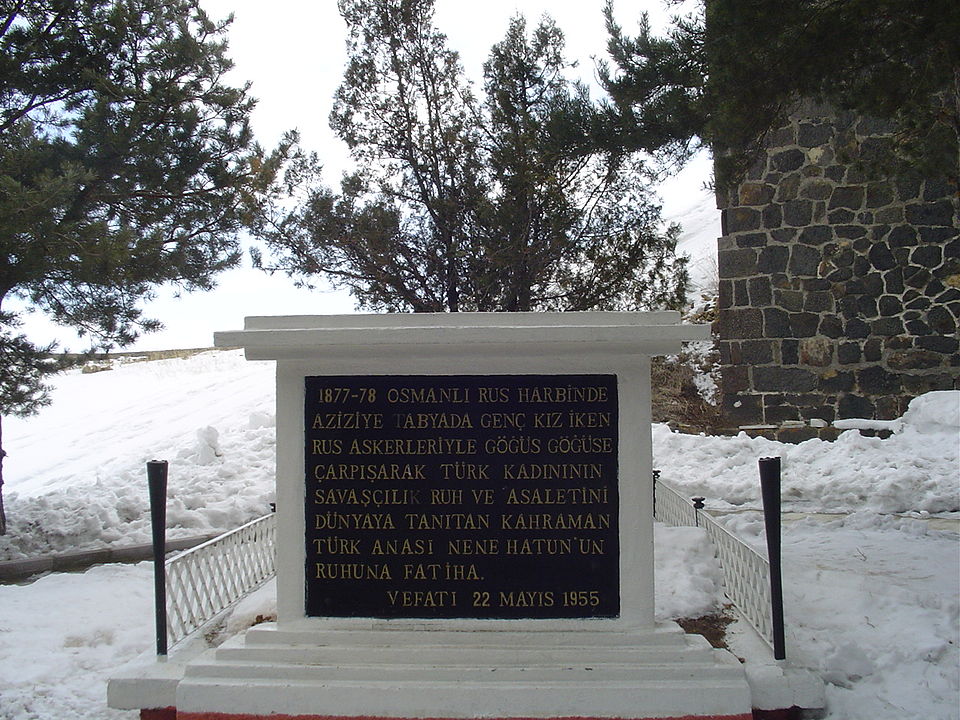
On the night of 7 November 1877, Nene Hatun's older brother Hasan staggered home to Erzurum's Aziziye neighborhood badly wounded and died in the house. Two nights later, on the night of 8 November, Russian troops captured Fort Aziziye, the stronghold guarding the city. When the news was announced from the minarets at morning prayer on 9 November, Nene Hatun, twenty years old, bent over her brother's body, kissed his head, and swore to avenge him.
She did not wait for anyone's permission. Leaving her newborn daughter and her three-month-old son Yusuf behind, she picked up her dead brother's rifle and her own hatchet and joined the counterattack forming in the streets. The assault on Fort Aziziye was not led by soldiers alone — it was a rising of ordinary townspeople, mostly women and elderly men, armed with axes, sticks, and whatever farm tools they had at hand.
What followed was carnage. Russian gunfire cut down hundreds of the advancing civilians as they pushed toward the fortress walls. But their numbers were overwhelming, and eventually they broke through the iron gates. Inside, the fight turned hand-to-hand — hatchets and farm implements against rifles and bayonets — until some 2,000 Russian soldiers lay dead and the rest fled. It was a brutal, improvised victory won largely by civilians who had never been trained for war.
When the fighting ended, searchers found Nene Hatun unconscious among the wounded, her hands still locked around her hatchet, blood on her clothes. She had survived. In the years that followed she would be singled out among the many who fought that day, remembered as the face of a whole city's resistance.
More from People

Frida Kahlo: Painting Through the Pain
An iron handrail pierced a teenage girl's body on a Mexico City street — and out of that wreckage came one of the most searingly honest artists of the twentieth century.

The Ox-Cart and the Snow: Şerife Bacı's Last Road
Somewhere on a frozen road outside Kastamonu, a young mother pressed her body against a quilt to keep her infant warm through the night. By morning, she had become a legend.

Pompey the Great: The Friendship That Broke Rome
He was called 'the teenage butcher' by his enemies and 'the Great' by his mentor — and the empire he helped build would ultimately be the death of him.

The Third Pole: How Hunt, Hillary and Tenzing Conquered Everest
For decades the world's highest mountain had turned back every climber who dared it — sometimes swallowing them whole. In the spring of 1953, one expedition finally reached the point where the sky simply stopped going up.

Two Rivals Under One Roof: Picasso and Matisse
Long before they were named together as the twin poles of modern art, they were simply two names on the walls of the same small Paris gallery — one already known for wild colour, the other not yet known at all.

Fire and Ice: The Borg–McEnroe Rivalry
One man never raised his voice. The other rarely lowered his. Between them they produced two of the greatest matches tennis has ever seen.