The Wrestler Who Fed a Billion People
He failed his college entrance exam and grew up on an Iowa farm — yet he would be credited with saving more human lives than anyone else in history.
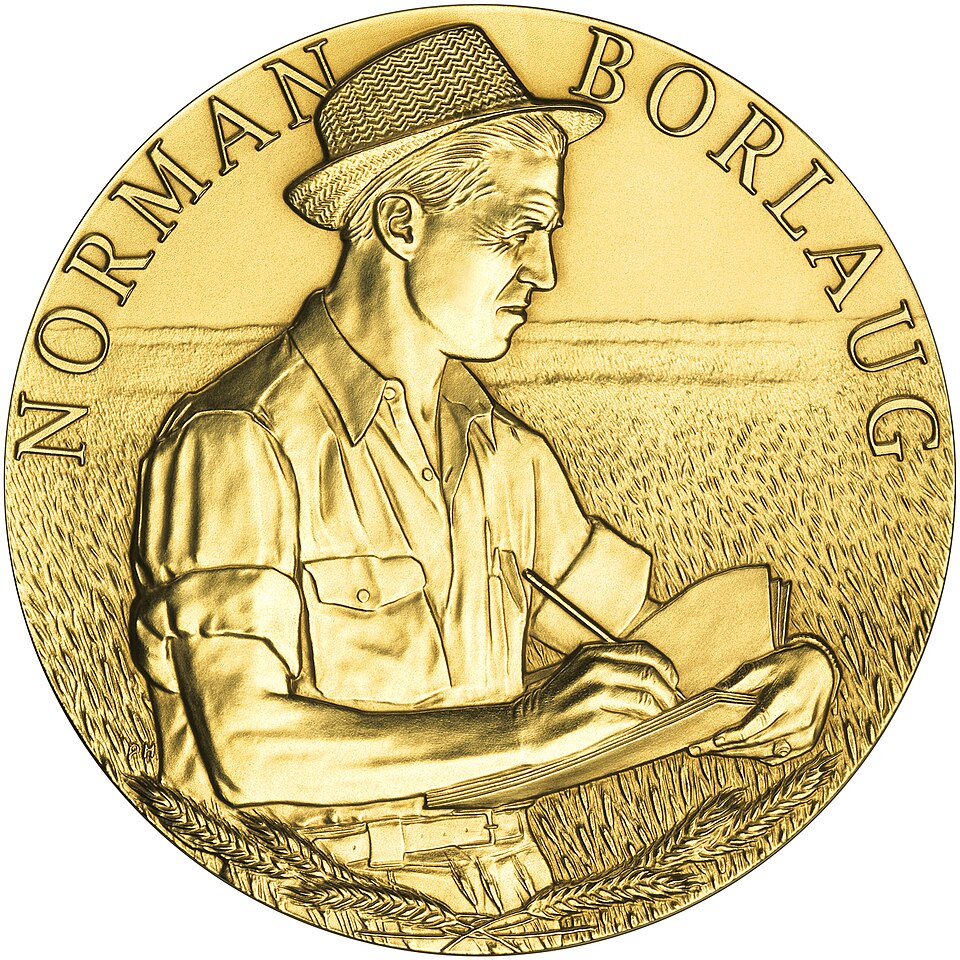
On a 106-acre farm west of Protivin, Iowa, a boy named Norman Borlaug spent his childhood fishing, hunting, and tending corn, oats, and cattle. He walked to a one-room schoolhouse through eighth grade, and it was his grandfather Nels Olson Borlaug who pushed him toward something bigger, telling him, 'You're wiser to fill your head now if you want to fill your belly later on.' It was advice Borlaug never forgot.
His path to the University of Minnesota wasn't smooth — he failed the entrance exam in 1933 and had to start in the school's newly created two-year General College before transferring into forestry. He was also a serious wrestler, reaching the Big Ten semifinals and later being inducted into the National Wrestling Hall of Fame. He credited the sport with a kind of toughness he carried for life, saying it taught him he could hold his own against the best in the world.
A turning point came in his final undergraduate months, when he attended a lecture by professor Elvin Charles Stakman titled 'These Shifty Little Enemies that Destroy our Food Crops.' Stakman spoke about rust, a parasitic fungus devastating wheat, oats, and barley, and about breeding methods that could produce resistant plants. When Borlaug's Forest Service job vanished in budget cuts, Stakman urged him to pursue plant pathology instead. Borlaug enrolled to study under him, eventually earning his PhD in plant pathology and genetics from Minnesota in 1942.
During the Great Depression, Borlaug had worked in the Civilian Conservation Corps, feeding unemployed men on federal projects. Many were starving, and he later said, 'I saw how food changed them. All of this left scars on me.' That memory would shape the rest of his career.
Borlaug took an agricultural research post with what became CIMMYT in Mexico, where he developed semi-dwarf, high-yield, disease-resistant wheat varieties. Working with the Mexican government, he helped triple the country's wheat production, and by 1963 Mexico had become a net exporter of wheat. He also developed triticale, a wheat-rye hybrid.
More from People

Frida Kahlo: Painting Through the Pain
An iron handrail pierced a teenage girl's body on a Mexico City street — and out of that wreckage came one of the most searingly honest artists of the twentieth century.

The Ox-Cart and the Snow: Şerife Bacı's Last Road
Somewhere on a frozen road outside Kastamonu, a young mother pressed her body against a quilt to keep her infant warm through the night. By morning, she had become a legend.

Pompey the Great: The Friendship That Broke Rome
He was called 'the teenage butcher' by his enemies and 'the Great' by his mentor — and the empire he helped build would ultimately be the death of him.

The Third Pole: How Hunt, Hillary and Tenzing Conquered Everest
For decades the world's highest mountain had turned back every climber who dared it — sometimes swallowing them whole. In the spring of 1953, one expedition finally reached the point where the sky simply stopped going up.

Two Rivals Under One Roof: Picasso and Matisse
Long before they were named together as the twin poles of modern art, they were simply two names on the walls of the same small Paris gallery — one already known for wild colour, the other not yet known at all.

Fire and Ice: The Borg–McEnroe Rivalry
One man never raised his voice. The other rarely lowered his. Between them they produced two of the greatest matches tennis has ever seen.