Thomas Edison: A Thousand Failed Attempts
A boy who sold newspapers on trains grew half-deaf and grew into a man who registered 1,093 patents — but the road ran through bankruptcy, a baggage-car fire, and a rival named Tesla he refused to pay.
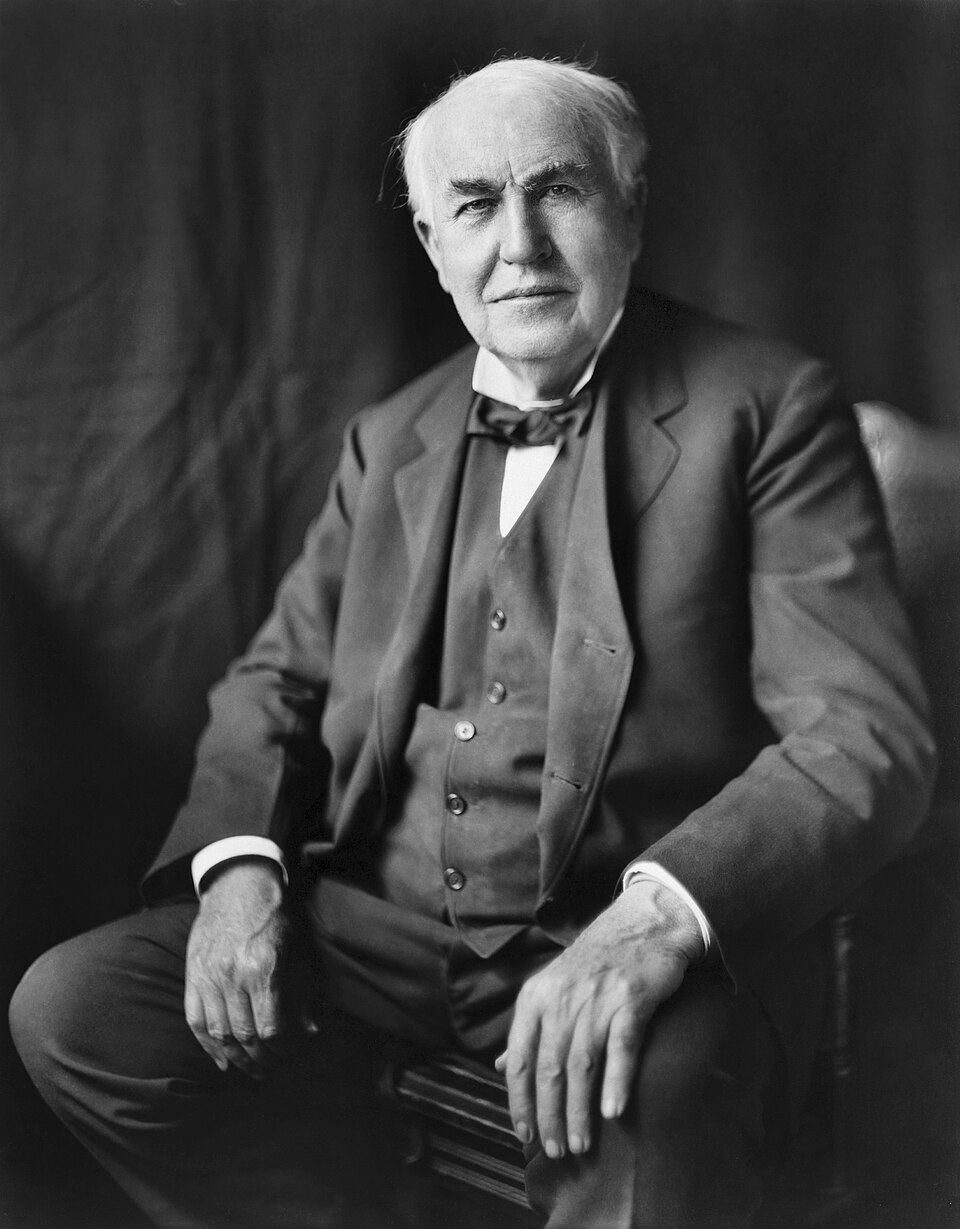
As a boy working as a 'news butcher,' Thomas Alva Edison sold newspapers, candy, and vegetables to passengers on trains running between Port Huron and Detroit, Michigan, pocketing enough profit to buy chemicals and equipment for experiments he ran secretly in a corner of the baggage car. One day a bottle of chemicals shattered and started a fire, costing young Edison both his makeshift laboratory and his job on the train. Around age 12, he began developing serious hearing problems — historian Paul Israel later attributed this to a bout of scarlet fever in childhood and recurring untreated ear infections. He would spend the rest of his life completely deaf in one ear and barely hearing in the other, a condition he later claimed helped him concentrate without distraction.
Edison had almost no formal schooling — a few months at most before a teacher's complaint about his slow comprehension ended it. His mother, a former teacher, taught him to read and write, and a book she gave him, on natural and experimental philosophy, sent him down a path of self-directed tinkering that never really stopped. By his early teens he was printing his own paper, the Grand Trunk Herald, which ran twenty-four issues and drew five hundred subscribers, proof of an entrepreneurial streak that would define his life.
From telegraph offices in Ontario, Michigan, Kentucky, Ohio, and Massachusetts, Edison built the technical foundation for everything that followed. Night shifts as a telegrapher gave him time to tinker with improvements to the machines themselves, and by age 22 he had sold enough of his early inventions to move to New York City and commit fully to engineering. Within a few years he owned a telegraph recorder factory in Newark employing more than a hundred people — proof that invention, for Edison, was inseparable from business.
His greatest institutional creation may have been Menlo Park, New Jersey — the first industrial research laboratory, a place built for the sole purpose of continuous invention. There, staff worked under grueling conditions driven by a boss known as 'The Wizard of Menlo Park,' who pushed himself and his associates to exhaustion. It was here that the phonograph emerged, a device that made Edison internationally famous even though it took years to become commercially viable — and here, too, that engineer William Joseph Hammer helped refine the incandescent lamp that would define an era.
In 1878, Edison turned to electric lighting, hoping to replace gas lamps outright. The path from a working bulb to a functioning power grid took decades of invention, investment, and hard-nosed maneuvering. Edison and his colleagues built the infrastructure of light bulbs, generators, and distribution networks that made whole cities luminous — but competition arrived in the form of George Westinghouse's alternating-current system, a rivalry sharpened by Edison's own former employee, Nikola Tesla, who had once proposed AC to Edison only to be waved off and, by his own account, denied a promised $50,000 for solving problems in the DC plant. The AC-DC battle eventually forced compromise, and out of it came General Electric.
More from People

Frida Kahlo: Painting Through the Pain
An iron handrail pierced a teenage girl's body on a Mexico City street — and out of that wreckage came one of the most searingly honest artists of the twentieth century.

The Ox-Cart and the Snow: Şerife Bacı's Last Road
Somewhere on a frozen road outside Kastamonu, a young mother pressed her body against a quilt to keep her infant warm through the night. By morning, she had become a legend.

Pompey the Great: The Friendship That Broke Rome
He was called 'the teenage butcher' by his enemies and 'the Great' by his mentor — and the empire he helped build would ultimately be the death of him.

The Third Pole: How Hunt, Hillary and Tenzing Conquered Everest
For decades the world's highest mountain had turned back every climber who dared it — sometimes swallowing them whole. In the spring of 1953, one expedition finally reached the point where the sky simply stopped going up.

Two Rivals Under One Roof: Picasso and Matisse
Long before they were named together as the twin poles of modern art, they were simply two names on the walls of the same small Paris gallery — one already known for wild colour, the other not yet known at all.

Fire and Ice: The Borg–McEnroe Rivalry
One man never raised his voice. The other rarely lowered his. Between them they produced two of the greatest matches tennis has ever seen.