Two Architects, One Race to the Stars
On opposite sides of an ocean and an ideology, two rocket engineers built the machines that would carry humanity off the Earth — yet neither ever met the other.
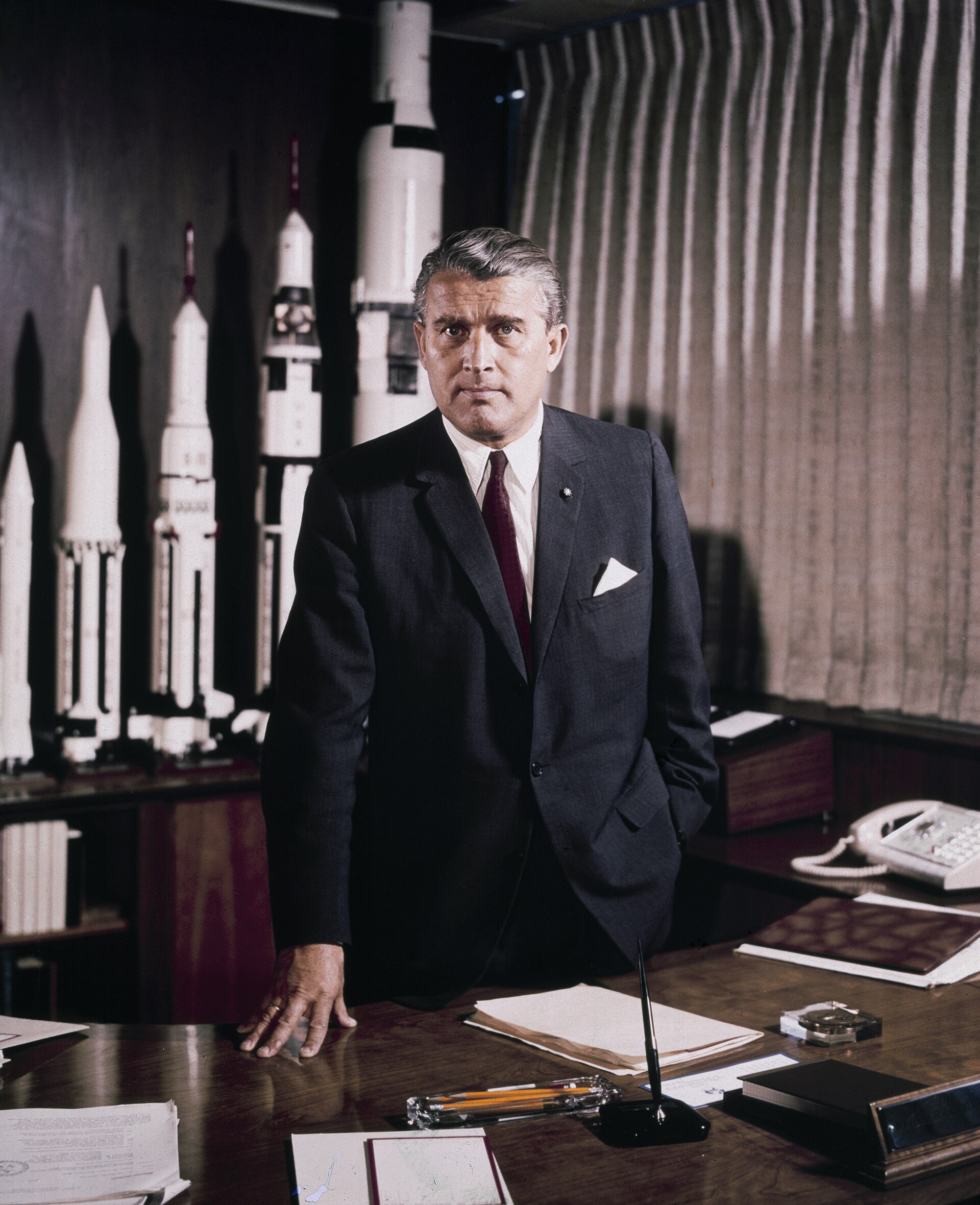
In the ruins of postwar Germany, American soldiers on bicycles and in jeeps combed the Bavarian countryside for a man whose name was already legend among engineers: Wernher von Braun. Born in 1912 in Wirsitz, in the Prussian province of Posen, von Braun had been fascinated by the stars since his mother gave him a telescope after his confirmation. He studied piano and cello, briefly dreamed of becoming a composer, and took lessons from Paul Hindemith — but a book by rocket pioneer Hermann Oberth, discovered at boarding school, redirected his life toward the heavens.
By 1930 he was a member of Berlin's Spaceflight Society, working alongside Willy Ley on liquid-fueled rocket motors. He earned a mechanical engineering diploma in 1932 and a doctorate in physics in 1934, all while the German military quietly absorbed his talents. From 1937 he served as technical director of rocket development at the Peenemünde research center, where the V-2 rocket took shape — the weapon that, on 20 June 1944, became the first artificial object to cross the Kármán line into space.
That achievement came at a monstrous cost. Von Braun had joined the Nazi Party and, in 1940, the SS, rising to Sturmbannführer. From 1943 he was involved in relocating V-2 production to the Dora-Mittelbau concentration camp, where prisoners built the rockets under brutal conditions. As Soviet forces closed in on Peenemünde in spring 1945, von Braun and his team, fearing reprisals, resolved to surrender to the Americans instead — and buried their secret plans in an abandoned mine shaft in the Harz mountains to keep them from SS destruction.
The surrender itself was almost theatrical. In May 1945, von Braun's brother Magnus, a rocket engineer himself, approached an American soldier on a bicycle and announced in broken English: 'My name is Magnus von Braun. My brother invented the V-2. We want to surrender.' Interrogated at Kransberg Castle alongside other elite scientists of the Reich, von Braun was soon swept up in Operation Paperclip — the secret American program that spirited some 1,600 German scientists, engineers and technicians across the Atlantic.
In America, his SS past was quietly erased from the record. He became a U.S. citizen in 1955, developed rockets for the Army, and in 1958 launched Explorer 1, the nation's first satellite. Between 1955 and 1957 he even collaborated with Walt Disney on films that sold ordinary Americans on the dream of human spaceflight. In 1960 his team was folded into the newly formed NASA, where von Braun directed the Marshall Space Flight Center in Huntsville and designed the Saturn V — the rocket that would carry Apollo astronauts to the Moon.
More from People

Frida Kahlo: Painting Through the Pain
An iron handrail pierced a teenage girl's body on a Mexico City street — and out of that wreckage came one of the most searingly honest artists of the twentieth century.

The Ox-Cart and the Snow: Şerife Bacı's Last Road
Somewhere on a frozen road outside Kastamonu, a young mother pressed her body against a quilt to keep her infant warm through the night. By morning, she had become a legend.

Pompey the Great: The Friendship That Broke Rome
He was called 'the teenage butcher' by his enemies and 'the Great' by his mentor — and the empire he helped build would ultimately be the death of him.

The Third Pole: How Hunt, Hillary and Tenzing Conquered Everest
For decades the world's highest mountain had turned back every climber who dared it — sometimes swallowing them whole. In the spring of 1953, one expedition finally reached the point where the sky simply stopped going up.

Two Rivals Under One Roof: Picasso and Matisse
Long before they were named together as the twin poles of modern art, they were simply two names on the walls of the same small Paris gallery — one already known for wild colour, the other not yet known at all.

Fire and Ice: The Borg–McEnroe Rivalry
One man never raised his voice. The other rarely lowered his. Between them they produced two of the greatest matches tennis has ever seen.