Two Kings, One War: Richard the Lionheart and Saladin
A king born in Oxford who spent barely six months of his reign in England became a legend of the Crusades — fighting not for conquest of a homeland he barely knew, but for a holy city he could see but never take.
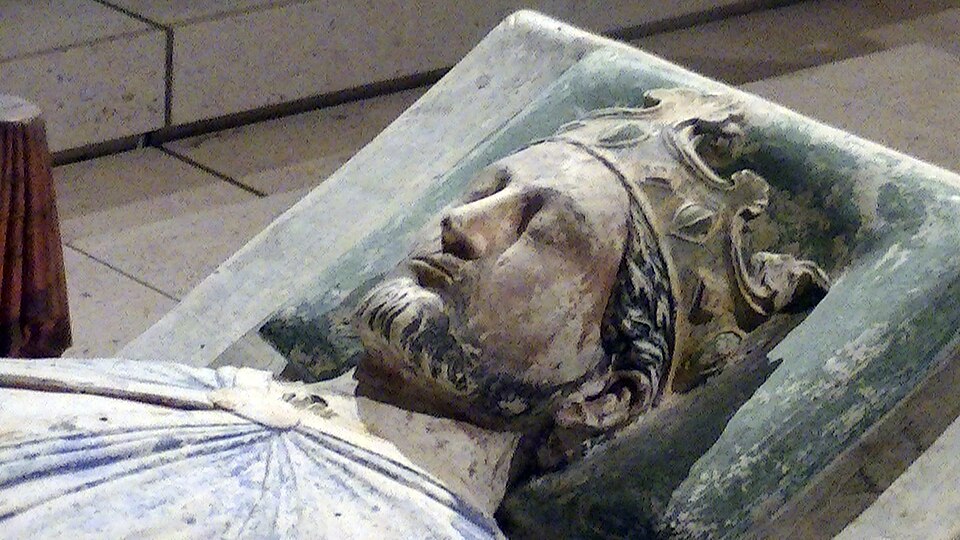
Richard was born on 8 September 1157, at Beaumont Palace in Oxford, the third of five legitimate sons of King Henry II of England and Eleanor of Aquitaine. As a younger son he was not expected to inherit the throne. But his elder brother Henry the Young King died in 1183 after rebelling against their father, and another brother, Geoffrey, died in a jousting accident in Paris in 1186. When Henry II died on 6 July 1189, Richard, his last surviving legitimate son, became King of England.
Described as tall, with hair between red and gold and light eyes, Richard had commanded his own army by age sixteen, putting down rebellions in Poitou against his father. Though born and raised partly in England, he spent most of his adult life in the Duchy of Aquitaine in southwest France, and after becoming king he spent perhaps as little as six months in England during his entire reign. His true domain was the sprawling Angevin Empire stretching across England and half of France.
When news reached Europe in 1187 that Saladin had retaken Jerusalem from the Crusaders, Richard resolved to join the Third Crusade alongside King Philip II of France. Setting out in the summer of 1190, he first seized Sicily, then captured Cyprus on 6 May 1191. On 7 September 1191, at the Battle of Arsuf, Richard defeated Saladin's forces — a victory that, while not destroying the Muslim army, broke its cohesion and lifted Crusader morale considerably.
After the fall of Jaffa in November 1191, the Crusader army pushed inland toward Jerusalem, marching as far as Beit Nuba, just 20 kilometers from the holy city. Morale among the Muslim defenders was so low that the Crusaders' arrival might well have forced a swift surrender. But the weather turned against them: violent storms of rain and hail crippled the army's advance, and the assault stalled.
During the ongoing campaign, Conrad of Montferrat, King of Jerusalem, was assassinated in Tyre on 28 April 1192 by two disguised assailants. One assassin was killed on the spot; the other, captured alive, claimed the plot had been ordered by Richard — though his actual involvement was never confirmed. Jerusalem remained under siege but was never taken. By June 1192 a fresh siege attempt collapsed amid growing distrust between Richard and Philip, with Richard suspecting both the French king and his own brother John of scheming against him.
More from People

Frida Kahlo: Painting Through the Pain
An iron handrail pierced a teenage girl's body on a Mexico City street — and out of that wreckage came one of the most searingly honest artists of the twentieth century.

The Ox-Cart and the Snow: Şerife Bacı's Last Road
Somewhere on a frozen road outside Kastamonu, a young mother pressed her body against a quilt to keep her infant warm through the night. By morning, she had become a legend.

Pompey the Great: The Friendship That Broke Rome
He was called 'the teenage butcher' by his enemies and 'the Great' by his mentor — and the empire he helped build would ultimately be the death of him.

The Third Pole: How Hunt, Hillary and Tenzing Conquered Everest
For decades the world's highest mountain had turned back every climber who dared it — sometimes swallowing them whole. In the spring of 1953, one expedition finally reached the point where the sky simply stopped going up.

Two Rivals Under One Roof: Picasso and Matisse
Long before they were named together as the twin poles of modern art, they were simply two names on the walls of the same small Paris gallery — one already known for wild colour, the other not yet known at all.

Fire and Ice: The Borg–McEnroe Rivalry
One man never raised his voice. The other rarely lowered his. Between them they produced two of the greatest matches tennis has ever seen.