A Beam of Light in a Roman Chapel
A tax collector counts his coins in a dim room — then a shaft of light falls across the table, and a hand points. Nobody knows for certain who it is pointing at.
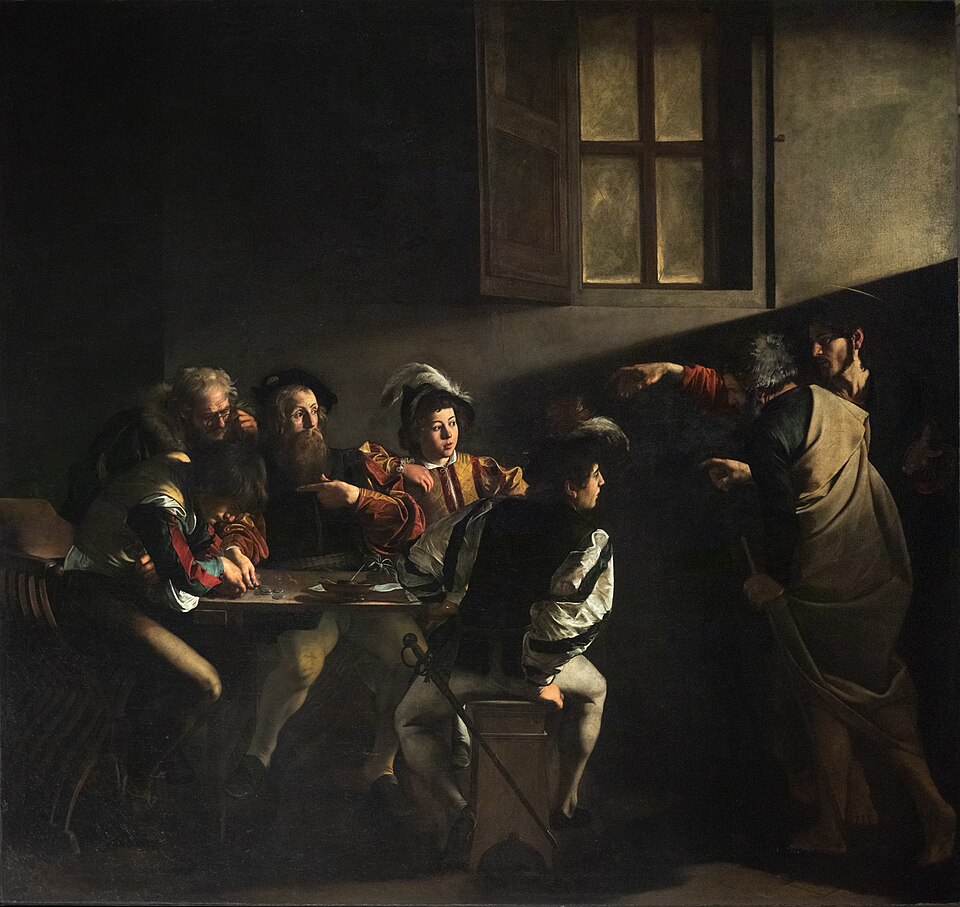
In the last years of the 1590s, a French cardinal's old will finally bore fruit in the heart of Rome. Cardinal Matthieu Cointerel had died more than a decade before, but he had left money and precise instructions for a chapel dedicated to his namesake, Saint Matthew, inside the church of San Luigi dei Francesi. The dome had already been frescoed by Giuseppe Cesari, a fashionable Mannerist painter and, notably, the former employer of a difficult young Lombard artist named Michelangelo Merisi da Caravaggio.
Cesari grew too busy with royal and papal commissions to finish the chapel's side walls. That opening became Caravaggio's chance. Cardinal Francesco Maria del Monte, his patron and the prefect of the Fabbrica of St Peter's, intervened to secure the young painter his first major church commission — and his first painting to contain more than a handful of figures. The contract for the two lateral canvases, The Calling of Saint Matthew and The Martyrdom of Saint Matthew, is dated July 1599, with final payment recorded in July 1600.
Though the Martyrdom was likely begun first, the Calling was reportedly finished first. It now hangs across from its companion. Between the two, at the altar, stands The Inspiration of Saint Matthew, completed in 1602.
The subject comes straight from the Gospel of Matthew: 'Jesus saw a man named Matthew at his seat in the custom house, and said to him, Follow me, and Matthew rose and followed Him.' Caravaggio set the scene not in ancient Judea but in what looks like a contemporary Roman tavern or counting-house. Matthew sits at a table with four other men, coins and account books between them. Christ and Saint Peter have just stepped into the room. Christ's hand is extended, pointing — and a beam of light cuts across the gloom, striking the faces of the men who turn toward him.
Even the identity of Matthew himself has never been fully settled. Most interpreters assume he is the bearded man at the table, pointing to himself as if asking 'Me?' — a reading reinforced by the fact that the same bearded figure clearly plays Matthew in the other two chapel paintings. A more recent theory suggests the bearded man is instead pointing toward the young man at the table's end, head bowed over his coins, as if asking 'Him?' — catching the instant just before that youth lifts his head to see Christ. Some scholars simply call the gesture deliberately ambiguous, a puzzle Caravaggio built into the canvas on purpose.
More from Art

The Painting With No Foreground
A single robed figure stares out at an empty grey sea — and the emptiness itself became a scandal. When it was unveiled in Berlin in 1810, no one knew quite what to do with it.

The Painter Who Chased the Light
For a few purple minutes each evening, an American exile knelt in an English garden and raced the dying sun to paint two little girls lighting lanterns. It took him two years to finish.

When a President Became a God
Look straight up inside the U.S. Capitol dome and you will find George Washington enthroned among the clouds, surrounded by goddesses — the founding father transformed into myth.

Marble Brought Back to Life
A corpse asleep, a wing barely brushing her skin — and marble somehow learns to breathe. This is the moment Antonio Canova dared to carve.

The World Turned Upside Down
Look closely at a sixteenth-century Flemish village and you'll find a man biting a pillar, another carrying daylight in a basket, and a wife slipping a blue cloak over her husband's shoulders. Every gesture is a joke — if you know the language.

The Girl in the Glass Case
She stood two-thirds life size, dressed in a real tutu and human hair — and the critics who saw her in 1881 recoiled as if she were something obscene.