A Sky Full of Empires: Altdorfer's Vision of Issus
A single canvas holds a hundred thousand men, a collapsing empire, and a sky that seems to be ending the world. Why did a German landscape painter choose to relive a battle fought eighteen centuries before his birth?
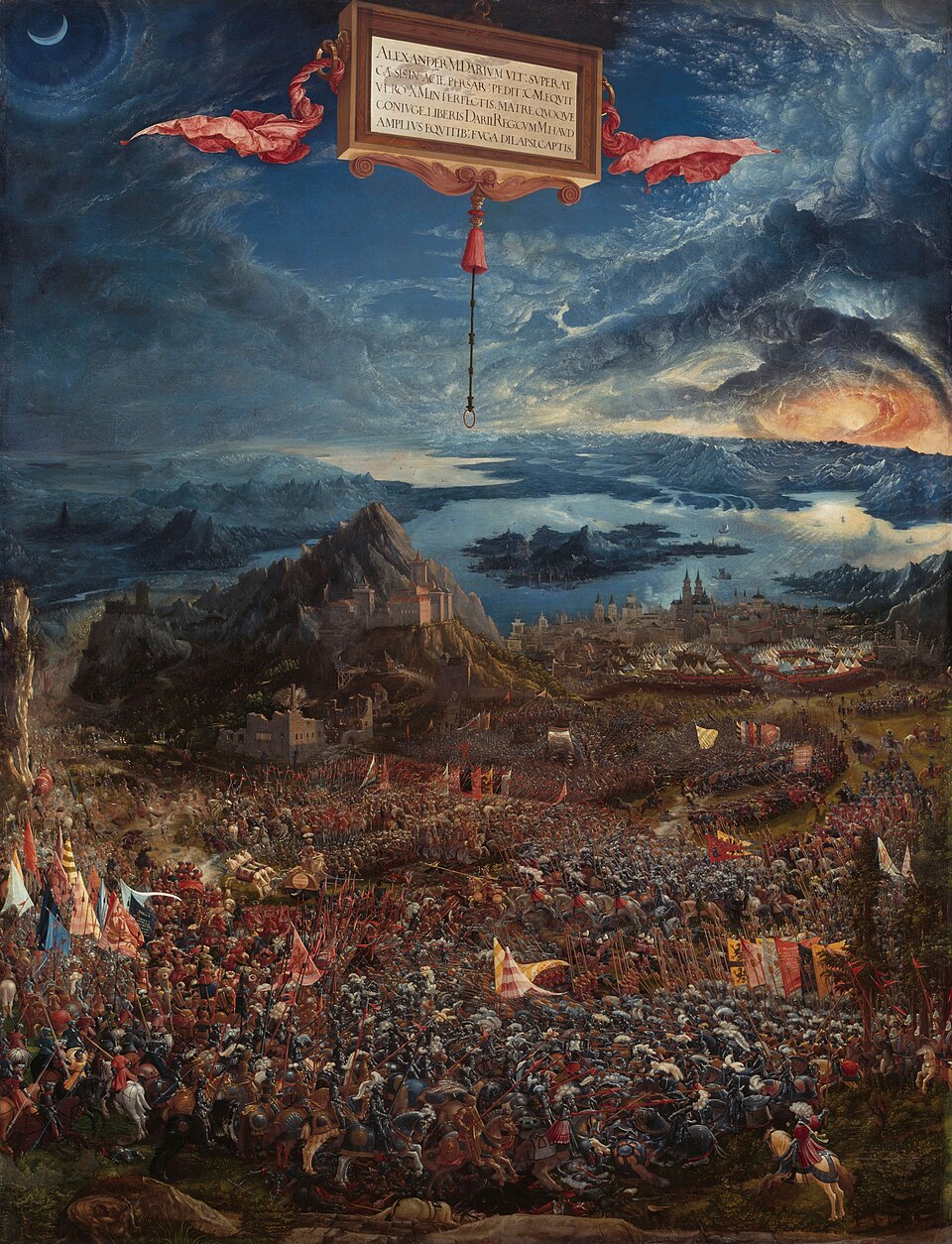
In 1528, Duke William IV of Bavaria commissioned a set of historical paintings to hang in his Munich residence, and among the artists he turned to was Albrecht Altdorfer, a founding figure of the Danube school and a pioneer in treating landscape as a subject worthy of grandeur in its own right. The result, completed in 1529, was The Battle of Alexander at Issus — an oil painting now considered Altdorfer's masterpiece and one of the most celebrated examples of the 'world landscape' style, in which the natural world dwarfs and frames human affairs rather than serving as mere backdrop.
The subject was the Battle of Issus, fought in 333 BC between Alexander the Great, King of Macedon, and Darius III of Persia. Alexander had launched his campaign against the Persian Empire in 334 BC, having already secured Greece and consolidated his forces of around 40,000 men. Early Persian resistance was weak: at the Battle of the Granicus that May, Darius' forces were easily defeated, and over the following year Alexander swept through western and coastal Asia Minor, forcing local satrapies to submit one by one.
As Alexander pushed into Cilicia through the Cilician Gates in October, illness delayed him at Tarsus. Darius, meanwhile, assembled a vast army — ancient sources suggest anywhere from 100,000 to grossly exaggerated figures beyond 600,000 — and marched it over the Amanus Mountains. By early November, the two armies had passed each other unknowingly on opposite sides of the range, leaving Darius unexpectedly positioned behind Alexander, cutting off his retreat and his supply lines at Issus. Only after encamping at the seaport of Myriandrus did Alexander learn of this reversal. He retraced his path to the Pinarus River, where he found Darius' army arrayed along the northern bank.
Darius fortified the riverbank with stakes and placed his elite vanguard — Greek mercenaries and Persian royal guard — at the center, with himself among them so he could direct the battle. Light infantry watched the foothills, anticipating a Macedonian approach from that side, while cavalry under Nabarsanes held the Persian right along the coast. Alexander answered by dispatching light infantry, archers, and cavalry to clear the foothills, a maneuver that succeeded in driving off or killing the Persian defenders there.
When the armies closed within missile range, Alexander personally led the Companion cavalry in a charge against the Persian left, cutting deeply into their ranks. On the Macedonian left, Parmenion's forces were pushed back by Nabarsanes' larger cavalry contingent, even as the Macedonian phalanx crossed the river to engage the Greek mercenaries fronting Darius' position. Sensing the risk of a widening gap in his own lines, Alexander redirected the Companions to strike the Persian center from the flank. Unable to withstand this pressure, the Persian vanguard fell back from the river, freeing the Macedonian phalanx to advance and relieving Parmenion's beleaguered wing.
More from Art

The Painting With No Foreground
A single robed figure stares out at an empty grey sea — and the emptiness itself became a scandal. When it was unveiled in Berlin in 1810, no one knew quite what to do with it.

The Painter Who Chased the Light
For a few purple minutes each evening, an American exile knelt in an English garden and raced the dying sun to paint two little girls lighting lanterns. It took him two years to finish.

When a President Became a God
Look straight up inside the U.S. Capitol dome and you will find George Washington enthroned among the clouds, surrounded by goddesses — the founding father transformed into myth.

Marble Brought Back to Life
A corpse asleep, a wing barely brushing her skin — and marble somehow learns to breathe. This is the moment Antonio Canova dared to carve.

The World Turned Upside Down
Look closely at a sixteenth-century Flemish village and you'll find a man biting a pillar, another carrying daylight in a basket, and a wife slipping a blue cloak over her husband's shoulders. Every gesture is a joke — if you know the language.

The Girl in the Glass Case
She stood two-thirds life size, dressed in a real tutu and human hair — and the critics who saw her in 1881 recoiled as if she were something obscene.