Amaterasu: The Sun Who Hid in a Cave
When the world's brightest goddess vanished into darkness, it took every trick the gods could muster to coax her back into the sky.
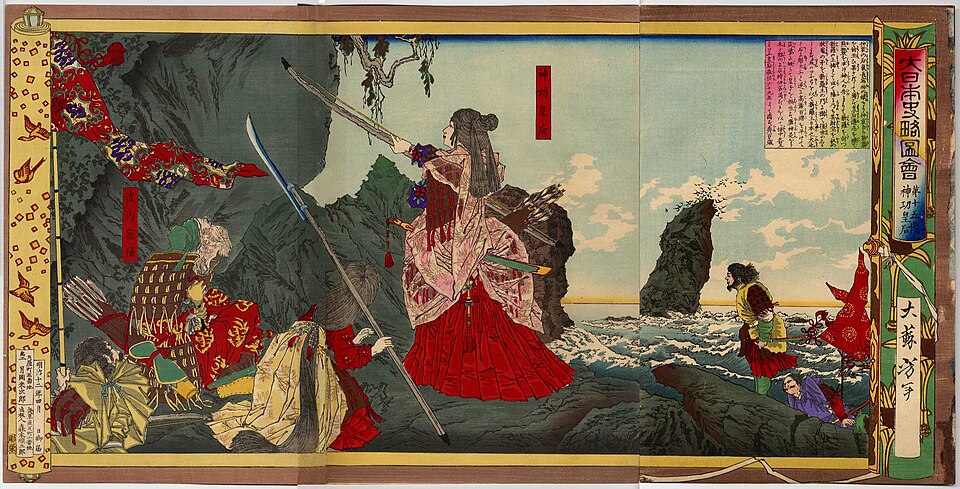
In the oldest Japanese chronicles, the Kojiki (c. 712 CE) and the Nihon Shoki (720 CE), Amaterasu Ōmikami is named as the sun goddess and often considered the chief deity of the Shinto pantheon. She is described as the ruler, or one of the rulers, of the heavenly realm Takamagahara, and as the mythical ancestress of the Imperial House of Japan through her grandson Ninigi no Mikoto.
Her birth is tied to an act of purification. According to the Kojiki, the god Izanagi had journeyed to Yomi, the underworld, in a failed attempt to rescue his dead wife Izanami. Upon his return, he bathed in a river near Tachibana in Himuka to cleanse himself. From this ritual bathing came three of his most important children, known as the Three Precious Children: Amaterasu, born from his left eye; the moon deity Tsukuyomi; and the storm god Susanoo, her impetuous younger brother.
The name Amaterasu itself is not a proper name in the ordinary sense but an attributive phrase meaning 'shining in heaven,' combined with the honorific Ōmikami, 'great august deity.' Other titles applied to her include Ōhirume-no-Muchi, sometimes read as 'great woman of the sun,' and Amateru Kami, a plainer form of the same epithet. Scholars have debated the exact nuance of these names for centuries, but all point toward the same core image: a deity whose very identity is light.
The most famous episode in her mythology concerns not her birth but her disappearance. Angered by the behavior of her brother Susanoo, Amaterasu withdrew into a cave, plunging the world into darkness. This single act — a goddess retreating from her siblings' conflict rather than confronting it directly — became one of the most enduring images in Japanese myth: the sun itself choosing to hide, and the world losing its light because of it.
The gods, faced with a world without sunlight, had to find a way to lure her out again. Her return to the sky restored order and light to the world, reaffirming her role as the ruler of the heavens and the source of life-giving illumination for all things below.
More from Mythology

The Doctor Who Sang a Nation Into Being
A country doctor rode into the forests of Karelia armed with nothing but a notebook — and rode out with the soul of a nation.

The Boat That Carried the Sun
Every sunset, the ancient Egyptians believed, the sun climbed into a boat and sailed straight into the realm of the dead — only to fight a monstrous serpent before dawn could return.

The Wild Man of the Snows
At 21,000 feet, a colonel found tracks in the snow that he blamed on a wolf — but his guides knew better, and gave the world a name that would echo for a century.

The Knight Who Went Mad for Love: Orlando Furioso
A hero so devoted to duty he was Charlemagne's greatest paladin loses his mind—not to a sword wound, but to heartbreak. To cure him, a friend must ride a flying horse to the Moon.

The Book That Turned the World Into Myth
A poet condemned to exile spent his final years in Rome finishing a poem that would outlive empires—a poem about nothing standing still, not gods, not lovers, not even the shape of a man.

Paradise Lost: Milton's Rebel Angel
A blind poet, dictating verses in the dark, dared to explain the ways of God to men — and in doing so, made Hell's ruler unforgettable.