Bellerophon and Pegasus: The Rider of the Winged Horse
A young man exiled for a killing is handed a death sentence disguised as a mission — and answers it by taming a horse born of a monster's blood.
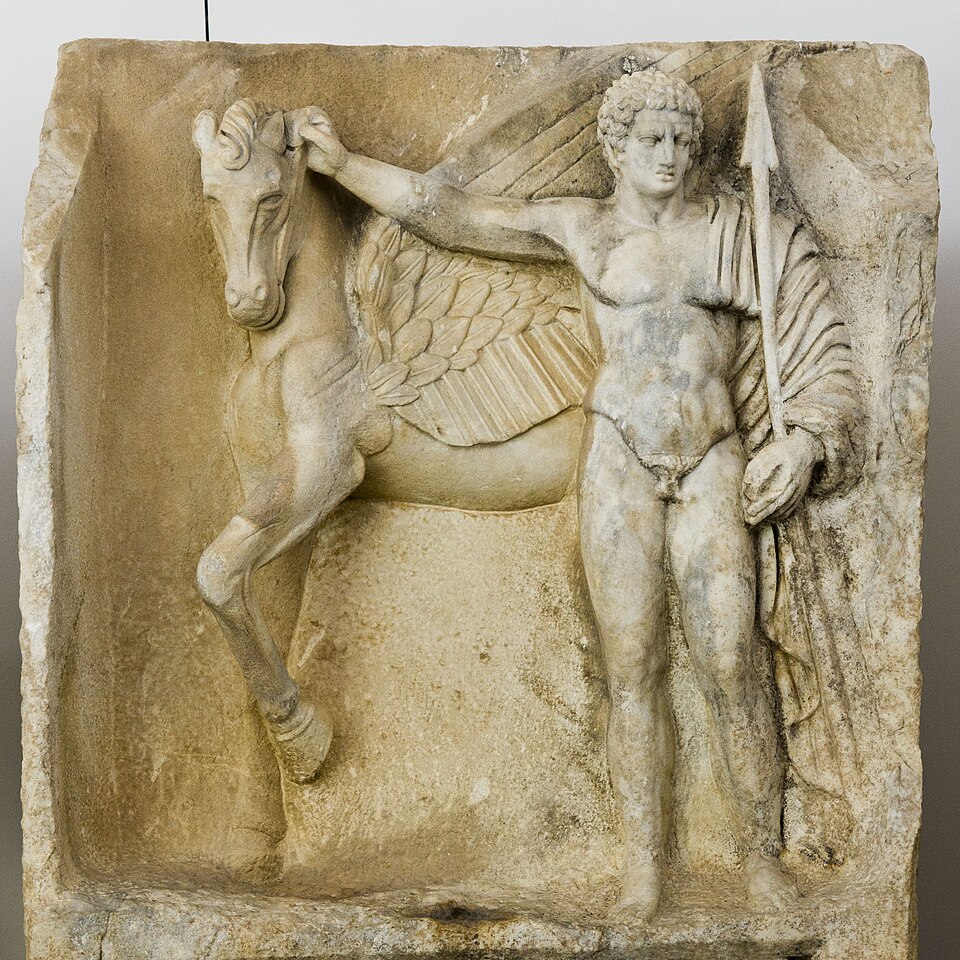
Bellerophon's story begins with blood spilled in exile-worthy violence, though the tellings disagree on its shape. In one narrative he killed his own brother, named variously as Deliades, Peiren, or Alcimenes. In a separate, more precise account, he accidentally killed a Corinthian citizen named Belleros while practicing knife-throwing with friends — and it was this second version that supposedly explains the change of his name from Hipponous, 'horse-knower,' to Bellerophon, 'slayer of Belleros.' Whichever the cause, the killing forced him into exile, a familiar opening for a Greek hero: banishment as the doorway to legend.
Bellerophon was said to be the son of Poseidon and the mortal woman Eurynome, raised as a foster son by Glaucus, king of Corinth and grandson of Sisyphus. He fled to Tiryns, in the Argolid, where King Proetus cleansed him of his crime according to the customs of hospitality. But Proetus's wife — called Anteia or Stheneboea in different sources — tried to seduce the young exile. When Bellerophon refused her, she accused him instead, claiming he had tried to force himself on her. Proetus, unwilling to kill a guest under his own roof for fear of divine punishment, chose a subtler cruelty: he sent Bellerophon to Lycia, to King Iobates — who was Proetus's own father-in-law — carrying a sealed tablet that asked Iobates to destroy the bearer.
Iobates feasted with his guest for nine days before reading the message. Once he did, he too balked at murdering a man under his protection. Instead, he devised a task he assumed would kill Bellerophon just as surely: slay the Chimera, a monster terrorizing nearby Caria, with the body of a goat, the head of a lion, and the tail of a serpent, breathing blasts of fire.
On the road to this seemingly impossible fight, Bellerophon met the Corinthian seer Polyeidos, who told him that to defeat the Chimera he would need the help of Pegasus, the untamed winged horse. Polyeidos instructed him to sleep in the temple of Athena. There, in a dream, the goddess left him a golden bridle, telling him to take the charm and show it to his father — Poseidon, the Tamer — while sacrificing a white bull. Waking with the bridle in hand, Bellerophon understood: he must approach Pegasus at the well where the horse came to drink.
With Athena's charmed bridle, he tamed the horse that had sprung, along with his brother Chrysaor, from the neck of Medusa at the moment of her death by Poseidon's seed. Mounted on Pegasus, Bellerophon flew above the Chimera and killed it — one of the great monster-slayings of Greek myth, ranking him, ancient sources say, alongside Cadmus and Perseus as heroes who came before Heracles.
More from Mythology

The Doctor Who Sang a Nation Into Being
A country doctor rode into the forests of Karelia armed with nothing but a notebook — and rode out with the soul of a nation.

The Boat That Carried the Sun
Every sunset, the ancient Egyptians believed, the sun climbed into a boat and sailed straight into the realm of the dead — only to fight a monstrous serpent before dawn could return.

The Wild Man of the Snows
At 21,000 feet, a colonel found tracks in the snow that he blamed on a wolf — but his guides knew better, and gave the world a name that would echo for a century.

The Knight Who Went Mad for Love: Orlando Furioso
A hero so devoted to duty he was Charlemagne's greatest paladin loses his mind—not to a sword wound, but to heartbreak. To cure him, a friend must ride a flying horse to the Moon.

The Book That Turned the World Into Myth
A poet condemned to exile spent his final years in Rome finishing a poem that would outlive empires—a poem about nothing standing still, not gods, not lovers, not even the shape of a man.

Paradise Lost: Milton's Rebel Angel
A blind poet, dictating verses in the dark, dared to explain the ways of God to men — and in doing so, made Hell's ruler unforgettable.