Blood and Bronze: The Painting That Shook an Empire
A canvas nearly eight meters wide, dragged through Rome, Madrid, Paris, a Spanish civil war and a dictator's storerooms — and it began as a scene of dead gladiators being stripped of their armor.
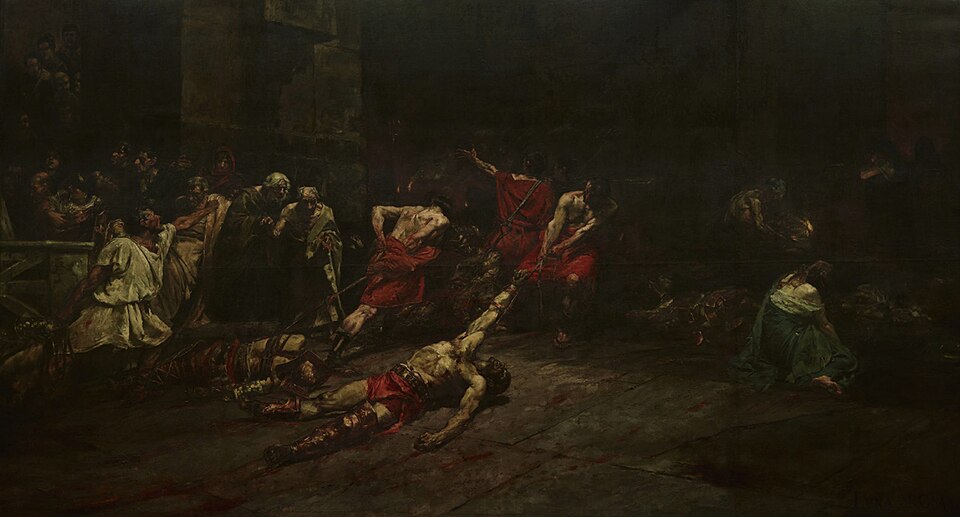
In 1884, a Filipino painter named Juan Luna unveiled a canvas he had labored over for eight months: the Spoliarium, a monumental depiction of a Roman circus scene in which dead gladiators are dragged away and stripped of their weapons and garments. He submitted it to the Exposición Nacional de Bellas Artes in Madrid, where, against painters from the colonizing nation itself, it won the first gold medal out of three awarded. Weeks later it traveled to Rome, exhibited alongside other works of the Spanish Academy.
At a banquet in Madrid celebrating Luna's win, alongside fellow Filipino painter Félix Resurrección Hidalgo, who took silver, José Rizal rose to speak. He called the victories 'fresh proof of racial equality,' describing the painting's 'bloody carcasses of slave gladiators being dragged away from the arena where they had entertained their Roman oppressors with their lives.' Rizal saw in the canvas something larger than art: 'humanity in severe ordeal, humanity unredeemed, reason and idealism in open struggle with prejudice, fanaticism and injustice.'
The painting stirred something in Rizal beyond admiration. He had been turning over the idea of a book since early that year, and the imagery of the Spoliarium — 'the tumult of the crowd, the shouts of slaves, the metallic clatter of dead men's armor, the sobs of orphans, the murmured prayers' — fed directly into what would become his novel Noli Me Tangere, sometimes called the Latin echo of the Spoliarium. Historian Ambeth Ocampo later wrote that Luna and Hidalgo's Madrid triumph proved to the world that Filipinos, dismissed as a 'barbarian race,' could paint better than the Spaniards who colonized them.
The painting's own journey proved as turbulent as the scene it depicted. In 1886, after touring Rome, Madrid, and Paris, it was purchased by the provincial government of Barcelona for 20,000 pesetas. In 1887 it moved to the Museo del Arte Moderno in Barcelona, where it sat in storage for decades — until the museum was burned and looted during the Spanish Civil War in 1937, damaging the canvas.
Under orders from Spanish dictator Francisco Franco, the wounded painting was shipped to Madrid for restoration, where it remained for eighteen years. It was only in the 1950s, after persistent calls from Filipinos and sympathetic Spaniards for its return, that Franco ordered the restoration finished and the painting donated to the Philippines. The work was completed in late 1957, and in January 1958 the canvas was formally handed to Philippine ambassador Manuel Nieto Sr. as a gift from the Spanish government.
More from Art

The Painting With No Foreground
A single robed figure stares out at an empty grey sea — and the emptiness itself became a scandal. When it was unveiled in Berlin in 1810, no one knew quite what to do with it.

The Painter Who Chased the Light
For a few purple minutes each evening, an American exile knelt in an English garden and raced the dying sun to paint two little girls lighting lanterns. It took him two years to finish.

When a President Became a God
Look straight up inside the U.S. Capitol dome and you will find George Washington enthroned among the clouds, surrounded by goddesses — the founding father transformed into myth.

Marble Brought Back to Life
A corpse asleep, a wing barely brushing her skin — and marble somehow learns to breathe. This is the moment Antonio Canova dared to carve.

The World Turned Upside Down
Look closely at a sixteenth-century Flemish village and you'll find a man biting a pillar, another carrying daylight in a basket, and a wife slipping a blue cloak over her husband's shoulders. Every gesture is a joke — if you know the language.

The Girl in the Glass Case
She stood two-thirds life size, dressed in a real tutu and human hair — and the critics who saw her in 1881 recoiled as if she were something obscene.