Discobolus: The Instant the Ancients Froze in Bronze
A young athlete bends into a torsion no modern coach would teach — because Myron wasn't capturing an athlete, he was capturing motion itself.
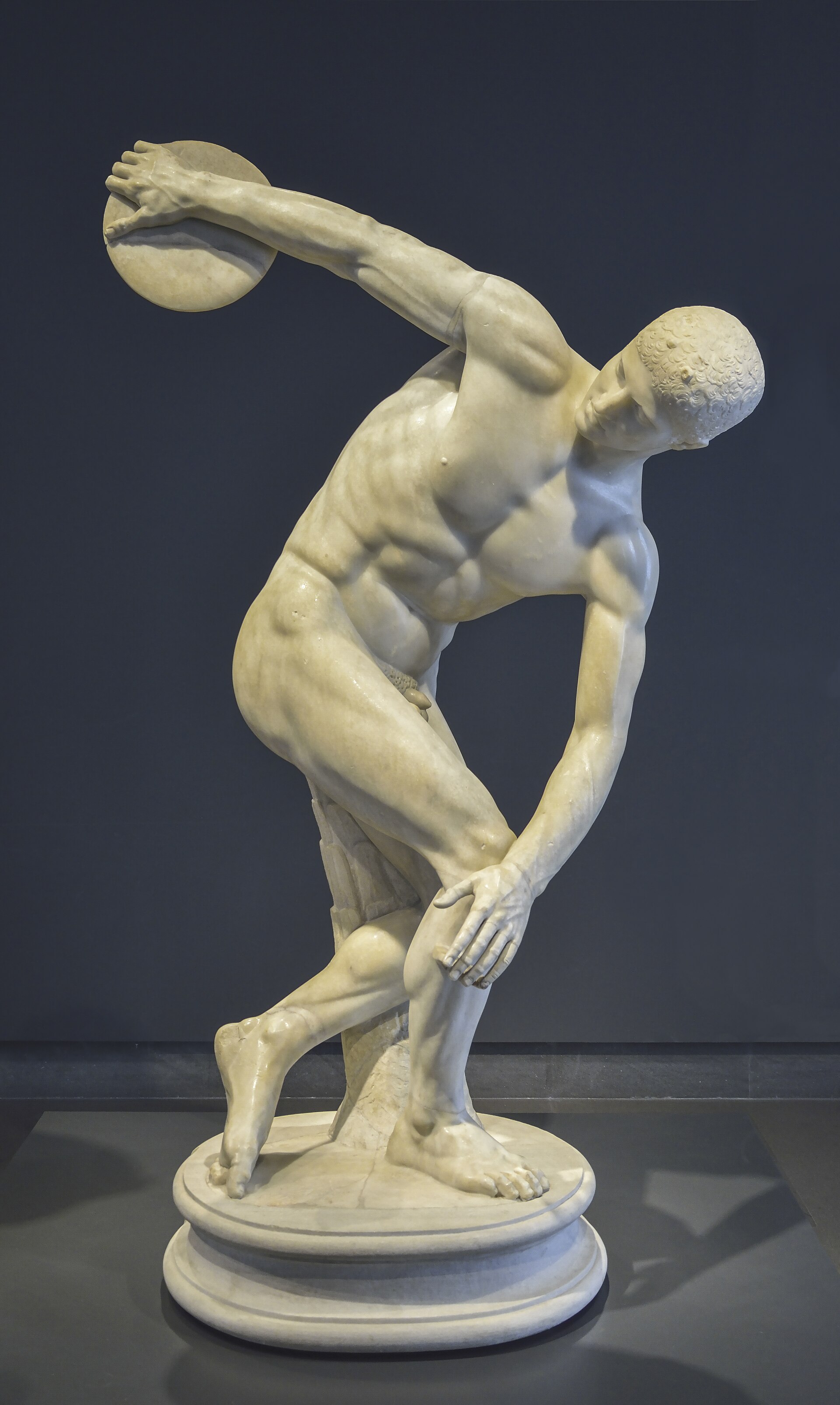
Somewhere in Greece, around 460 to 450 BC, a bronze figure stood twisted at the waist, one arm swept far back with a discus, head turned toward the hand that held it. The sculptor was Myron, and the work would become one of the most recognized images of the ancient world — though the bronze itself is long gone, lost to time, known to us only through the echo of Roman copies made centuries later.
The pose itself is strange to modern eyes. Athletes today do not throw a discus this way; by contemporary standards, the stance is inefficient, even unnatural. But Myron was not documenting technique. He was chasing something harder: the moment of maximum tension just before release, the instant an athlete's whole body coils like a spring about to snap forward. Kenneth Clark once observed that Myron created 'the enduring pattern of athletic energy,' seizing an action so fleeting that people still debate whether it's physically possible — and giving it the permanence of a carved gem.
What makes the figure remarkable is the gap between effort and expression. The limbs strain outward, the torso twists in contrapposto, weight shifting subtly from one leg to the other — yet the face shows only the faintest concentration. There is no grimace, no visible muscular struggle. This was Myron's signature: symmetria, the meticulous proportioning of every muscle and sinew, married to a kind of serene restraint. The result feels less like a snapshot of strain and more like an idealized harmony between body and motion.
The statue emerged from a Greece that saw no separation between athletic and artistic achievement. The ancient Olympics were religious as much as sporting events, and Myron's work reflects the philosophy of kalokagathia — the belief that physical beauty and moral virtue were intertwined, that a well-trained body and a well-ordered mind were two expressions of the same ideal.
For centuries, the Discobolus survived only in words. Lucian of Samosata described it in his dialogue Philopseudes, sketching a figure 'bent over into the throwing position, with his head turned back to the hand that holds the discus' — a description so precise that later scholars would use it to distinguish Myron's true Discobolus from other statues, like the standing Discophorus, which had wrongly worn the name Discobolus in the 17th and 18th centuries until Ennio Quirino Visconti sorted out the confusion.
More from Art

The Painting With No Foreground
A single robed figure stares out at an empty grey sea — and the emptiness itself became a scandal. When it was unveiled in Berlin in 1810, no one knew quite what to do with it.

The Painter Who Chased the Light
For a few purple minutes each evening, an American exile knelt in an English garden and raced the dying sun to paint two little girls lighting lanterns. It took him two years to finish.

When a President Became a God
Look straight up inside the U.S. Capitol dome and you will find George Washington enthroned among the clouds, surrounded by goddesses — the founding father transformed into myth.

Marble Brought Back to Life
A corpse asleep, a wing barely brushing her skin — and marble somehow learns to breathe. This is the moment Antonio Canova dared to carve.

The World Turned Upside Down
Look closely at a sixteenth-century Flemish village and you'll find a man biting a pillar, another carrying daylight in a basket, and a wife slipping a blue cloak over her husband's shoulders. Every gesture is a joke — if you know the language.

The Girl in the Glass Case
She stood two-thirds life size, dressed in a real tutu and human hair — and the critics who saw her in 1881 recoiled as if she were something obscene.