Fifty Faces of Marilyn
A month after the world's most photographed woman died, an ex-illustrator from Pittsburgh turned her face into an assembly line — and made her immortal twice over.
In August 1962, Andy Warhol sat in his home studio at 1342 Lexington Avenue in New York, experimenting with a new technique. He had just begun silkscreening — a process that let him blow up a photograph, transfer it in glue onto silk, and roll ink through it, producing the same image again and again, each time slightly, chancily different. His first attempts had been heads of Troy Donahue and Warren Beatty. Then, that same month, Marilyn Monroe died.
Monroe had died on August 4, 1962, from a barbiturate overdose, at age 36. She had risen through Twentieth Century-Fox to become one of the most recognizable stars in Hollywood, appearing in The Asphalt Jungle, All About Eve, Gentlemen Prefer Blondes, Niagara, and The Seven Year Itch — yet she had spent much of her career fighting the studio's insistence on casting her as a 'dumb blonde.' Warhol, who had grown up escaping a working-class Pittsburgh childhood through movie magazines and autograph collecting, was struck by her death. He got the idea, as he later wrote, to make screens of 'her beautiful face — the first Marilyns.'
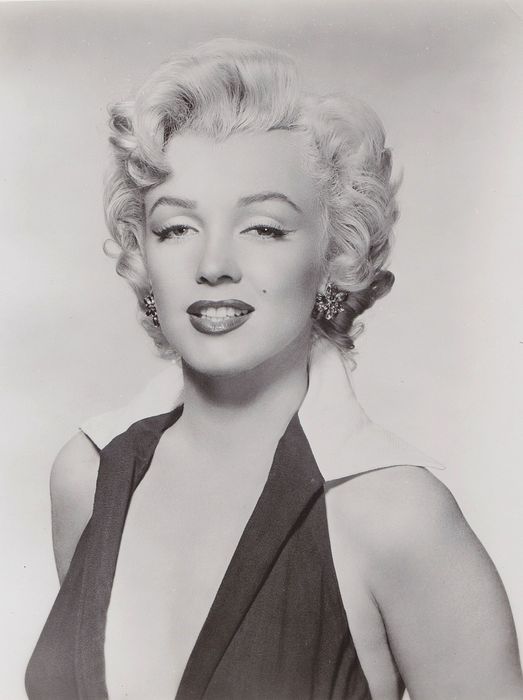
He based the image on a publicity still from the 1953 film Niagara, photographed by Gene Kornman. Using this single photograph, he silkscreened fifty repeated impressions across two adjoining canvases: twenty-five in bright, off-register color on one side, twenty-five in fading, degraded black-and-white on the other, each one blurring further than the last, like a newspaper photo reproduced one too many times.
Warhol had originally thought of the two canvases as separate works. That changed during a studio visit from art director and collector Emily Hall Tremaine and her husband Burton Tremaine. At the time, Warhol was still an emerging artist without gallery representation, selling directly out of his studio. Tremaine later recalled that Warhol first showed them the black Marilyns, and only several pictures later did the colored one appear. She suggested the two be presented together as a diptych. Warhol's reply, by her account, was simply: 'gee whiz yes.' He brought the black canvas back and stood it beside the colored one, and the group saw, in her words, that they had achieved 'a very complex and moving statement about Marilyn.'
The Tremaines bought both canvases on the spot, and from that day the two halves were never separated again. Around the same time, Warhol produced a cluster of related works using the same Niagara photograph — Marilyn x 100, Twenty-Five Colored Marilyns, Marilyn Monroe Twenty Times, and The Six Marilyns — the beginning of a body of Marilyn imagery he would keep returning to through 1967, including Gold Marilyn Monroe, the Flavor Marilyns, and the Shot Marilyns.
More from Art

The Painting With No Foreground
A single robed figure stares out at an empty grey sea — and the emptiness itself became a scandal. When it was unveiled in Berlin in 1810, no one knew quite what to do with it.

The Painter Who Chased the Light
For a few purple minutes each evening, an American exile knelt in an English garden and raced the dying sun to paint two little girls lighting lanterns. It took him two years to finish.

When a President Became a God
Look straight up inside the U.S. Capitol dome and you will find George Washington enthroned among the clouds, surrounded by goddesses — the founding father transformed into myth.

Marble Brought Back to Life
A corpse asleep, a wing barely brushing her skin — and marble somehow learns to breathe. This is the moment Antonio Canova dared to carve.

The World Turned Upside Down
Look closely at a sixteenth-century Flemish village and you'll find a man biting a pillar, another carrying daylight in a basket, and a wife slipping a blue cloak over her husband's shoulders. Every gesture is a joke — if you know the language.

The Girl in the Glass Case
She stood two-thirds life size, dressed in a real tutu and human hair — and the critics who saw her in 1881 recoiled as if she were something obscene.