Karacaoğlan: The Wandering Poet of Love and Mountains
No one knows exactly who he was, or if he was even one man — yet for centuries, an entire people have sung his verses as their own.
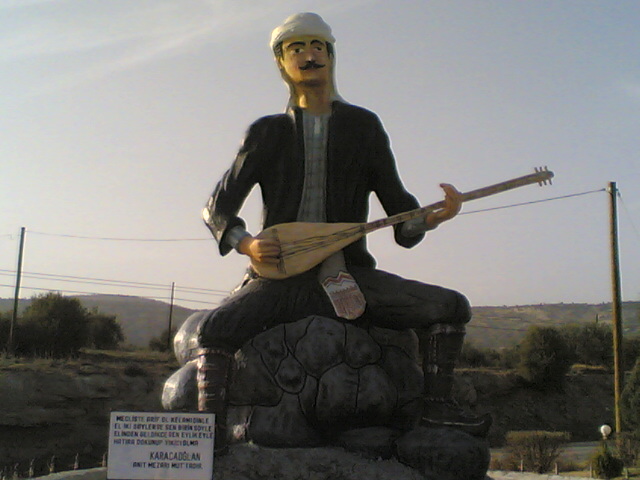
Somewhere in the Toros mountains, sometime around 1606, a boy was born who would leave behind almost nothing certain — no grave date, no fixed hometown, not even a settled name. He is remembered as Karacaoğlan, a pseudonym; scholars believe his real name may have been Simayil, İsmail, Halil, or Hasan. According to Hoca Hamdi Efendi of Akşehir, one account of Karacaoğlan — a Türkmen boy born in Varsak, later called Hasan in this telling — was orphaned young and fled to Maraş after his father's death, wandering Anatolia and settling among Turkmen tribes for the rest of his life.
Competing traditions claim him for their own soil. The Barak tribe of Gaziantep and the Çavuşlu tribe of Kilis both insist he belongs to them. Some say he was born near Mount Kozan, in a village called Varsak; others place his origins in modern Osmaniye or Kahramanmaraş. Most agree he was born near Çukurova and spent his life among the nomadic Turkmen communities of that mountainous southern region, though his death, believed to have occurred around 1679, is placed by many in Kahramanmaraş.
His poetry captured this world in plain, vivid language — nature, love, longing for home, and death, rendered without ornament, direct and simple, as was typical of Anatolian folk poetry of his era. In his verses he mentions taking two of his sisters all the way to Bursa or Istanbul, one of the few personal details that survive in his own words.
Modern researchers have complicated the picture further. They argue that 'Karacaoğlan' was never a single individual but a shared Oghuz tradition, a name attached to different folk poets across centuries and regions. As early as the 16th century, the Ottoman writer Gelibolulu Mustafa Âli noted that inferior poets attributed their own verses to Karacaoğlan, and a 1582 festival account records that the people of Istanbul entertained themselves with 'Karacaoğlan songs' — proof the name was already a beloved folk brand generations before the Çukurova poet most people know today.
Scholar Dr. Müjgan Cunbur identified multiple Karacaoğlans spanning the 15th through 19th centuries. One, called the Rumelian or 'First Karacaoğlan,' is said to have been a Janissary and Bektaşi from the 15th or 16th century, his real name given as İsmail, a native of Belgrade — a figure documented by the researcher Wilhelm Radloff through a Crimean tale of two lovers united after trials set by fairies. Others include a Silifke-Mersin poet nicknamed 'Little Karacaoğlan,' a 19th-century poet from Yozgat, and a figure known as İbrahim of Kadirli-Osmaniye.
More from Mythology

The Doctor Who Sang a Nation Into Being
A country doctor rode into the forests of Karelia armed with nothing but a notebook — and rode out with the soul of a nation.

The Boat That Carried the Sun
Every sunset, the ancient Egyptians believed, the sun climbed into a boat and sailed straight into the realm of the dead — only to fight a monstrous serpent before dawn could return.

The Wild Man of the Snows
At 21,000 feet, a colonel found tracks in the snow that he blamed on a wolf — but his guides knew better, and gave the world a name that would echo for a century.

The Knight Who Went Mad for Love: Orlando Furioso
A hero so devoted to duty he was Charlemagne's greatest paladin loses his mind—not to a sword wound, but to heartbreak. To cure him, a friend must ride a flying horse to the Moon.

The Book That Turned the World Into Myth
A poet condemned to exile spent his final years in Rome finishing a poem that would outlive empires—a poem about nothing standing still, not gods, not lovers, not even the shape of a man.

Paradise Lost: Milton's Rebel Angel
A blind poet, dictating verses in the dark, dared to explain the ways of God to men — and in doing so, made Hell's ruler unforgettable.