La Araucana: The Soldier Who Wrote an Epic in the Smoke of Battle
On scraps of paper, between skirmishes, a Spanish soldier scribbled verses about the very war he was fighting — and unwittingly gave a distant kingdom its founding epic.
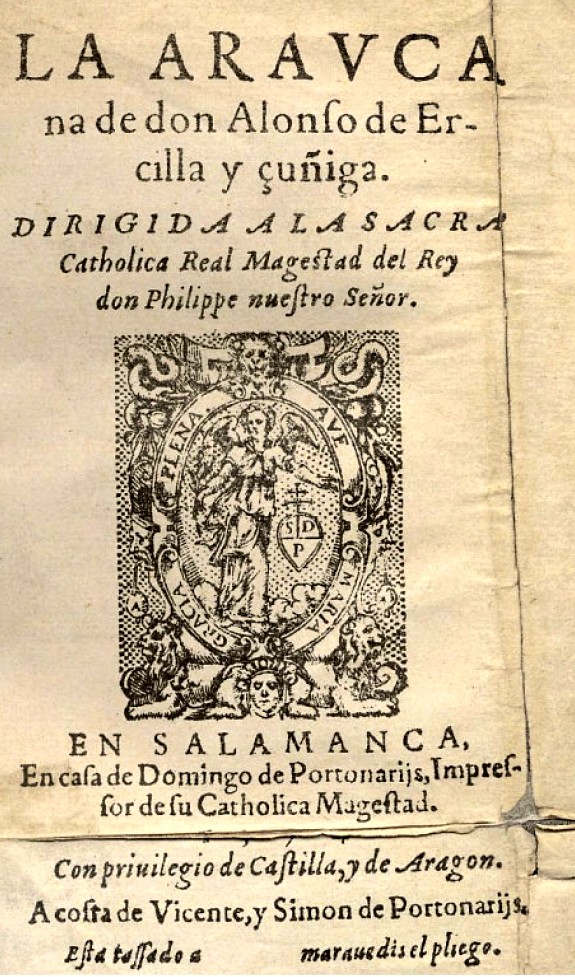
In the lulls between clashes of the Arauco War, a young nobleman named Alonso de Ercilla crouched over scraps of paper and wrote poetry. He was not composing from a study or a court, but from the field itself, jotting versified octaves about the fighting he had just survived and his own part in it. Those fragments, gathered and expanded over years, would become La Araucana, one of the most celebrated works of the Spanish Golden Age.
Ercilla had been born into a noble family in Madrid and had served in the household of Prince Philip, later King Philip II of Spain. Rather than remain at court, he requested and received an appointment to a military expedition sent to subdue the Araucanians of southern Chile. He distinguished himself in the campaign that followed, though his time there was not without conflict: after quarrelling with a comrade, he was condemned to death in 1558 by his own general, García Hurtado de Mendoza. The sentence was commuted to imprisonment, and Ercilla was soon released, going on to fight at the Battle of Quipeo on 14 December 1558. He was later exiled to Peru before returning to Spain in 1562.
Out of this lived experience came a poem of 37 cantos, published in three parts: the first in 1569, the second in 1578 alongside the first, and the third in 1589 with both earlier sections. Ercilla wrote in octava real, the demanding eight-line Italian stanza of eleven-syllable verses bound by a tight abababcc rhyme scheme — a form only recently adapted into Castilian and mastered by few poets of the era.
The poem recounts the early phase of the Arauco War, the Spanish attempt to conquer southern Chile, a conflict that would shape the country's economics, politics, and social life for centuries. Ercilla placed this lesser-known campaign at the center of his epic precisely because he had lived it himself, giving the work an immediacy rare in Renaissance literature: the narrator is a participant in the events he describes, a new development for Spanish letters at the time.
What made La Araucana extraordinary was not just its firsthand authenticity but its literary ambition. Ercilla wove in fantastical elements reminiscent of medieval chivalric romance, drawing on classical sources such as Virgil and Lucan and Italian Renaissance poets like Ludovico Ariosto and Torquato Tasso. He transformed the Araucanian people into figures worthy of ancient Greek or Roman heroism — a common practice of his time, but one that gave the defeated indigenous fighters unusual dignity. Caupolicán, the Araucanian warrior and chieftain, emerges as the poem's true protagonist, a noble and brave figure lacking only, in Ercilla's Christian framework, the true faith.what gives the poem grandeur is this exaltation of the vanquished, written by one of the victors.the poet-soldier, Ercilla emerges as its true hero.the appeal to the 'noble savage,' an idea rooted in classical authors and revived in the Renaissance, would echo for two centuries afterward across European literature.
More from Mythology

The Doctor Who Sang a Nation Into Being
A country doctor rode into the forests of Karelia armed with nothing but a notebook — and rode out with the soul of a nation.

The Boat That Carried the Sun
Every sunset, the ancient Egyptians believed, the sun climbed into a boat and sailed straight into the realm of the dead — only to fight a monstrous serpent before dawn could return.

The Wild Man of the Snows
At 21,000 feet, a colonel found tracks in the snow that he blamed on a wolf — but his guides knew better, and gave the world a name that would echo for a century.

The Knight Who Went Mad for Love: Orlando Furioso
A hero so devoted to duty he was Charlemagne's greatest paladin loses his mind—not to a sword wound, but to heartbreak. To cure him, a friend must ride a flying horse to the Moon.

The Book That Turned the World Into Myth
A poet condemned to exile spent his final years in Rome finishing a poem that would outlive empires—a poem about nothing standing still, not gods, not lovers, not even the shape of a man.

Paradise Lost: Milton's Rebel Angel
A blind poet, dictating verses in the dark, dared to explain the ways of God to men — and in doing so, made Hell's ruler unforgettable.