Loki: The God Who Would Not Be Bound
He could become a mare, a fly, an old woman — and still could not escape the fate he himself helped set in motion. This is the story of the trickster who broke a god's world, and paid for it in a cave beneath the earth.
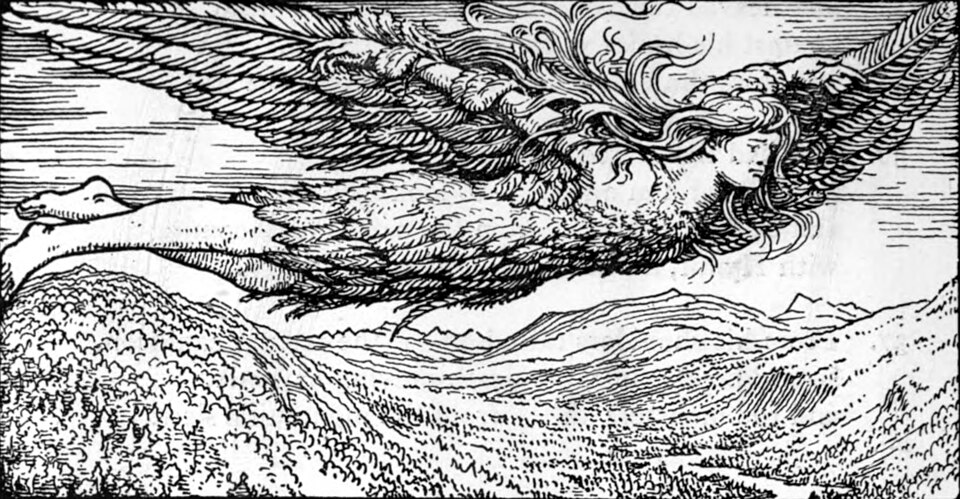
In the sagas of the Norse gods, Loki is never quite what he seems. Son of the jötunn Fárbauti and the goddess Laufey, brother to Helblindi and Býleistr, he belongs to neither camp fully — jötunn by blood, Æsir by adoption, and trickster by nature. He is married to Sigyn, with whom he has two sons, Narfi (also called Nari) and Váli. But his family sprawls further and stranger: with the jötunn Angrboða he fathers three beings who will shape the end of the world — Hel, ruler of the dead; the wolf Fenrir; and the world-serpent Jörmungandr.
Loki's strangeness is not only in his children but in his own body. He is a shapeshifter, appearing across the old sources as a salmon, a mare, a fly, and possibly as an old woman named Þökk. In one of the odder tales, Loki takes the form of a mare to distract the stallion Svaðilfari, is impregnated by him, and gives birth to the eight-legged horse Sleipnir — a gift, in the end, to Odin.
For a time Loki moves easily among the gods, sometimes helpful, often mischievous, always unpredictable. But his mischief curdles into something darker when he engineers the death of Baldr, the beloved son of Odin, tricking the blind god Höðr into striking the fatal blow. It is the one betrayal the gods cannot forgive.
The punishment is severe and strange. Odin's son Váli binds Loki with the entrails of one of Loki's own sons — in the Prose Edda, Narfi is killed by another of Loki's sons, also named Váli, and it is Narfi's entrails that become the chains. The goddess Skaði places a venomous serpent above the bound god, its poison dripping down toward his face.
Sigyn, his wife, does not abandon him. She sits beside him holding a bowl to catch the venom before it can touch him. But the bowl fills, and when she must empty it, the poison falls freely, and Loki writhes in agony. The old Norse believed this convulsing god beneath the earth was the true cause of earthquakes.
More from Mythology

The Doctor Who Sang a Nation Into Being
A country doctor rode into the forests of Karelia armed with nothing but a notebook — and rode out with the soul of a nation.

The Boat That Carried the Sun
Every sunset, the ancient Egyptians believed, the sun climbed into a boat and sailed straight into the realm of the dead — only to fight a monstrous serpent before dawn could return.

The Wild Man of the Snows
At 21,000 feet, a colonel found tracks in the snow that he blamed on a wolf — but his guides knew better, and gave the world a name that would echo for a century.

The Knight Who Went Mad for Love: Orlando Furioso
A hero so devoted to duty he was Charlemagne's greatest paladin loses his mind—not to a sword wound, but to heartbreak. To cure him, a friend must ride a flying horse to the Moon.

The Book That Turned the World Into Myth
A poet condemned to exile spent his final years in Rome finishing a poem that would outlive empires—a poem about nothing standing still, not gods, not lovers, not even the shape of a man.

Paradise Lost: Milton's Rebel Angel
A blind poet, dictating verses in the dark, dared to explain the ways of God to men — and in doing so, made Hell's ruler unforgettable.