Marduk and Tiamat: The War That Made the World
Before there was sky or earth, there was only the mingling of two waters — until the noise of new gods provoked a silence-breaking murder, and murder provoked a war that would carve the cosmos itself.
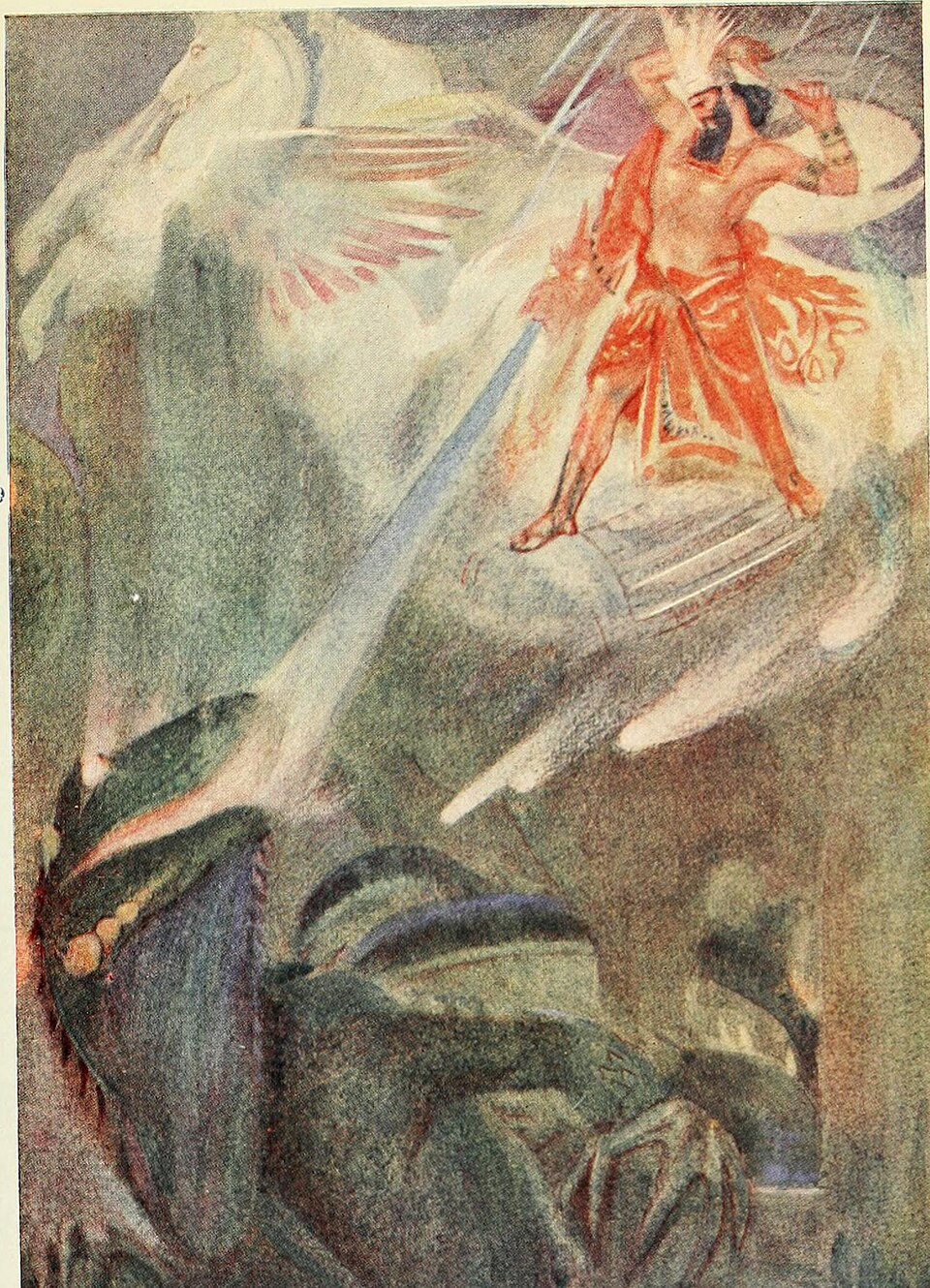
In the beginning, say the Babylonian scribes who wrote the Enūma Eliš in the second millennium BCE, there was no heaven above and no earth below — only Tiamat, the salt sea, and Apsû, the fresh groundwater, mingling their waters together. From this union came the first gods: Lahmu and Lahamu, then Anshar and Kishar, the 'ends' of heaven and earth, who in turn brought forth Anu and Ki, Heaven and Earth themselves. Tiamat is remembered as 'shining,' the mother of it all, called Ummu-Hubur, 'she who formed all things.'
But the younger gods multiplied and grew loud, and their tumult disturbed Apsû's rest. Enki — also called Ea — learned that Apsû intended to destroy his own noisy children, and struck first: he captured Apsû and imprisoned him beneath his own temple, the É Abzu, killing him.
Word of Apsû's death reached Tiamat through Qingu, her and Apsû's son. Enraged, she resolved to avenge her husband and turned against the very gods she had borne. To arm herself, she conjured eleven monsters — Bašmu the venomous snake, Ušumgallu the great dragon, Mušmaḫḫū the exalted serpent, Mušḫuššu the furious snake, Lahmu the hairy one, Ugallu the big weather-beast, Uridimmu the mad hound, Girtablullû the scorpion-man, Umū dabrūtu the violent storms, Kulullû the fish-man, and Kusarikku the bull-man — each one her own offspring, filled, the text says, with poison instead of blood.
Tiamat took Qingu as her new consort and lover, and placed in his hands the Tablet of Destinies, the object that conferred legitimate rulership over the gods. Terrified by the monstrous army she had assembled, the younger deities turned to Anu for rescue, swearing to honor whoever could defeat her as 'king of the gods.'
Anu tried first, armed with the arrows of the winds, a net, a club, and an invincible spear, but the role of champion passed instead to Enlil, and finally — in the version that survives from after the First Babylonian Dynasty — to Marduk, son of Enki, the storm-god.
More from Mythology

The Doctor Who Sang a Nation Into Being
A country doctor rode into the forests of Karelia armed with nothing but a notebook — and rode out with the soul of a nation.

The Boat That Carried the Sun
Every sunset, the ancient Egyptians believed, the sun climbed into a boat and sailed straight into the realm of the dead — only to fight a monstrous serpent before dawn could return.

The Wild Man of the Snows
At 21,000 feet, a colonel found tracks in the snow that he blamed on a wolf — but his guides knew better, and gave the world a name that would echo for a century.

The Knight Who Went Mad for Love: Orlando Furioso
A hero so devoted to duty he was Charlemagne's greatest paladin loses his mind—not to a sword wound, but to heartbreak. To cure him, a friend must ride a flying horse to the Moon.

The Book That Turned the World Into Myth
A poet condemned to exile spent his final years in Rome finishing a poem that would outlive empires—a poem about nothing standing still, not gods, not lovers, not even the shape of a man.

Paradise Lost: Milton's Rebel Angel
A blind poet, dictating verses in the dark, dared to explain the ways of God to men — and in doing so, made Hell's ruler unforgettable.