Odin: The God Who Traded an Eye for Wisdom
He gave up an eye to drink from a well of knowledge — and became the one-eyed ruler of nine worlds, watching everything from a single throne.
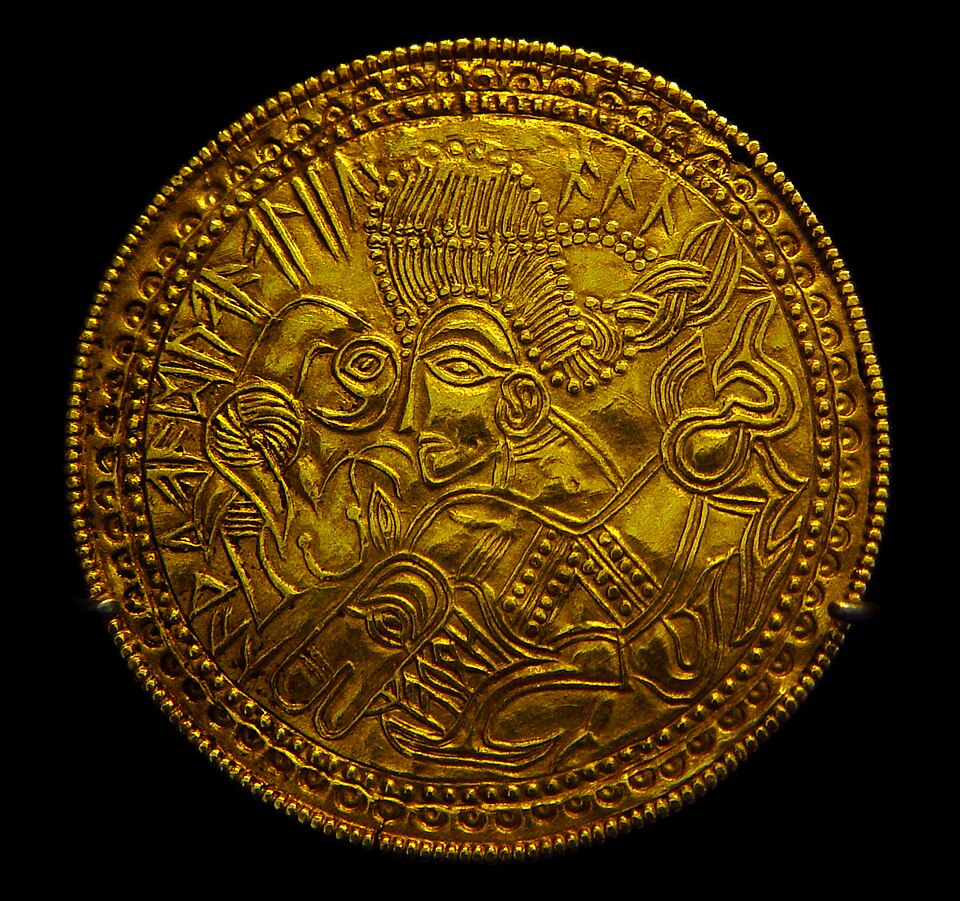
On the throne of Hlidskjalf, in a hall called Valaskjalf within Asgard, sat a god with only one eye. The other was gone, sacrificed so he could drink from the Well of Wisdom, and in exchange he gained knowledge without end. From that seat he could see across all nine realms — Asgard, Vanaheim, Midgard, Jotunheim, Nidavellir, Helheim, Niflheim, Alfheim, and Muspelheim — missing nothing that happened in any of them. This was Odin, the figure most Norse mythology calls the highest of the Germanic gods, husband to the goddess Frigg, and father to Baldr.
His name itself carries the memory of frenzy. It traces back to the reconstructed Proto-Germanic word *Wōðanaz, meaning 'lord of frenzy' or 'leader of the possessed,' rooted in an adjective meaning 'possessed, inspired, delirious, raging.' Writing his Gesta Hammaburgensis ecclesiae pontificum in 1075–1080 AD, the chronicler Adam of Bremen linked Wodan directly to the Latin furor — rage, fury, madness. That same root produced the Old Norse word óðr, meaning both 'mad, furious' and, remarkably, 'poetry.' In Odin, war-madness and poetic inspiration were never far apart.
Most of what survives about him comes from the 13th-century Prose Edda and the older Poetic Edda, along with the Ynglinga saga. These texts describe Odin as the head of the Æsir pantheon, carrying a spear and a ring. He was the son of Bestla and Borr, brother to Vili and Vé. He fathered Baldr with Frigg, and Thor with the earth-goddess Jörð, among other sons. Alongside him moved animal familiars: the ravens Huginn and Muninn, whose names mean thought and memory, and the wolves Geri and Freki.
According to the Prose Edda, Odin and his brothers built the world itself by slaying the primordial being Ymir, and it was Odin who gave life to the first humans, Ask and Embla. He is pictured as long-bearded, often as an old man, always missing one eye. His weapon, the spear Gungnir, never missed its target — and by some accounts it was cut from a branch of the world tree itself, after Odin hung there for nine or seven days learning the runes, depending on the telling. His ring, Draupnir, produced eight new rings every ninth night. His horse, the eight-legged Sleipnir, could travel over both land and water.
Odin was revered above all as a god of the dead and of warfare. Slain warriors — the einherjar — were carried by the Valkyries to his hall, Valhöll, the 'Hall of the Slain.' Early travelers to Northern Europe recorded human sacrifices offered to him. In Old English sources he was euhemerized as a royal ancestor, credited as a founding figure for peoples such as the Langobards. Roman writers, including Tacitus, equated him with Mercury. Later folklore cast him as leader of the Wild Hunt, a ghostly procession of the dead riding through the night.
More from Mythology

The Doctor Who Sang a Nation Into Being
A country doctor rode into the forests of Karelia armed with nothing but a notebook — and rode out with the soul of a nation.

The Boat That Carried the Sun
Every sunset, the ancient Egyptians believed, the sun climbed into a boat and sailed straight into the realm of the dead — only to fight a monstrous serpent before dawn could return.

The Wild Man of the Snows
At 21,000 feet, a colonel found tracks in the snow that he blamed on a wolf — but his guides knew better, and gave the world a name that would echo for a century.

The Knight Who Went Mad for Love: Orlando Furioso
A hero so devoted to duty he was Charlemagne's greatest paladin loses his mind—not to a sword wound, but to heartbreak. To cure him, a friend must ride a flying horse to the Moon.

The Book That Turned the World Into Myth
A poet condemned to exile spent his final years in Rome finishing a poem that would outlive empires—a poem about nothing standing still, not gods, not lovers, not even the shape of a man.

Paradise Lost: Milton's Rebel Angel
A blind poet, dictating verses in the dark, dared to explain the ways of God to men — and in doing so, made Hell's ruler unforgettable.