Painting an Idea: How Norman Rockwell Made Roosevelt's Four Freedoms Visible
A president gave a speech about human rights in the abstract. A magazine illustrator turned it into four kitchen-table scenes that raised over $132 million for the war effort.
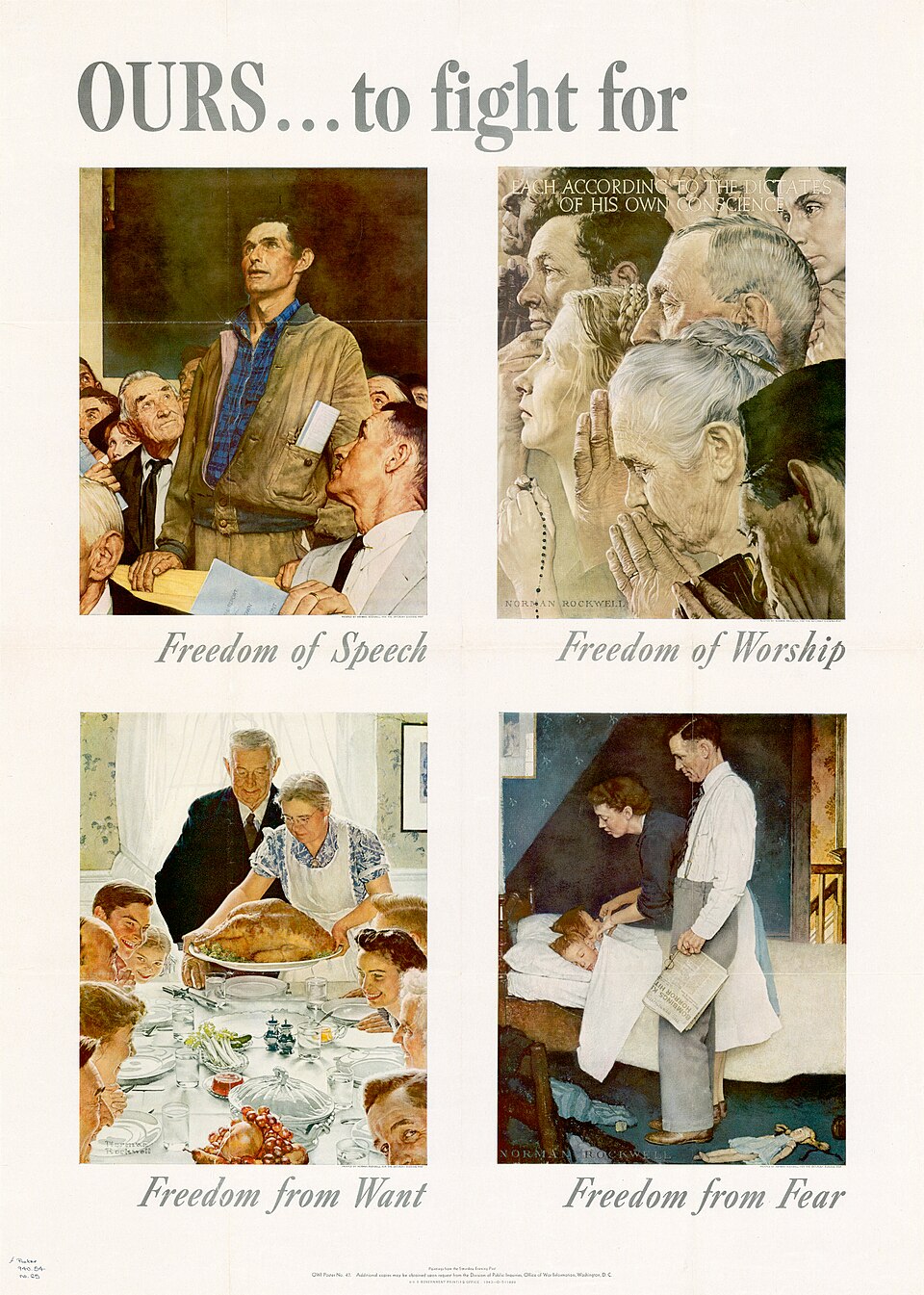
On January 6, 1941, with Nazi Germany occupying much of Western Europe, President Franklin D. Roosevelt stood before Congress and delivered his annual State of the Union address. He asked Americans to support the coming war effort, and he closed with a vision: a world founded on four essential human freedoms — freedom of speech, freedom of worship, freedom from want, and freedom from fear. The address became known simply as the Four Freedoms Speech, and it would echo far beyond that single evening.
Roosevelt's words did more than stir a nation. They shaped the language of the Atlantic Charter and later became embedded in the Charter of the United Nations. Yet only two of the four freedoms — speech and worship — were explicitly guaranteed in the U.S. Constitution. The other two, freedom from want and freedom from fear, were aspirations rather than legal guarantees, ideals Roosevelt hoped America's war effort could help secure for the world.
Among those listening, in spirit if not in the chamber, was Norman Rockwell, already one of the most widely reproduced illustrators in America. Since 1916, Rockwell had been painting covers for The Saturday Evening Post, and by the time editor George Horace Lorimer died in 1937, Rockwell was free of the old restrictions that had once kept him in the shadow of more established artists. He saw in Roosevelt's four freedoms the chance of a lifetime: an opportunity to translate lofty political rhetoric into scenes ordinary Americans would instantly recognize.
Rockwell set to work in 1943, producing four oil paintings, each roughly 45.75 by 35.5 inches: Freedom of Speech, Freedom of Worship, Freedom from Want, and Freedom from Fear. Rather than depicting statesmen or battlefields, he painted a man standing to speak at a town meeting, neighbors bowed in worship, a family gathered around a holiday table, and parents tucking children into bed. These were not abstractions — they were front porches, dinner tables, and community halls, the very fabric of American life Roosevelt had invoked.
The paintings debuted in The Saturday Evening Post over four consecutive weeks — February 20, February 27, March 6, and March 13, 1943 — each accompanied by an essay from a prominent writer: Booth Tarkington, Will Durant, Carlos Bulosan, and Stephen Vincent Benét. Pairing image with argument gave the series both emotional and intellectual weight, reaching a readership that made The Post one of the most widely read magazines in America.
More from Art

The Painting With No Foreground
A single robed figure stares out at an empty grey sea — and the emptiness itself became a scandal. When it was unveiled in Berlin in 1810, no one knew quite what to do with it.

The Painter Who Chased the Light
For a few purple minutes each evening, an American exile knelt in an English garden and raced the dying sun to paint two little girls lighting lanterns. It took him two years to finish.

When a President Became a God
Look straight up inside the U.S. Capitol dome and you will find George Washington enthroned among the clouds, surrounded by goddesses — the founding father transformed into myth.

Marble Brought Back to Life
A corpse asleep, a wing barely brushing her skin — and marble somehow learns to breathe. This is the moment Antonio Canova dared to carve.

The World Turned Upside Down
Look closely at a sixteenth-century Flemish village and you'll find a man biting a pillar, another carrying daylight in a basket, and a wife slipping a blue cloak over her husband's shoulders. Every gesture is a joke — if you know the language.

The Girl in the Glass Case
She stood two-thirds life size, dressed in a real tutu and human hair — and the critics who saw her in 1881 recoiled as if she were something obscene.