Rostam and Sohrab: The Father Who Killed His Son Unknowing
On a battlefield thick with dust, two of the greatest warriors of Iran and Turan grappled for hours — not knowing they were father and son.
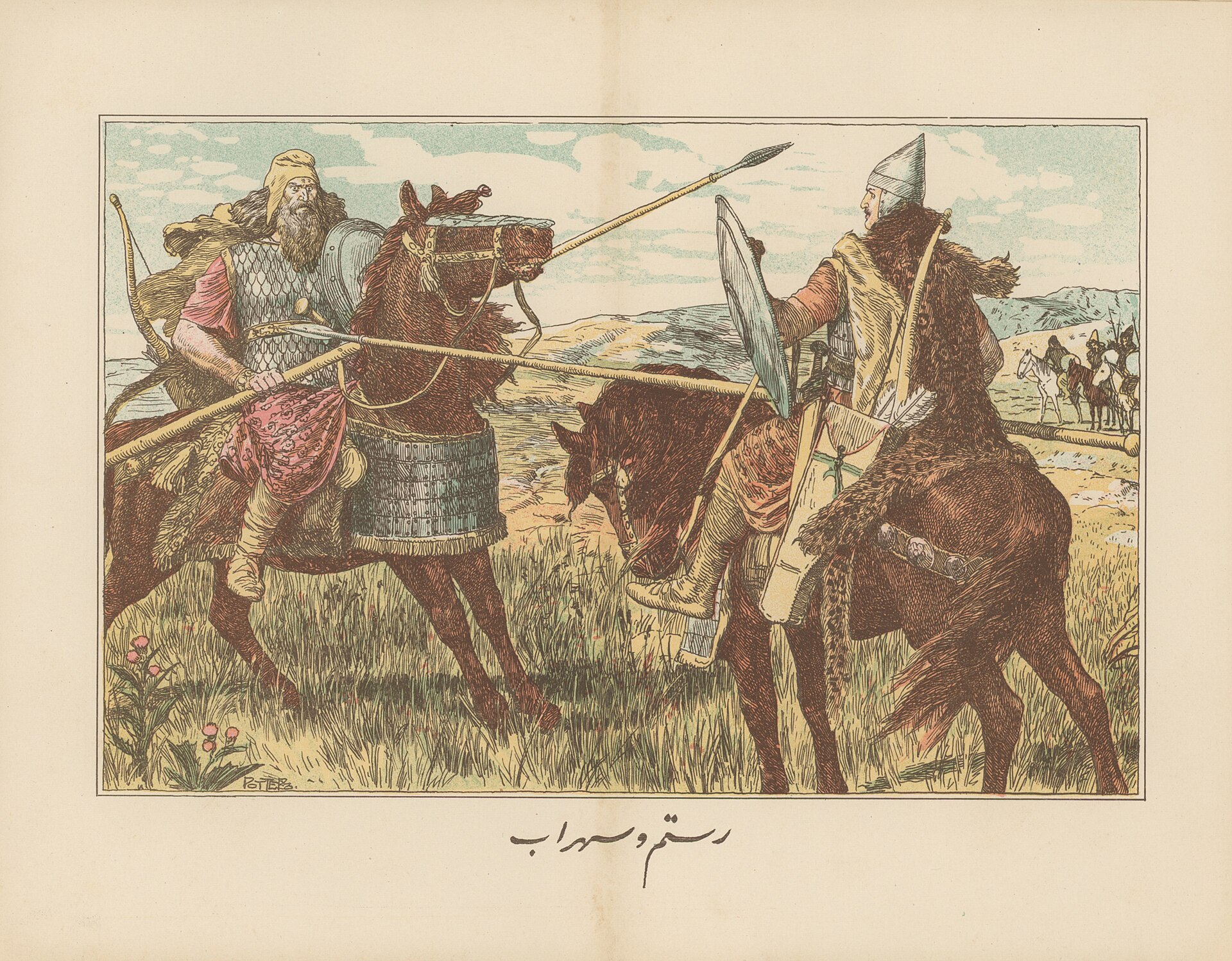
Among the vast tapestry of tales gathered in the Shahnameh, the 10th-century Persian epic composed by Ferdowsi, none carries a sharper sting than the story of Rostam and Sohrab. It belongs to the mythical age of the epic, before history hardens into record, when heroes wrestle with fate as much as with each other.
Rostam, Iran's greatest hero and favorite of King Kay Kavus, once wandered into the kingdom of Samangan while tracking his lost horse, Rakhsh. There he became the guest of the king and met Princess Tahmineh, who had heard of his fame and admired him deeply. Bold in matters of love, she came to his room at night and declared herself to him. Rostam married her — but left abruptly after she conceived, giving her two tokens before departing: a jewel, to be plaited into a daughter's hair, or a seal, to be bound on a son's arm.
Tahmineh bore a son and named him Sohrab. But she never revealed his father's identity, nor did she keep the token in a way that could later prove his lineage to the world. This silence, born of conflict and fear, sealed the tragedy long before the two men ever met on a battlefield.
Sohrab grew into a fierce and ambitious young warrior, leading the Turanian army with valor but little political wisdom. He harbored dreams of overthrowing King Kay Kavus and seizing the throne for Afrasiab, the cunning king of Turan. Afrasiab, ever the schemer, worked behind the scenes rather than on the field, exploiting Sohrab's youth and ambition to provoke a war that would weaken Iran — and, unknown to Sohrab, bring him face to face with his own father.
The path to that confrontation was paved by others. Gordafarid, a bold Iranian warrior, skirmished briefly with Sohrab, feigning surrender to buy time for Iran's forces. Hojir, an Iranian commander, tried to block Sohrab's advance but was captured; in their exchange he misled Sohrab with falsehoods that clouded his sense of who stood as friend or foe. Meanwhile, Goudarz, a respected elder statesman, pressed Rostam relentlessly to return to arms, making the fated meeting between father and son unavoidable.
More from Mythology

The Doctor Who Sang a Nation Into Being
A country doctor rode into the forests of Karelia armed with nothing but a notebook — and rode out with the soul of a nation.

The Boat That Carried the Sun
Every sunset, the ancient Egyptians believed, the sun climbed into a boat and sailed straight into the realm of the dead — only to fight a monstrous serpent before dawn could return.

The Wild Man of the Snows
At 21,000 feet, a colonel found tracks in the snow that he blamed on a wolf — but his guides knew better, and gave the world a name that would echo for a century.

The Knight Who Went Mad for Love: Orlando Furioso
A hero so devoted to duty he was Charlemagne's greatest paladin loses his mind—not to a sword wound, but to heartbreak. To cure him, a friend must ride a flying horse to the Moon.

The Book That Turned the World Into Myth
A poet condemned to exile spent his final years in Rome finishing a poem that would outlive empires—a poem about nothing standing still, not gods, not lovers, not even the shape of a man.

Paradise Lost: Milton's Rebel Angel
A blind poet, dictating verses in the dark, dared to explain the ways of God to men — and in doing so, made Hell's ruler unforgettable.