Self-Portrait with Bandaged Ear
He looked into a mirror and painted the wound he had inflicted on himself — a canvas built from a night of blood, threats, and a razor.
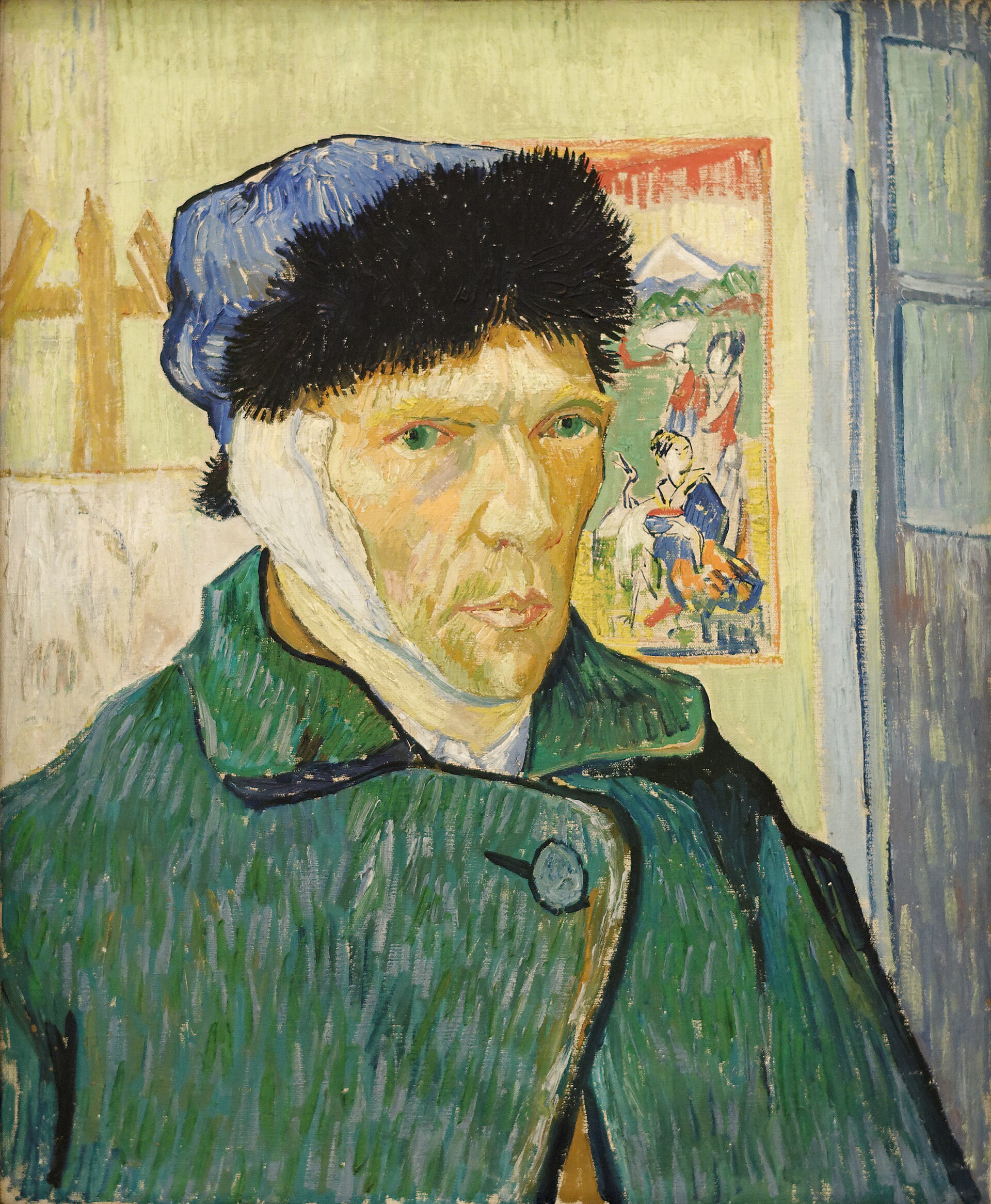
On the evening of 23 December 1888, inside the Yellow House in Arles, something broke. Paul Gauguin, the friend Vincent van Gogh had invited south to build a community of artists called the Studio of the South, threatened to leave. Van Gogh, in the grip of crisis, approached him with a razor. Later that same night, alone, Van Gogh sliced off his own left ear.
What happened next reads like the darkest footnote to an already dark story: he carried the severed ear to a prostitute named Rachel in Arles. When she was handed the grim parcel, she was so distressed that she called the police, who arrested Van Gogh on suspicion of lunacy.
Weeks later, in a letter to his brother Theo dated 17 January 1889, Van Gogh mentioned he had painted a new self-portrait. Historians believe this is the very picture now known as Self-Portrait with Bandaged Ear. In it, he shows himself wrapped in bandage from ear to chin, wearing a blue cap trimmed with black fur and a heavy green overcoat — the cap itself a practical object, bought only recently to hold the bandage in place and shield him from the January cold.
Because Van Gogh painted himself from a mirror, the wound appears reversed: the bandage sits over what looks like his right ear, though it was in fact his left that he had cut. It is a quiet visual trick, born simply of how mirrors work, but it has confused viewers for more than a century.
Behind him in the composition, Van Gogh placed two telling objects: a blank canvas on an easel, marked only with a few indistinguishable strokes, and a Japanese woodblock print — Geishas in a Landscape, made by Satō Torakiyo in the 1870s. Van Gogh was an avid collector of Japanese prints, amassing hundreds over his lifetime, and their bold colors and flattened spatial effects had already begun reshaping his own style. Placing one in the background of this self-portrait was no accident; it was a declaration of the artistic language he was trying to build even as his personal world was falling apart.
More from Art

The Painting With No Foreground
A single robed figure stares out at an empty grey sea — and the emptiness itself became a scandal. When it was unveiled in Berlin in 1810, no one knew quite what to do with it.

The Painter Who Chased the Light
For a few purple minutes each evening, an American exile knelt in an English garden and raced the dying sun to paint two little girls lighting lanterns. It took him two years to finish.

When a President Became a God
Look straight up inside the U.S. Capitol dome and you will find George Washington enthroned among the clouds, surrounded by goddesses — the founding father transformed into myth.

Marble Brought Back to Life
A corpse asleep, a wing barely brushing her skin — and marble somehow learns to breathe. This is the moment Antonio Canova dared to carve.

The World Turned Upside Down
Look closely at a sixteenth-century Flemish village and you'll find a man biting a pillar, another carrying daylight in a basket, and a wife slipping a blue cloak over her husband's shoulders. Every gesture is a joke — if you know the language.

The Girl in the Glass Case
She stood two-thirds life size, dressed in a real tutu and human hair — and the critics who saw her in 1881 recoiled as if she were something obscene.