Seventy Metres of Wool: How the Bayeux Tapestry Told a Conquest
A comet blazed over England in 1066 — and someone stitched it into history as a divine omen. What else did they sew into truth, and what did they leave out?
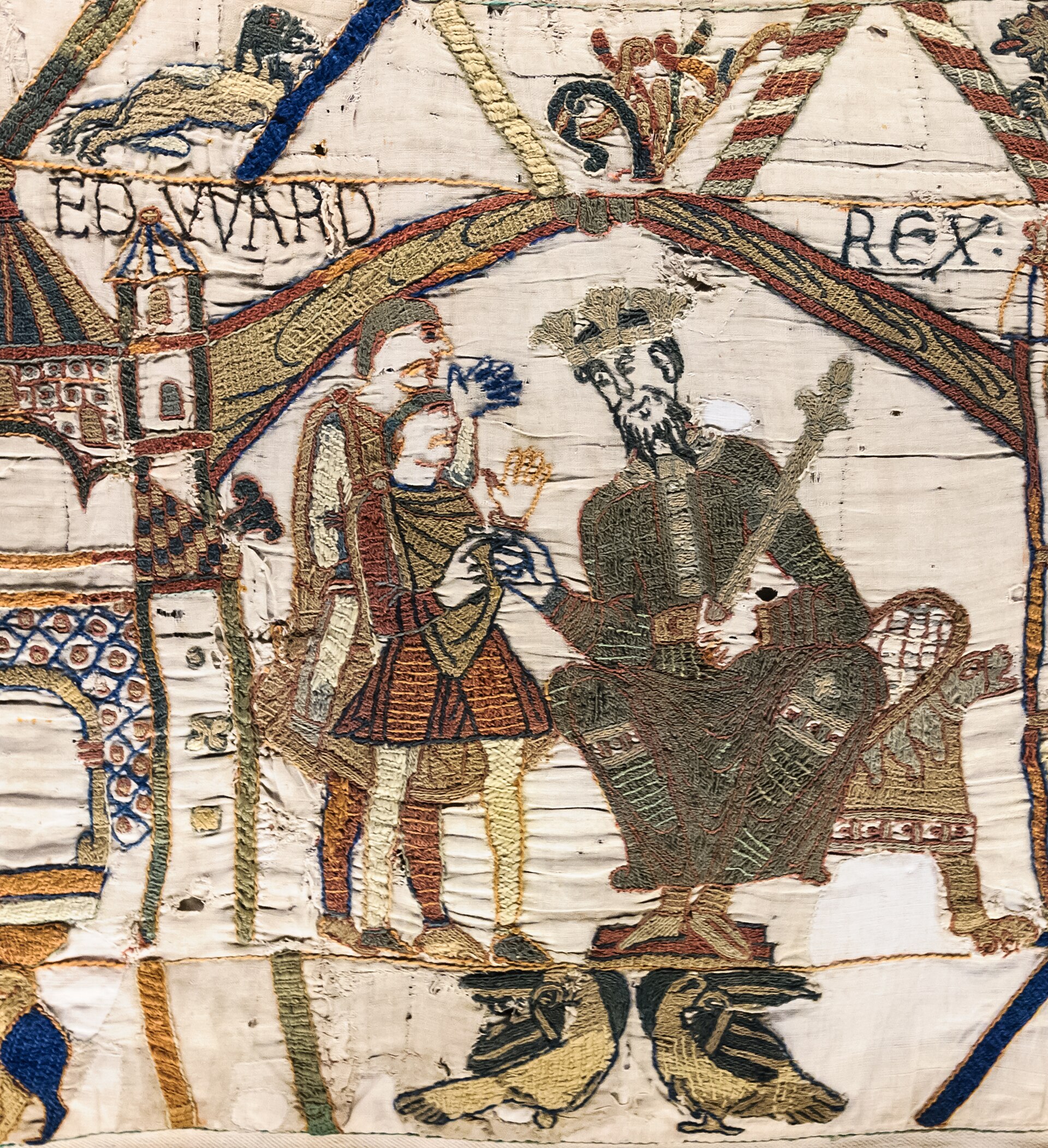
In a cathedral treasury in Normandy, an inventory clerk in 1476 noted a long embroidered cloth among the church's possessions. He had no idea he was recording the first known trace of one of the most extraordinary surviving artifacts of medieval Europe: a strip of linen nearly 70 metres long and only 50 centimetres tall, stitched with coloured wool into 58 scenes, each labelled in Medieval Latin.
The cloth tells the story of the Norman Conquest of England in 1066, when William, Duke of Normandy, crossed the sea to challenge Harold II for the English crown. It begins with the aging King Edward, who has no heir, and follows Harold's fateful journey to Normandy, where — according to the tapestry's Norman-slanted narrative — he swore on holy relics to support William's claim to the throne. When Edward died and Harold seized the crown for himself, William prepared an invasion fleet to reclaim what he believed was rightfully his.
The embroidery does not shy from omens. Halley's Comet, which appeared in the skies four months after Harold's coronation, is stitched directly into the narrative — read by medieval eyes as a portent of disaster, and later claimed by William as a sign of divine favor for his cause. The Norman forces landed in England, learned of Harold's earlier victory over Viking invaders at Stamford Bridge, and prepared for the decisive clash.
On 14 October 1066, the Battle of Hastings unfolded, and the tapestry stretches it out scene by scene: English infantry holding a shield wall, Norman cavalry pressing the attack, and finally the fall of Harold, though the embroidery leaves ambiguous exactly which fallen figure is the king himself.
Who made this thing, and why, remains genuinely contested. French legend long credited Queen Matilda, William's wife, and her ladies — hence its French nickname, La Tapisserie de la Reine Mathilde. But twentieth-century scholarship points instead to Bishop Odo of Bayeux, William's half-brother, who became Earl of Kent and regent of England. Three of Odo's followers, named in the Domesday Book, appear in the embroidery; it was found in the cathedral he built; and it may have been finished by 1077 for that cathedral's dedication.
More from Art

The Painting With No Foreground
A single robed figure stares out at an empty grey sea — and the emptiness itself became a scandal. When it was unveiled in Berlin in 1810, no one knew quite what to do with it.

The Painter Who Chased the Light
For a few purple minutes each evening, an American exile knelt in an English garden and raced the dying sun to paint two little girls lighting lanterns. It took him two years to finish.

When a President Became a God
Look straight up inside the U.S. Capitol dome and you will find George Washington enthroned among the clouds, surrounded by goddesses — the founding father transformed into myth.

Marble Brought Back to Life
A corpse asleep, a wing barely brushing her skin — and marble somehow learns to breathe. This is the moment Antonio Canova dared to carve.

The World Turned Upside Down
Look closely at a sixteenth-century Flemish village and you'll find a man biting a pillar, another carrying daylight in a basket, and a wife slipping a blue cloak over her husband's shoulders. Every gesture is a joke — if you know the language.

The Girl in the Glass Case
She stood two-thirds life size, dressed in a real tutu and human hair — and the critics who saw her in 1881 recoiled as if she were something obscene.