The Anatomy Lesson of Dr Nicolaes Tulp: The Painting That Made Rembrandt
A hanged thief, a roomful of paying surgeons, and a 25-year-old painter new to Amsterdam — together they produced one of art history's most unsettling masterpieces.
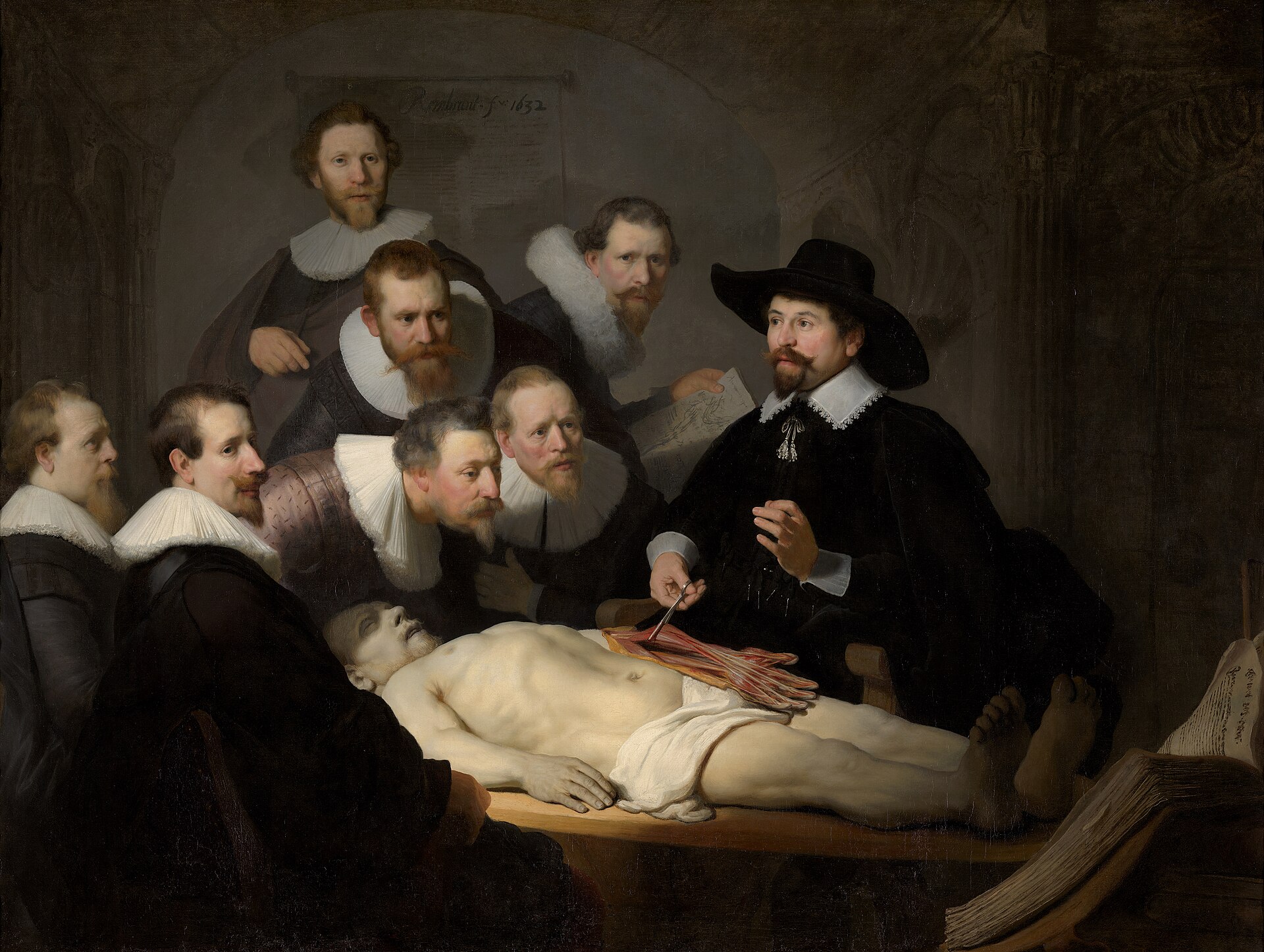
On 16 January 1632, the Amsterdam Guild of Surgeons gathered for their single permitted public dissection of the year. Such events were social theatre as much as science: students, colleagues, and curious members of the public paid an entrance fee to watch a body opened in a lecture hall built like an amphitheatre. The corpse belonged to Aris Kindt, alias of Adriaan Adriaanszoon, a criminal convicted of armed robbery and hanged that same day. Presiding was Dr Nicolaes Tulp, the guild's official City Anatomist, a man of standing in Dutch medicine.
To commemorate the occasion, the Surgeons Guild commissioned a portrait, as they did every five to ten years, from a leading painter of the period. This time the commission went to Rembrandt, only 25 years old and newly arrived in Amsterdam — his first major commission in the city. Each man included in the painting paid to appear in it, with more central figures, especially Tulp, likely paying considerably more. The result, The Anatomy Lesson of Dr Nicolaes Tulp, would become one of Rembrandt's earliest masterpieces.
Rembrandt broke sharply from convention. Earlier anatomical group portraits rarely centered a full corpse; here, the body of Kindt dominates the composition, painted with a Christ-like solemnity. It is, in truth, an invented moment — real dissections began with the chest and thorax, since internal organs decayed fastest, not with the arm. Rembrandt instead shows Tulp explaining the musculature of the arm, a more visually elegant and legible demonstration than reality would have offered. No cutting instruments appear in the scene; instead, in the lower right corner sits a large open textbook, likely Andreas Vesalius's 1543 De Humani Corporis Fabrica. This is telling: an eminent scientist like Tulp would not have done the bloody preparatory work himself. That task fell to an unnamed Preparator, absent from the painting entirely.
The corpse's face is partly obscured in shadow, an effect scholars call umbra mortis, 'shadow of death' — a technique Rembrandt would return to throughout his career. The French art historian Jean-Marie Clarke has even suggested that the shape of Kindt's navel resembles a capital R, tying it to a moment when Rembrandt was experimenting with different forms of his signature. Indeed, the painting is signed in the top-left corner 'Rembrant. f. 1632' — possibly the first time he signed with his forename rather than his earlier monogram RHL, a small but telling sign of a young artist's growing confidence.
Medical specialists have long marveled at the anatomical precision in the arm painted by the 26-year-old artist, though how he acquired such knowledge remains unknown; he may have consulted an anatomical text directly. Yet the picture isn't flawless: a 2006 Dutch recreation using a real cadaver found discrepancies in the depicted forearm. A 2007 study by American anatomist David J. Jackowe proposed that a mysterious white cord running along the cadaver's wrist and little finger — long debated as either a nerve variant or simple error — was most likely the tendon of a rare forearm muscle, the accessory abductor digiti minimi.
More from Art

The Painting With No Foreground
A single robed figure stares out at an empty grey sea — and the emptiness itself became a scandal. When it was unveiled in Berlin in 1810, no one knew quite what to do with it.

The Painter Who Chased the Light
For a few purple minutes each evening, an American exile knelt in an English garden and raced the dying sun to paint two little girls lighting lanterns. It took him two years to finish.

When a President Became a God
Look straight up inside the U.S. Capitol dome and you will find George Washington enthroned among the clouds, surrounded by goddesses — the founding father transformed into myth.

Marble Brought Back to Life
A corpse asleep, a wing barely brushing her skin — and marble somehow learns to breathe. This is the moment Antonio Canova dared to carve.

The World Turned Upside Down
Look closely at a sixteenth-century Flemish village and you'll find a man biting a pillar, another carrying daylight in a basket, and a wife slipping a blue cloak over her husband's shoulders. Every gesture is a joke — if you know the language.

The Girl in the Glass Case
She stood two-thirds life size, dressed in a real tutu and human hair — and the critics who saw her in 1881 recoiled as if she were something obscene.