The Angel Who Would Not Explain Herself
Two solemn boys carry a bandaged, bleeding angel through a Helsinki park — and the painter who created her refused, to his dying day, to say what it meant.
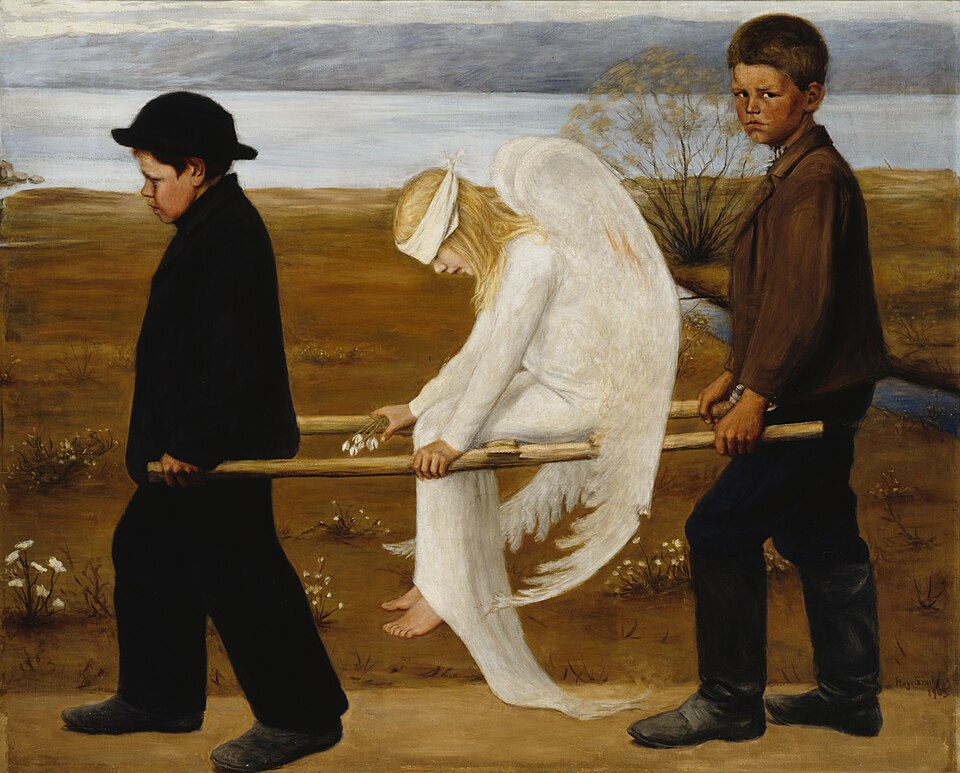
In the autumn of 1903, a painting arrived at the Ateneum's exhibition halls that would eventually be crowned, more than a century later, Finland's national painting. It showed a girl with wings, her eyes bound in a bandage, one wing marked with blood, being carried on a stretcher by two young boys dressed in sombre clothes, as if in mourning. The boy on the right stares directly out of the canvas, past the viewer, his expression unreadable. Its creator was Hugo Simberg, a Finnish symbolist painter whose work was already known for its melancholic, dreamlike atmosphere.
The setting was no invented fantasy landscape. Simberg placed his wounded angel in a place any Helsinki resident of the time would recognize: Eläintarha park, with Töölönlahti Bay stretching behind the procession. The same road along the bay still exists today. In Simberg's era, Eläintarha was a favored leisure spot for the working classes, and it was also home to several charitable institutions — including the Blind Girls' School and the Home for Cripples. The two boys, in the painting's implied narrative, are carrying their injured charge toward one of these very buildings.
In her hands, the angel clutches a small bunch of snowdrops — flowers long associated with healing and rebirth, among the first to bloom after winter's end. It is one of the painting's few unambiguous symbols, a quiet suggestion that despite her wounds, recovery is possible.
Simberg himself gave the world almost nothing to go on. Asked repeatedly what the painting meant, he declined every invitation to interpret it, insisting that viewers should arrive at their own conclusions. What is known is more personal and physical: Simberg had recently suffered from meningitis, and the act of painting The Wounded Angel became, for him, a source of strength as he recovered from the illness.
The painting's debut was a triumph among Simberg's peers. In a letter to his sister Blenda dated 10 October 1903, Simberg wrote with evident relief and pride that he had not been rejected by an unusually strict jury, and that he seemed to have won something of a grand succés among his colleagues. He recounted that the painter Akseli Gallen-Kallela was so enthusiastic he could hardly be taken seriously, showering the work with flattery and remarking that it felt as though Simberg had painted it alone in a small cabin deep in a forest, indifferent to the outside world. Gallén said the painting radiated peace and harmony unlike anything else in the exhibition. Even Albert Edelfelt, another towering figure of Finnish art, offered kind words.
More from Art

The Painting With No Foreground
A single robed figure stares out at an empty grey sea — and the emptiness itself became a scandal. When it was unveiled in Berlin in 1810, no one knew quite what to do with it.

The Painter Who Chased the Light
For a few purple minutes each evening, an American exile knelt in an English garden and raced the dying sun to paint two little girls lighting lanterns. It took him two years to finish.

When a President Became a God
Look straight up inside the U.S. Capitol dome and you will find George Washington enthroned among the clouds, surrounded by goddesses — the founding father transformed into myth.

Marble Brought Back to Life
A corpse asleep, a wing barely brushing her skin — and marble somehow learns to breathe. This is the moment Antonio Canova dared to carve.

The World Turned Upside Down
Look closely at a sixteenth-century Flemish village and you'll find a man biting a pillar, another carrying daylight in a basket, and a wife slipping a blue cloak over her husband's shoulders. Every gesture is a joke — if you know the language.

The Girl in the Glass Case
She stood two-thirds life size, dressed in a real tutu and human hair — and the critics who saw her in 1881 recoiled as if she were something obscene.