The Bells of Impermanence: How a Blind Bard's Song Became Japan's Great Epic
A blind monk with a lute-like instrument, chanting in the dark — and from his voice rose one of the most haunting epics ever told. It begins with the sound of bells, and ends with an empire in ashes.
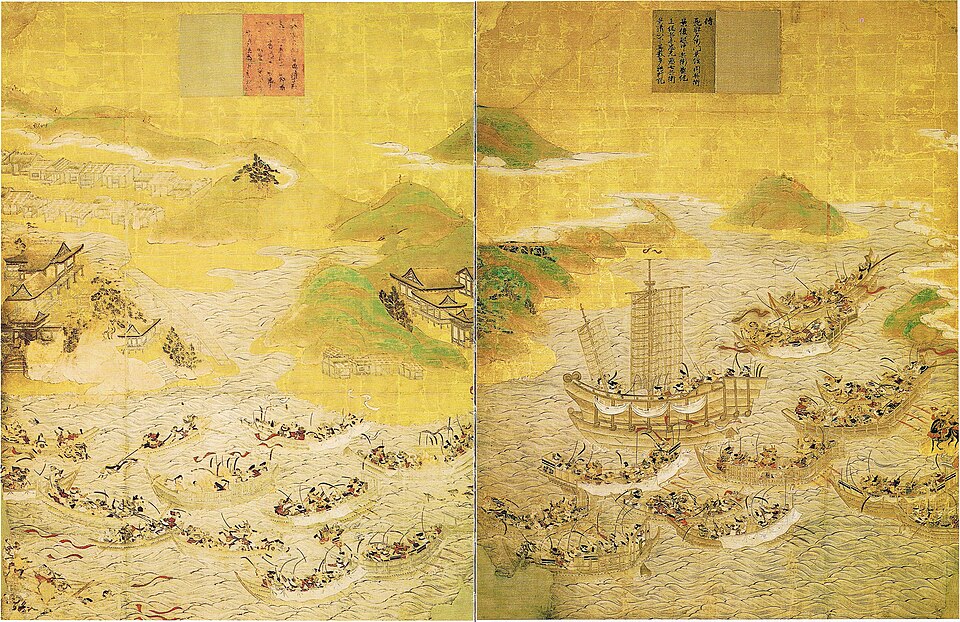
The story opens with a sound: the echo of bells at the Gion Shōja temple, tolling out a truth no warrior or emperor can escape — that all things pass. This is how The Tale of the Heike begins, and it is fitting, because the tale itself was born not on a page but in sound, carried across Japan for generations by wandering blind monks called biwa hōshi, who chanted its verses to the accompaniment of the biwa, a lute-like instrument.
The events it describes are real and bloody: the Genpei War of 1180–1185, the climactic struggle between the Taira clan (also called Heike) and the Minamoto clan (also called Genji) for control of Japan. The Taira had risen to dominance, defeating the imperial-backed Minamoto in 1161, only to be undone by their own arrogance. In 1185 the revitalized Minamoto crushed them, and from the wreckage of that war rose the Kamakura shogunate — the first samurai government in Japanese history.
No single author wrote this epic, which was compiled prior to 1330 out of a long oral tradition, shaped and reshaped by generations of performers. The monk Yoshida Kenkō, writing in 1330 in his work Tsurezuregusa, offered one theory: that a former governor of Shinano named Yukinaga wrote the Heike Monogatari and taught it to a blind man named Shōbutsu, who chanted it. Shōbutsu, said to be from the eastern provinces, had reportedly gathered details about samurai — their bows, their horses, their strategies — which Yukinaga then wove into the text. The work is written in a demanding blend of Chinese and Japanese script, wakan konkō shō, a style mastered mainly by educated monks and nobles like Yukinaga.
Yet the inconsistencies within the text — shifts in style, repeated episodes told differently — suggest it was never the product of one mind. It was compiled, not composed: a collective inheritance passed mouth to mouth. The version most widely read today was later shaped by a blind monk named Kakuichi, in 1371.
Two currents run through the tale, intertwined like threads in brocade. One is the samurai spirit — courage, cruelty, glory, sacrifice, sorrow — rendered with an eye toward the aesthetic rather than the merely brutal. The famous image of drowned warriors compared to a maple-leaf brocade floating on the waves captures this impulse: even catastrophe is given the shape of beauty.
More from Mythology

The Doctor Who Sang a Nation Into Being
A country doctor rode into the forests of Karelia armed with nothing but a notebook — and rode out with the soul of a nation.

The Boat That Carried the Sun
Every sunset, the ancient Egyptians believed, the sun climbed into a boat and sailed straight into the realm of the dead — only to fight a monstrous serpent before dawn could return.

The Wild Man of the Snows
At 21,000 feet, a colonel found tracks in the snow that he blamed on a wolf — but his guides knew better, and gave the world a name that would echo for a century.

The Knight Who Went Mad for Love: Orlando Furioso
A hero so devoted to duty he was Charlemagne's greatest paladin loses his mind—not to a sword wound, but to heartbreak. To cure him, a friend must ride a flying horse to the Moon.

The Book That Turned the World Into Myth
A poet condemned to exile spent his final years in Rome finishing a poem that would outlive empires—a poem about nothing standing still, not gods, not lovers, not even the shape of a man.

Paradise Lost: Milton's Rebel Angel
A blind poet, dictating verses in the dark, dared to explain the ways of God to men — and in doing so, made Hell's ruler unforgettable.