The Bird That Outlived the Blast
A tiny painted bird, chained to a feeder, survived the explosion that killed the man who painted it — and then vanished for two centuries.
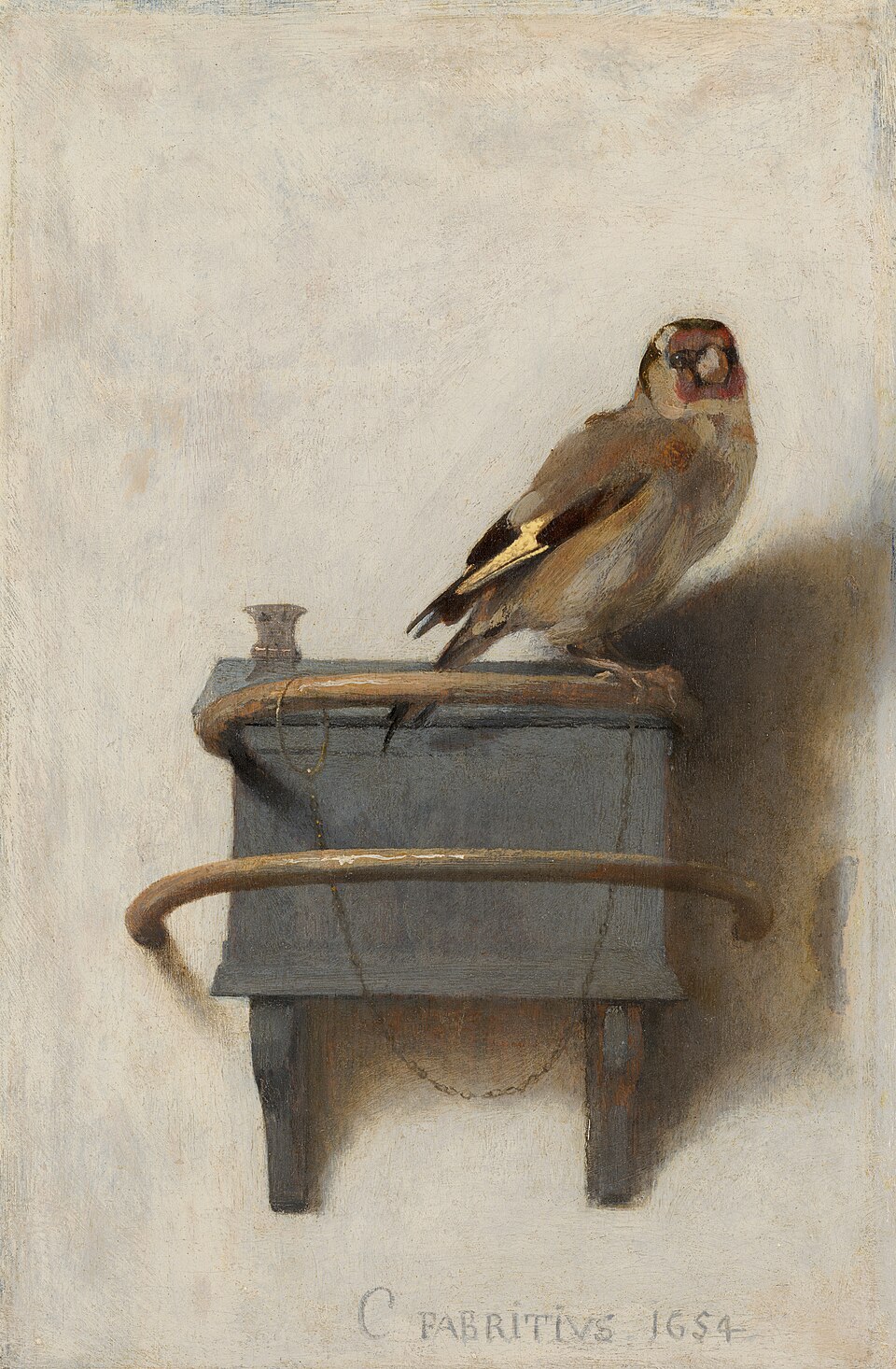
In 1654, in the Dutch city of Delft, a painter named Carel Fabritius signed a small wooden panel: 'C fabritivs 1654'. On it he had rendered, with uncanny precision, a life-sized European goldfinch perched atop a blue feeder, its leg fastened by a fine chain to a wooden ring fixed against a plastered wall. The panel measured just 33.5 by 22.8 centimetres, yet it captured something extraordinary — a small, ordinary household pet transformed into an object of quiet wonder.
Goldfinches were common companions in 17th-century Dutch homes. Colourful and sweet-voiced, they were believed to bring good health, and had been kept as pets for at least two thousand years. Pliny the Elder had already recorded that they could be taught tricks, and by Fabritius's time it had become fashionable to train them to draw water from a bowl using a miniature bucket on a chain — a habit reflected in the painting's Dutch title, Het puttertje, meaning 'little draw-water', an old nickname for the bird.
The goldfinch carried deeper symbolism too. Pliny linked it to fertility, and it appears beside a naked couple in Hieronymus Bosch's The Garden of Earthly Delights. In Renaissance religious art, nearly 500 paintings — including works by Leonardo da Vinci, Raphael, and Piero della Francesca — depicted the bird as a symbol of Christian redemption. Its habit of feeding on thistles and its red face were seen as foreshadowing Christ's crucifixion, the bird supposedly stained with blood while trying to remove his crown of thorns. Many such devotional images were painted during the Black Death.
Fabritius's goldfinch, though, is strikingly plain by comparison — no religious scene, no ornament, just the bird, its chain, and a bare wall rendered with startling illusionistic skill. This simplicity was unusual for Dutch Golden Age painting, and it is part of why the work still feels so modern.
The panel itself holds clues to a hidden history. It was once thicker and part of a larger structure — perhaps a window jamb or a hinged protective cover. Nail holes on its back suggest it was hung in at least two different ways over time, and a discarded gilded frame once bordered it before being removed. Restoration in 2003, using a CT scanner to see beneath the lead-based paint, also revealed dozens of tiny dents formed while the paint was still wet — possibly caused by the very gunpowder explosion that killed Fabritius and devastated much of Delft, an event the panel may have witnessed from inside his workshop.
More from Art

The Painting With No Foreground
A single robed figure stares out at an empty grey sea — and the emptiness itself became a scandal. When it was unveiled in Berlin in 1810, no one knew quite what to do with it.

The Painter Who Chased the Light
For a few purple minutes each evening, an American exile knelt in an English garden and raced the dying sun to paint two little girls lighting lanterns. It took him two years to finish.

When a President Became a God
Look straight up inside the U.S. Capitol dome and you will find George Washington enthroned among the clouds, surrounded by goddesses — the founding father transformed into myth.

Marble Brought Back to Life
A corpse asleep, a wing barely brushing her skin — and marble somehow learns to breathe. This is the moment Antonio Canova dared to carve.

The World Turned Upside Down
Look closely at a sixteenth-century Flemish village and you'll find a man biting a pillar, another carrying daylight in a basket, and a wife slipping a blue cloak over her husband's shoulders. Every gesture is a joke — if you know the language.

The Girl in the Glass Case
She stood two-thirds life size, dressed in a real tutu and human hair — and the critics who saw her in 1881 recoiled as if she were something obscene.