The Bird Who Remembered the World's Endings
A creature old enough to have watched the world burn three times over, nesting in a tree that seeds all of creation — and once, it saved a mortal child left to die on a mountainside.
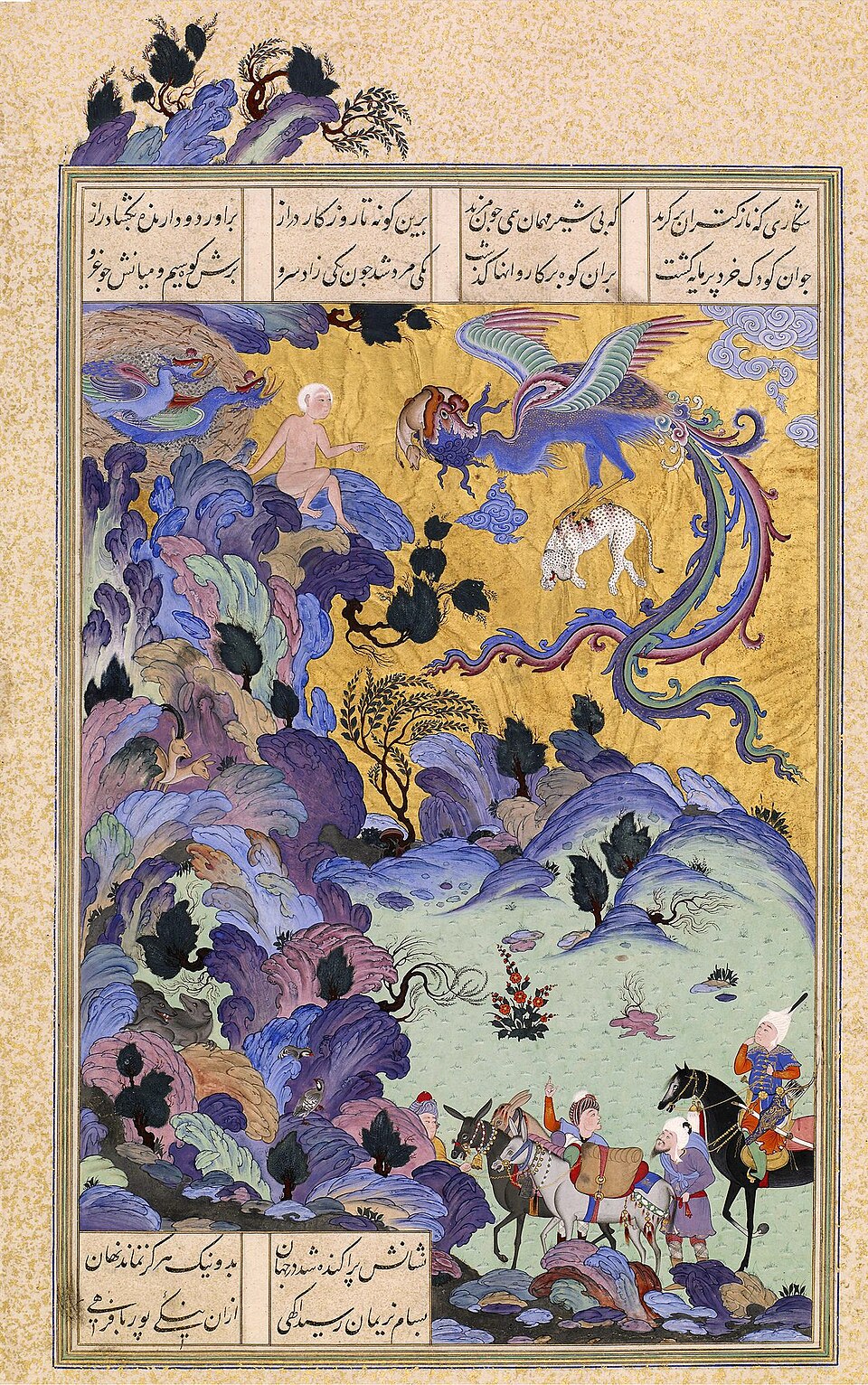
High on Mount Alborz, in the harsh air above the reach of ordinary birds, lived a creature the Persians called the simurgh — a winged giant powerful enough to carry off an elephant or a whale. In art it was rendered as a peacock with the head of a dog and the claws of a lion, sometimes given a human face, its copper-colored feathers catching light like a creature that belonged to no single order of animal. It was, in the truest sense, a hybrid of everything: part bird, part mammal, nursing its young as beasts do, sworn enemy of snakes, drawn always to water.
The name itself carries centuries of drift. It descends from the Avestan mərəγō Saēnō, 'the bird Saēna,' likely once a raptor — an eagle, falcon, or sparrowhawk — before Middle Persian softened it into sēnmurw and eventually sīmurğ. A stubborn folk etymology later connected the 'sī' to the Persian word for 'thirty,' spinning legends that the simurgh was as vast as thirty birds combined, or shimmered with thirty colors. The two ideas were never historically related, but myths rarely wait for etymology's permission.
What set the simurgh apart from ordinary monsters was its age and its purpose. Iranian legend held that it had lived long enough to witness the destruction of the world three separate times, accumulating in that impossible span the knowledge of every age. Some accounts gave it a lifespan of 1,700 years before it plunged itself into flame, echoing the phoenix's fiery cycle; other traditions simply called it immortal. Either way, the simurgh was not a beast to be feared but a keeper of memory itself.
Its home was Gaokerena, the Tree of Life, rooted in the middle of the cosmic sea Vourukasha. This was no ordinary tree — it held the seeds of every plant that would ever exist, and its sap was medicine potent enough to heal any wound. When the simurgh took flight, its wings shook the tree's leaves loose, scattering seeds on the winds of Vayu-Vata and the rains of Tishtrya, seeding the entire world with every plant that would ever grow and, with them, cures for humanity's illnesses.
The bird's benevolence extended into politics and kingship. The simurgh was closely bound to farrah, the divine glory that legitimized a king's rule — appearing as a presence resting on the heads of would-be rulers and clerics, a sign that heaven itself had chosen them. The Sasanian dynasty embraced the image so thoroughly that the simurgh became something like a royal emblem, woven through their art and propaganda as a stamp of divine sanction.
More from Mythology

The Doctor Who Sang a Nation Into Being
A country doctor rode into the forests of Karelia armed with nothing but a notebook — and rode out with the soul of a nation.

The Boat That Carried the Sun
Every sunset, the ancient Egyptians believed, the sun climbed into a boat and sailed straight into the realm of the dead — only to fight a monstrous serpent before dawn could return.

The Wild Man of the Snows
At 21,000 feet, a colonel found tracks in the snow that he blamed on a wolf — but his guides knew better, and gave the world a name that would echo for a century.

The Knight Who Went Mad for Love: Orlando Furioso
A hero so devoted to duty he was Charlemagne's greatest paladin loses his mind—not to a sword wound, but to heartbreak. To cure him, a friend must ride a flying horse to the Moon.

The Book That Turned the World Into Myth
A poet condemned to exile spent his final years in Rome finishing a poem that would outlive empires—a poem about nothing standing still, not gods, not lovers, not even the shape of a man.

Paradise Lost: Milton's Rebel Angel
A blind poet, dictating verses in the dark, dared to explain the ways of God to men — and in doing so, made Hell's ruler unforgettable.