The Book That Refused to Disappear
A priest in a small Guatemalan town copied down words that were never meant to be written — and in doing so, saved a civilization's memory of its own creation.
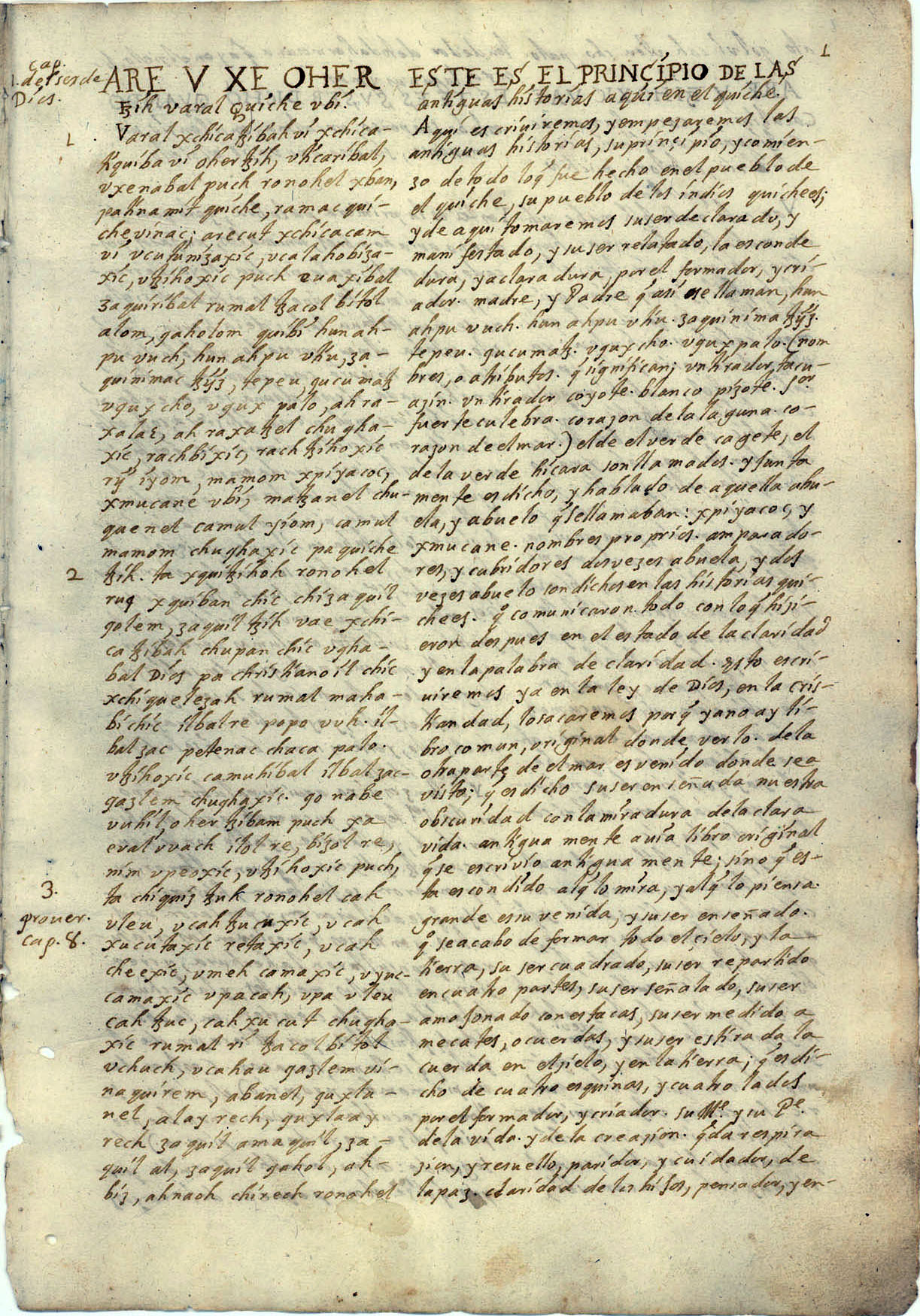
In 1701, a Dominican friar named Francisco Ximénez arrived in the town of Santo Tomás Chichicastenango, deep in Kʼicheʼ territory. There, he encountered something remarkable: an oral tradition so vast it described the birth of the universe, the deeds of hero twins, and the lineage of a people stretching back before the Spanish ever set foot in the Americas. Ximénez transcribed it, setting Kʼicheʼ text beside a Spanish translation in parallel columns, using Latin characters adapted to capture sounds his own alphabet had never needed before.
The work he preserved came to be known as the Popol Vuh — 'Book of the Community' or 'Book of Counsel,' its name rooted in the image of a woven mat, the ancient Kʼicheʼ symbol of a royal throne and of communal unity. Before Ximénez, the text had lived only in memory, passed mouth to mouth, until around 1550 when it was first set down in writing. No one knows exactly who first inscribed it — theories point to men like Diego Reynoso or Don Cristóbal Velasco, signatories of related colonial documents — but the text itself hints at urgency, declaring that it must be written now, 'under the Law of God and Christianity,' before it vanished entirely.
That sense of vanishing was not paranoia. The Spanish conquest, led in the region by Pedro de Alvarado starting in 1524, brought with it the destruction of countless Mesoamerican documents. Missionaries and colonists burned and discarded what they saw as pagan record-keeping. Against that tide, the Popol Vuh's survival is something of a miracle — a fragile chain of oral memory converted just in time into ink and paper.
Ximénez's manuscript itself nearly succumbed to a different kind of erasure: obscurity. After his death, the Dominican Order held onto his writings until 1829–30, when General Francisco Morazán expelled clerics from Guatemala and the documents passed largely into the hands of the Universidad de San Carlos. There they sat, waiting.
In the 1850s, two European travelers stumbled onto the manuscript within a few years of each other. Carl Scherzer, arriving in Guatemala City in 1854, found it in the university library and, with help from Guatemalan archivist Juan Gavarrete, copied out the Spanish portion to publish back in Europe. A year later, French abbot Charles Étienne Brasseur de Bourbourg found the same manuscript — and simply took it, spiriting the original volume out of Guatemala and back to France.
More from Mythology

The Doctor Who Sang a Nation Into Being
A country doctor rode into the forests of Karelia armed with nothing but a notebook — and rode out with the soul of a nation.

The Boat That Carried the Sun
Every sunset, the ancient Egyptians believed, the sun climbed into a boat and sailed straight into the realm of the dead — only to fight a monstrous serpent before dawn could return.

The Wild Man of the Snows
At 21,000 feet, a colonel found tracks in the snow that he blamed on a wolf — but his guides knew better, and gave the world a name that would echo for a century.

The Knight Who Went Mad for Love: Orlando Furioso
A hero so devoted to duty he was Charlemagne's greatest paladin loses his mind—not to a sword wound, but to heartbreak. To cure him, a friend must ride a flying horse to the Moon.

The Book That Turned the World Into Myth
A poet condemned to exile spent his final years in Rome finishing a poem that would outlive empires—a poem about nothing standing still, not gods, not lovers, not even the shape of a man.

Paradise Lost: Milton's Rebel Angel
A blind poet, dictating verses in the dark, dared to explain the ways of God to men — and in doing so, made Hell's ruler unforgettable.