The Boxer Who Slept for Two Thousand Years
He rose from the Roman earth in 1885 looking as if he had just lost a fight — and had been buried, deliberately, to keep his power intact.
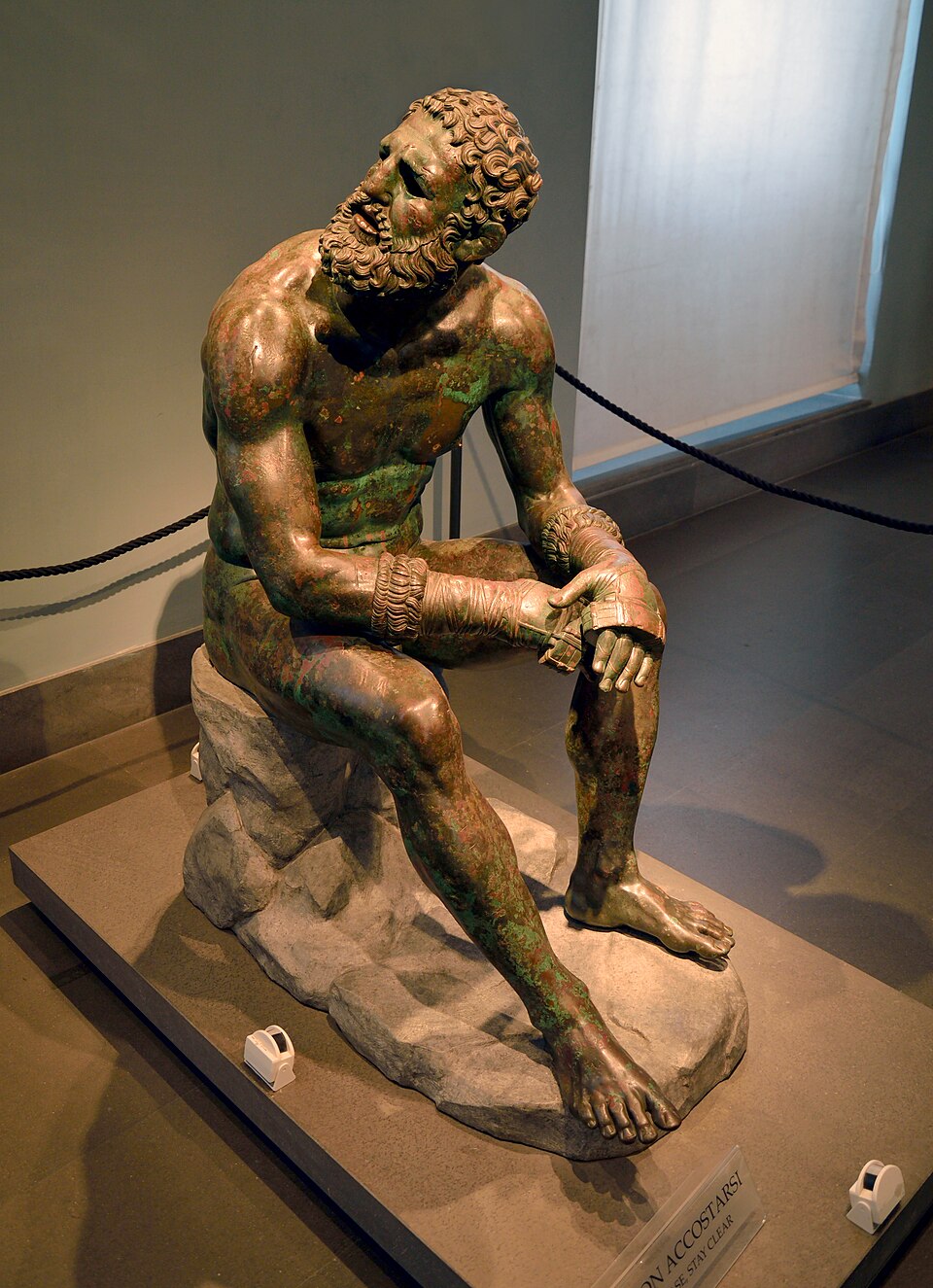
In 1885, on the slopes of Rome's Quirinal Hill, workers unearthed a bronze figure that stopped the archaeologist Rodolfo Lanciani cold. He later wrote that in his long career he had never felt such an extraordinary impression as watching this 'semi-barbaric athlete' emerge slowly from the ground, as if awakening from a long repose after his gallant fights. The statue, seated and nude, still wore the leather hand-wraps called himantes. It would come to be known as the Boxer at Rest, or the Terme Boxer.
It was found within a month of another Hellenistic bronze, the unidentified figure now called the Hellenistic Prince, both possibly from the remains of the Baths of Constantine. Neither had simply been lost. Both appear to have been carefully buried in antiquity, a detail that would later shape how scholars understood the Boxer's meaning to the people who once touched it.
Dated broadly between 330 and 50 BCE, the sculpture is a rare survivor from a period whose bronzes were routinely melted down for new uses. Its survival lets us see, in remarkable detail, a shift in Greek art away from idealized heroic bodies toward emotional and psychological realism — the hallmark of the Hellenistic style.
The figure is built like a professional fighter well past his prime: a top-heavy, over-muscled torso, a scarred and bruised face, cauliflower ears, a broken nose, a mouth suggesting broken teeth, and a Morton's toe. His penis is bound by a kynodesme, and he wears a beard, typical of ancient boxers. The classicist R. R. R. Smith argues this isn't a portrait of one man but genre realism — a generic 'boxer' type. A 2018 reconstruction by the Frankfurt Liebieghaus Polychromy Research Project, led by Vinzenz Brinkmann, instead revives an older theory identifying the figure as Amykos, King of the Bebryces.
The craftsmanship is extraordinary. The statue is soldered together from eight separately cast segments, their joins filed nearly invisible. The lips, wounds, and scars were originally inlaid with copper, and further copper inlays on the right shoulder, forearm, caestus, and thigh depicted drops and trickles of blood. The fingers and toes are worn smooth, apparently from being touched by passersby in antiquity — evidence that the Boxer held talismanic value before being buried, perhaps when the Baths fell into disuse after Goths cut the aqueducts that fed them. The site later saw pilgrim burials near the Xenodochium of Santi Nereo ed Achilleo in the 6th and 7th centuries.
More from Art

The Painting With No Foreground
A single robed figure stares out at an empty grey sea — and the emptiness itself became a scandal. When it was unveiled in Berlin in 1810, no one knew quite what to do with it.

The Painter Who Chased the Light
For a few purple minutes each evening, an American exile knelt in an English garden and raced the dying sun to paint two little girls lighting lanterns. It took him two years to finish.

When a President Became a God
Look straight up inside the U.S. Capitol dome and you will find George Washington enthroned among the clouds, surrounded by goddesses — the founding father transformed into myth.

Marble Brought Back to Life
A corpse asleep, a wing barely brushing her skin — and marble somehow learns to breathe. This is the moment Antonio Canova dared to carve.

The World Turned Upside Down
Look closely at a sixteenth-century Flemish village and you'll find a man biting a pillar, another carrying daylight in a basket, and a wife slipping a blue cloak over her husband's shoulders. Every gesture is a joke — if you know the language.

The Girl in the Glass Case
She stood two-thirds life size, dressed in a real tutu and human hair — and the critics who saw her in 1881 recoiled as if she were something obscene.